NUSEX
A 150-tonne iron tracking calorimeter in the Mont Blanc tunnel that searched for proton decay and recorded atmospheric neutrinos from 1982.
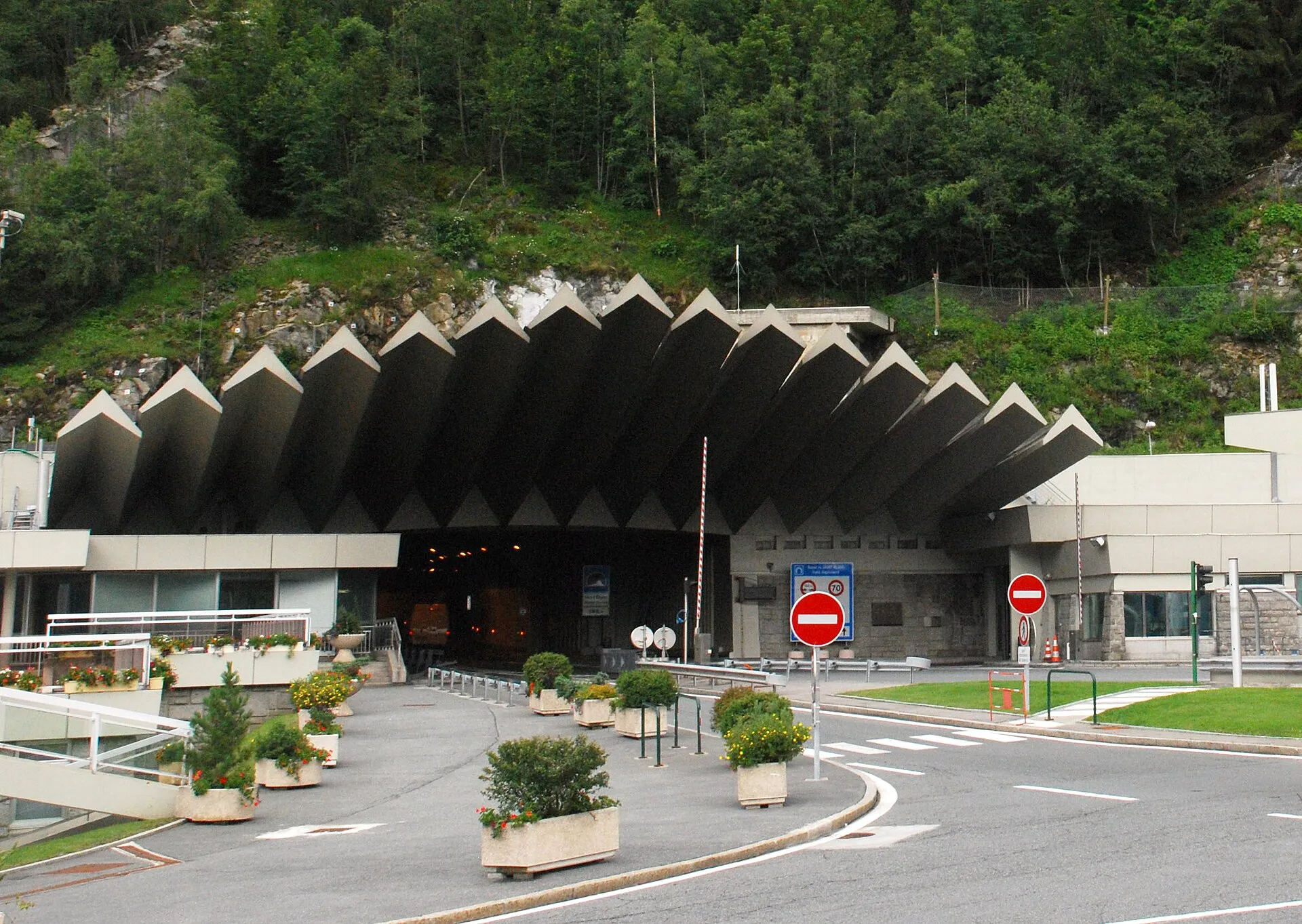
The Nucleon Stability Experiment stacked 134 iron plates of 3.5 × 3.5 m with about 43,000 plastic streamer tubes in a laboratory off the Mont Blanc road tunnel. Running from 1982, it set limits on nucleon decay and recorded a small sample of contained atmospheric neutrino events whose flavour ratio was consistent with expectation, unlike the deficit seen in Kamiokande and IMB.
Compare all experiments → · World map →
In plain words
In the late 1970s, grand unified theories predicted that protons might decay with lifetimes of around 10³⁰ years. Physicists across the world built large detectors deep underground to watch thousands of tonnes of matter for a single decay. NUSEX was the Italian–CERN contribution: a compact block of iron instrumented like a giant three-dimensional camera, installed beside the road tunnel under Mont Blanc.
How the detector worked
NUSEX was a tracking calorimeter of 134 horizontal iron plates, each 3.5 m square and 1 cm thick, interleaved with 42,880 plastic streamer tubes read out by orthogonal pickup strips. With an average density of 3.5 g/cm³ the cube weighed about 150 tonnes. Its fine granularity, with a position resolution of about 3 mm, allowed it to reconstruct individual tracks and to separate muon-like from shower-like events. The rock of the Mont Blanc massif, about 5,000 m water equivalent, made it one of the deepest detectors of its generation. A test module was exposed to a CERN neutrino beam to calibrate the background that neutrino interactions would create for the proton-decay search.
Key results
- NUSEX began taking data in 1982 and reported nucleon-decay results from 1983. It found one candidate in the p → μ⁺K⁰ channel with an expected background of 0.09 events, which was not enough to claim a discovery; later, larger detectors set limits far beyond its reach.
- It recorded about 40 contained atmospheric neutrino events. The ratio of muon-like to electron-like events was consistent with the no-oscillation expectation, as was the early result of the Fréjus detector.
Historical significance
The contrast between the iron detectors and the water Cherenkov detectors Kamiokande and IMB, which saw a clear deficit of muon neutrinos, was part of a debate in the late 1980s and early 1990s about whether the atmospheric anomaly was real. The low statistics of NUSEX left the question open. The issue was settled by Soudan 2, an iron calorimeter that confirmed the deficit, and decisively by Super-Kamiokande in 1998.
Frequently asked questions
Did NUSEX see proton decay?
No. It found a single candidate event in one decay channel, compatible with background, and set lower limits on the nucleon lifetime.
Why did iron detectors seem to disagree with water detectors?
NUSEX and Fréjus had small event samples and different systematic uncertainties. With larger exposures, the iron calorimeter Soudan 2 found the same muon-neutrino deficit as the water Cherenkov detectors.
Original papers
- Final resultM. Aglietta et al. (NUSEX Collaboration), Experimental study of atmospheric neutrino flux in the NUSEX experiment, Europhys. Lett. 8, 611 (1989)
Related terms
People
Mentioned in 6 pages
Last updated: · Editorial standard
Cite this page
Text
Neutrino Atlas (2026). “NUSEX”. Retrieved 22 November 2026, from https://neutrino-atlas.com/terms/nusex/BibTeX
@misc{neutrinoatlas2026termsnusex,
  title        = {NUSEX},
  author       = {{Neutrino Atlas}},
  year         = {2026},
  url          = {https://neutrino-atlas.com/terms/nusex/},
  note         = {Accessed 2026-11-22},
  language     = {english}
}