Fréjus detector
900-tonne iron tracking calorimeter in the Modane underground laboratory that saw no atmospheric neutrino anomaly in the late 1980s.
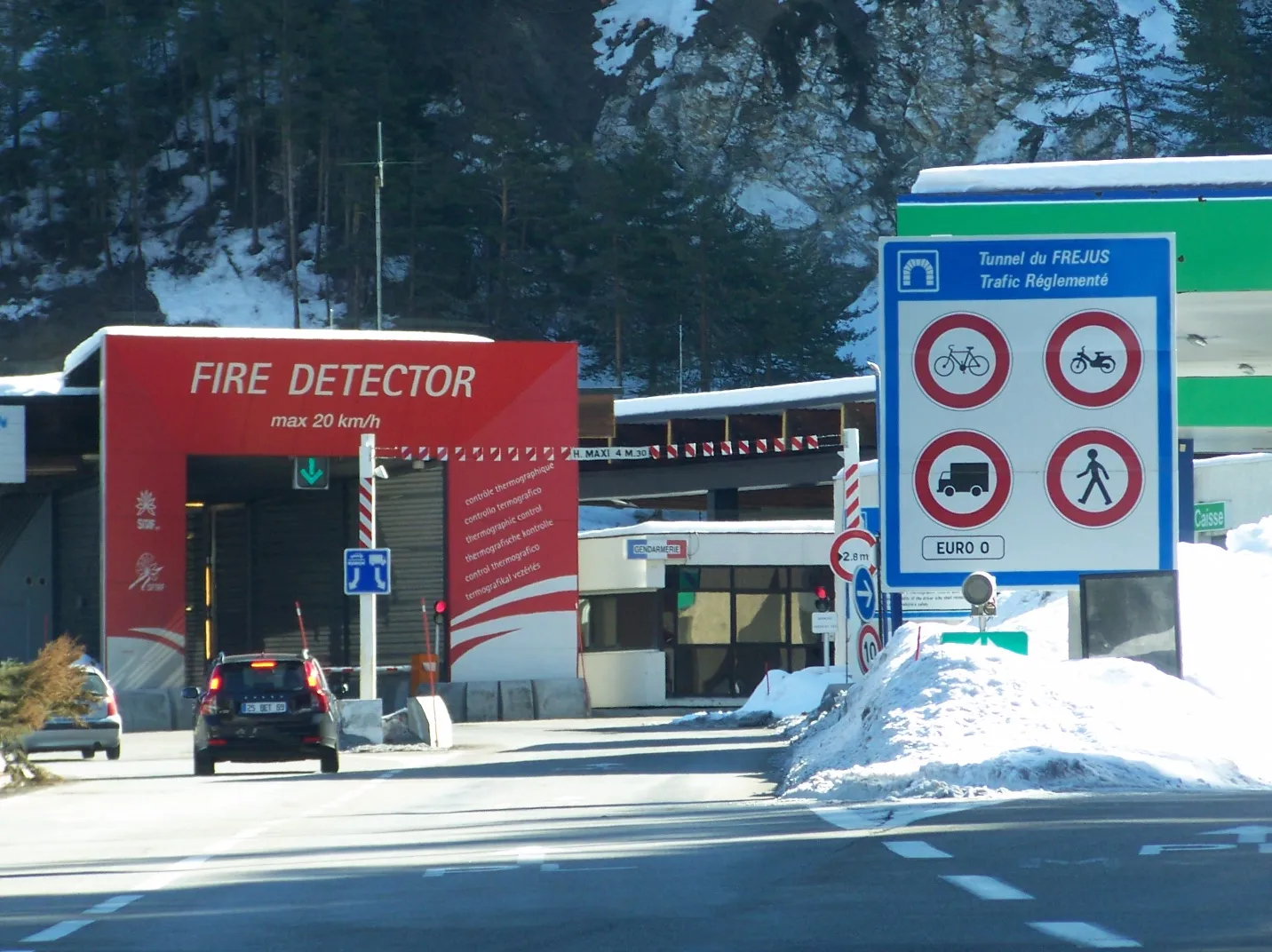
The Fréjus detector ran from February 1984 to September 1988 in the Laboratoire Souterrain de Modane. It consisted of 912 layers of 3 mm iron plates interleaved with flash tubes and Geiger tubes, reaching its full 912 t in June 1985. Built to search for proton decay, it found an electron-to-muon ratio of atmospheric neutrinos consistent with no oscillation, in apparent conflict with Kamiokande and IMB.
Compare all experiments → · World map →
In plain words
In the 1980s several large detectors went underground to look for proton decay, and all of them also recorded atmospheric neutrinos. The water Cherenkov detectors Kamiokande and IMB found fewer muon neutrinos than expected compared with electron neutrinos. Fréjus, built from iron plates rather than water, did not. For several years this disagreement was a real argument against the idea that neutrinos oscillate.
How the detector works
The detector was installed in the Modane laboratory, dug beside the Fréjus road tunnel between France and Italy under about 4,800 metres water equivalent of rock. It was a fine-grained tracking calorimeter of 6 m × 6 m × 12.3 m: 912 vertical iron plates, each 3 mm thick, alternating with planes of 5 mm plastic flash tubes that recorded tracks in two orthogonal views, with Geiger tubes providing the trigger. Construction proceeded in stages, from 240 t when data taking began on 19 February 1984 to the full 912 t in June 1985. The collaboration included groups from Aachen, Wuppertal, Orsay, Palaiseau and Saclay.
Key results
With a fiducial exposure of 1.56 kt·yr, the 1990 analysis found electron-to-muon ratios of 0.53 to 0.57 in three independent methods, against Monte Carlo expectations of 0.56 to 0.61 without oscillation. The collaboration therefore saw no muon-neutrino deficit and set oscillation limits, in agreement with NUSEX but not with the water detectors. A 1995 paper derived absolute atmospheric νe and νμ spectra between 0.32 and 30 GeV. The proton-decay search, with 2.0 kt·yr, found no signal and set partial lifetime limits up to 10³² years.
Why it matters for neutrino physics
The Fréjus result raised the question of whether the anomaly came from the water Cherenkov technique itself. This motivated the iron calorimeter Soudan 2, which later confirmed a low ratio. The 1998 Super-Kamiokande zenith-angle result settled the issue; the small Fréjus data set with its systematic uncertainties is now regarded as a statistical fluctuation rather than a contradiction.
Frequently asked questions
Why did Fréjus disagree with Kamiokande?
The reason was never fully identified. Low statistics and systematic uncertainties in the iron calorimeter, about 0.08 on the ratio, are the usual explanation.
Was Fréjus a neutrino experiment?
It was built for proton decay, but atmospheric neutrinos were its main background and became an important measurement in their own right.
Original papers
- Final resultK. Daum et al. (Fréjus Collaboration), Determination of the atmospheric neutrino spectra with the Fréjus detector, Z. Phys. C 66, 417 (1995)DOI 10.1007/BF01556368
Related terms
Mentioned in 3 pages
Last updated: · Editorial standard
Cite this page
Text
Neutrino Atlas (2026). “Fréjus detector”. Retrieved 22 November 2026, from https://neutrino-atlas.com/terms/frejus-detector/BibTeX
@misc{neutrinoatlas2026termsfrejusdetector,
  title        = {Fréjus detector},
  author       = {{Neutrino Atlas}},
  year         = {2026},
  url          = {https://neutrino-atlas.com/terms/frejus-detector/},
  note         = {Accessed 2026-11-22},
  language     = {english}
}