Kolar Gold Fields neutrino experiments
Deep-mine experiments in southern India that recorded some of the first atmospheric neutrino interactions in 1965.
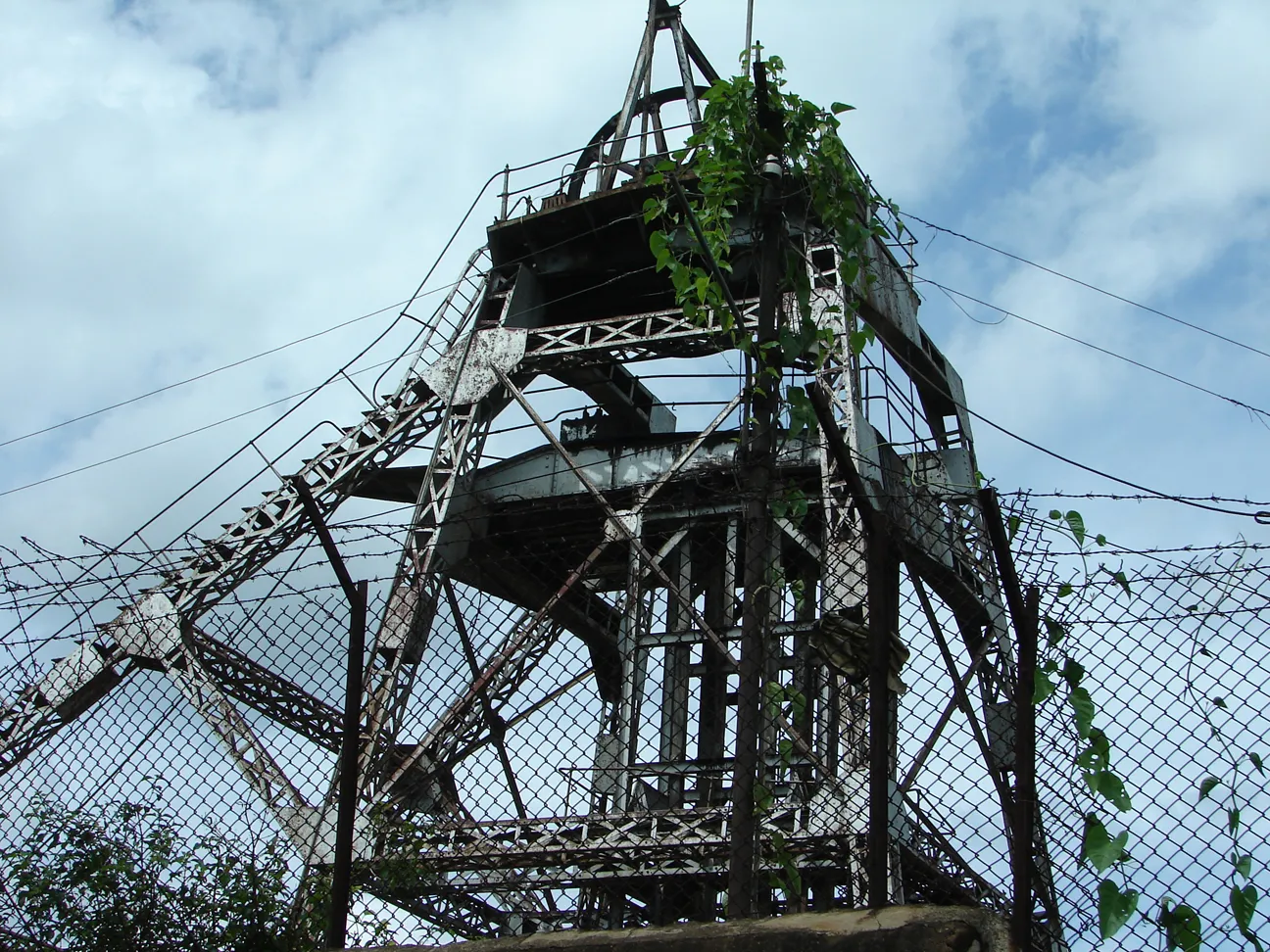
The Bombay–Osaka–Durham collaboration placed scintillators and neon flash tubes about 2.3 km underground (~7,500 m w.e.) in the Kolar gold mines. In 1965 it recorded horizontal muons produced by cosmic-ray neutrinos and published two weeks before the competing South African experiment. The site later hosted early proton-decay searches until the experiments ended in the early 1990s.
Compare all experiments → · World map →
In plain words
Cosmic rays create neutrinos in the atmosphere all the time, but in the early 1960s nobody had yet caught one. The trick was to go so deep that ordinary cosmic-ray muons, which come from above, are almost completely absorbed. A muon arriving horizontally at great depth cannot have crossed kilometres of rock; it must have been made nearby by a neutrino. The gold mines of Kolar, among the deepest in the world, offered exactly that shelter.
How the detectors worked
Indian physicists from the Tata Institute of Fundamental Research (TIFR) had measured cosmic rays in the Kolar mines since the 1950s. For the neutrino search the Bombay–Osaka–Durham collaboration installed detectors at a depth of about 2.3 km, roughly 7,500 metres water equivalent. Walls of plastic scintillator provided the trigger, and neon flash tubes, which light up along the path of a charged particle, recorded the track direction. The signature was a muon arriving close to the horizontal, where the rock overburden is enormous.
Key results
The group recorded its first neutrino candidate on 20 April 1965 and published in Physics Letters on 15 August 1965. In South Africa, Frederick Reines and the Case–Witwatersrand group had recorded their first horizontal muon on 23 February 1965 and published on 30 August. Historians therefore credit Reines with the first observed cosmic neutrino and the Kolar team with the first publication. Together the two experiments opened the study of atmospheric neutrinos.
Later work and legacy
In the 1980s the TIFR and Osaka groups used iron calorimeters at Kolar for some of the earliest searches for proton decay. A handful of unexplained "Kolar events" from those years are still discussed. The experiments ended in the early 1990s and the mines closed in 2001. The tradition fed into plans for the India-based Neutrino Observatory with its iron calorimeter, although that project has stalled.
Frequently asked questions
Who detected atmospheric neutrinos first, Kolar or South Africa?
The South African detector saw the first event, about two months earlier. The Kolar group published about two weeks earlier, so formal priority of publication lies with Kolar.
Why did the experiment look for horizontal muons?
At great depth almost all muons from above have been absorbed. Muons arriving horizontally would have had to cross far more rock, so the few that are seen must come from neutrinos interacting nearby.
Original papers
- DiscoveryC. V. Achar et al., Detection of muons produced by cosmic ray neutrinos deep underground, Phys. Lett. 18, 196 (1965)DOI 10.1016/0031-9163(65)90712-2
Related terms
- Atmospheric neutrinos
- Case–Witwatersrand–Irvine (East Rand) experiment
- Underground depth & metres water equivalent
- INO-ICAL
Mentioned in 8 pages
Last updated: · Editorial standard
Cite this page
Text
Neutrino Atlas (2026). “Kolar Gold Fields neutrino experiments”. Retrieved 22 November 2026, from https://neutrino-atlas.com/terms/kolar-gold-fields/BibTeX
@misc{neutrinoatlas2026termskolargoldfields,
  title        = {Kolar Gold Fields neutrino experiments},
  author       = {{Neutrino Atlas}},
  year         = {2026},
  url          = {https://neutrino-atlas.com/terms/kolar-gold-fields/},
  note         = {Accessed 2026-11-22},
  language     = {english}
}