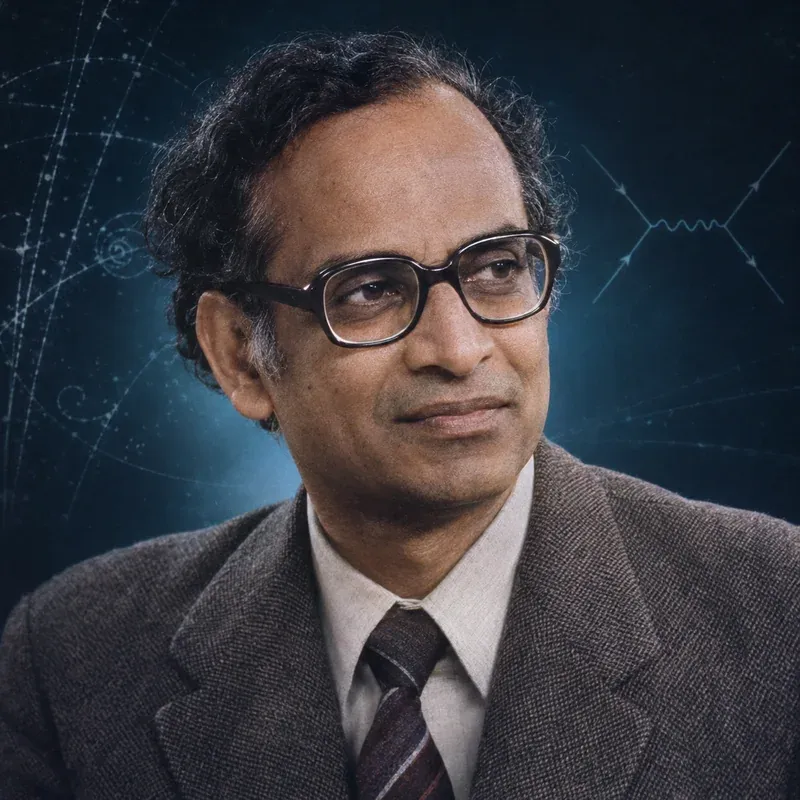
 Illustration
Ramanath Cowsik
In 1972, with J. McClelland, Cowsik derived an upper limit of about 8 eV on the mass of a single neutrino species from the requirement that relic neutrinos not overclose the universe, the first such bound published in the West (following Gershtein and Zeldovich). He also argued that massive relic neutrinos could form dark matter halos, and made early detailed calculations of atmospheric neutrino fluxes from cosmic-ray interactions.
- Born
- 1940
Nagpur, India - Nationality
- Indian
- Field
- Astrophysics; cosmic rays; astroparticle physics
- Institutions
- Tata Institute of Fundamental Research, University of California, Berkeley, Indian Institute of Astrophysics, Washington University in St. Louis
Early life and education
Ramanath Cowsik was born in Nagpur, India, in 1940. He earned a bachelor's degree from Mysore University in 1958 and a master's degree in physics from Karnatak University, Dharwad, in 1960. After the postgraduate course of the Atomic Energy Establishment Training School at Trombay he joined the Tata Institute of Fundamental Research (TIFR) in Bombay in 1961, and he received his PhD from Bombay University in 1968 under the cosmic-ray physicist Yash Pal.
Path to neutrino physics
Cowsik began in cosmic-ray physics, a field in which TIFR was strong. The institute's group ran the deep Kolar Gold Fields mine experiments, which recorded some of the first atmospheric neutrinos in 1965, and Cowsik made early calculations of the neutrino flux produced when cosmic rays strike the atmosphere. From 1970 to 1973 he was an assistant professor at the University of California, Berkeley, at the invitation of P. Buford Price. There, with J. McClelland, he did the work for which he is best known in neutrino physics.
Key contributions
The hot Big Bang leaves behind a sea of relic neutrinos, a little over a hundred per cubic centimetre for each flavour. If neutrinos have mass, this sea carries an energy density equal to the number density times the mass. Since the expansion rate and age of the universe limit how much matter it can contain, the neutrino mass cannot be too large. Semyon Gershtein and Yakov Zeldovich had applied this idea in 1966 and obtained a limit of about 400 eV. In their 1972 Physical Review Letters paper 'An upper limit on the neutrino rest mass', Cowsik and McClelland used updated cosmological input and arrived at about 8 eV for a single neutrino species, far below any laboratory limit of the time.
In a 1973 follow-up the two argued that massive relic neutrinos would gather gravitationally around galaxies and clusters, and so could form the unseen mass in their halos. This was one of the earliest proposals of particle dark matter. Neutrinos turned out to be hot dark matter: their free streaming smooths out small structures, so they cannot be the main component. The same physics, however, is what lets cosmology today set a cosmological mass bound of roughly Σmν < 0.12 eV from Planck data.
Later work
Cowsik directed the Indian Institute of Astrophysics from 1992 to 2003 and helped establish its high-altitude observatory at Hanle in Ladakh, at about 4,500 m. He built sensitive torsion balances to test for a 'fifth force' and for deviations from Newton's inverse-square law at short distances, and measured the double beta decay half-life of tellurium-128 at about 7.7 × 10²⁴ years. Since 2002 he has been at Washington University in St. Louis, where he directs the McDonnell Center for the Space Sciences. His honours include the Shanti Swarup Bhatnagar Prize (1984), the Padma Shri (2002) and the IUPAP O'Ceallaigh Medal (2009); he is a foreign associate of the US National Academy of Sciences.
Known for
- Cowsik–McClelland cosmological neutrino mass bound (1972)
- Neutrino dark matter halos
- Early atmospheric neutrino flux calculations
Chronology
- 1972Cowsik–McClelland neutrino mass bound
- 1984Shanti Swarup Bhatnagar Prize
- 1992Director of the Indian Institute of Astrophysics (to 2003)
- 2004Elected to the US National Academy of Sciences
Original papers
- R. Cowsik, J. McClelland, An upper limit on the neutrino rest mass, Phys. Rev. Lett. 29, 669 (1972)DOI 10.1103/PhysRevLett.29.669
Experiments
- Planck
- Super-Kamiokande
Connected people
Frequently asked questions
What is the Cowsik–McClelland bound?
An upper limit on neutrino mass derived from the requirement that the energy density of relic neutrinos not exceed what the observed expansion and age of the universe allow. In 1972 it gave about 8 eV for one species; in modern form it limits the sum of neutrino masses.
Are neutrinos the dark matter?
Only a tiny part of it. Cowsik and McClelland's idea was natural in 1973, but because light neutrinos move fast they erase small-scale structure. Observations of galaxies and the cosmic microwave background show that the dominant dark matter must be 'cold'; neutrinos contribute well under one percent of the total matter density.
On the timeline
Mentioned in 9 pages
Last updated: · Editorial standard
Cite this page
Text
Neutrino Atlas (2026). “Ramanath Cowsik”. Retrieved 22 November 2026, from https://neutrino-atlas.com/people/ramanath-cowsik/BibTeX
@misc{neutrinoatlas2026peopleramanathcowsik,
  title        = {Ramanath Cowsik},
  author       = {{Neutrino Atlas}},
  year         = {2026},
  url          = {https://neutrino-atlas.com/people/ramanath-cowsik/},
  note         = {Accessed 2026-11-22},
  language     = {english}
}