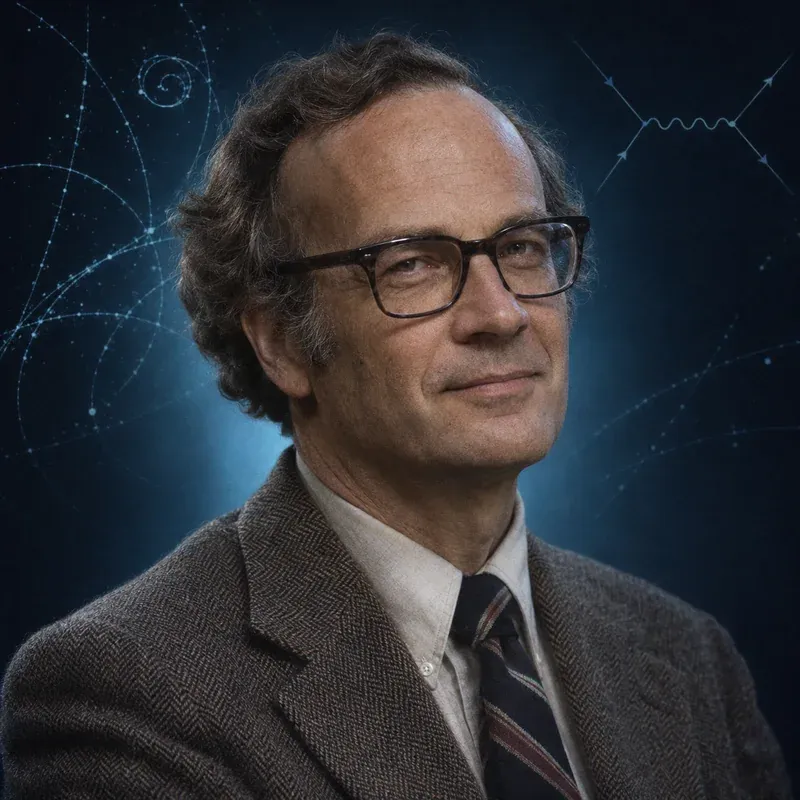
 Illustration
P. Buford Price
Price was a founding member of the AMANDA collaboration. His Berkeley group measured ice transparency in South Pole boreholes in 1989, and his solid-state expertise helped show that AMANDA and IceCube must operate below about 1,400 m to avoid light scattering by air bubbles, which had spoiled the first shallow array.
- Born
- 8 November 1932
Memphis, Tennessee, USA - Died
- 28 December 2021
- Nationality
- American
- Field
- Experimental physics, astroparticle physics
- Institutions
- University of California, Berkeley
A physicist across disciplines
Paul Buford Price (1932–2021), from Memphis, Tennessee, was a professor of physics at the University of California, Berkeley, who described himself as an experimentalist who liked projects that cross traditional disciplinary boundaries. His work ranged from solid-state physics and cosmic rays to glaciology and the biology of extreme environments, a breadth that proved decisive for neutrino astronomy.
Tracks in solids
Early in his career Price, together with Robert Fleischer and Robert Walker, developed a way of recording the paths of energetic charged particles in insulating solids such as the plastic Lexan: the particle leaves a trail of radiation damage that chemical etching enlarges into a visible pit or channel. The method is used from fission-track dating of rocks to Nucleopore filters, whose etched pores trap cells and viruses. The three shared the E. O. Lawrence Award in 1971, and Price was elected to the National Academy of Sciences in 1975. That year a balloon-borne Lexan stack also recorded an unusual track his team tentatively read as a magnetic monopole; they withdrew this in 1978, and Luis Alvarez proposed a conventional explanation.
AMANDA and the ice
Price was a founding member of AMANDA, the first neutrino telescope in the Antarctic ice and the forerunner of IceCube. An ice Cherenkov detector needs ice so transparent that light travels tens of metres to the optical modules. His Berkeley group measured ice transparency in South Pole boreholes in 1989. When the first AMANDA strings, deployed in 1993–94 at depths of roughly 800 to 1,000 m, showed that light was being scattered by residual air bubbles, his understanding of how bubbles turn into clathrate crystals under pressure supported the decision to go deeper: below about 1,400 m the ice is effectively bubble-free. The deeper array then detected atmospheric neutrinos, published in Nature in 2001.
Life and history in deep ice
His group also built instruments to log polar ice down to bedrock, mapping microbial life and volcanic layers with depth. They showed that bacteria and archaea can survive in liquid veins between ice grains kilometres deep, and ash from the Toba eruption about 74,000 years ago, found within IceCube's instrumented volume, helped make the South Pole the site of a major ice-coring project.
Known for
- Founding member of AMANDA
- Optical properties of deep polar ice
- Nuclear track detectors (Nucleopore filters)
- 1975 magnetic monopole candidate (later withdrawn)
Chronology
- 1971E. O. Lawrence Award
- 1975Elected to National Academy of Sciences
- 1989South Pole ice transparency measurements
- 1993First AMANDA strings deployed (1993/94)
Original papers
- E. Andres et al. (AMANDA), Observation of high-energy neutrinos using Čerenkov detectors embedded deep in Antarctic ice, Nature 410, 441 (2001)DOI 10.1038/35068509
Experiments
Connected people
Frequently asked questions
Why did AMANDA have to be built so deep?
In the upper kilometre of South Pole ice, air bubbles scatter Cherenkov light and blur the direction of tracks. Below about 1,400 m the bubbles have turned into clathrate crystals, and the ice is clear enough for a neutrino telescope.
Did P. Buford Price discover a magnetic monopole?
No. A 1975 balloon event was first interpreted as a possible monopole, but Price and colleagues withdrew that interpretation in 1978.
On the timeline
Mentioned in 3 pages
Last updated: · Editorial standard
Cite this page
Text
Neutrino Atlas (2026). “P. Buford Price”. Retrieved 22 November 2026, from https://neutrino-atlas.com/people/p-buford-price/BibTeX
@misc{neutrinoatlas2026peoplepbufordprice,
  title        = {P. Buford Price},
  author       = {{Neutrino Atlas}},
  year         = {2026},
  url          = {https://neutrino-atlas.com/people/p-buford-price/},
  note         = {Accessed 2026-11-22},
  language     = {english}
}