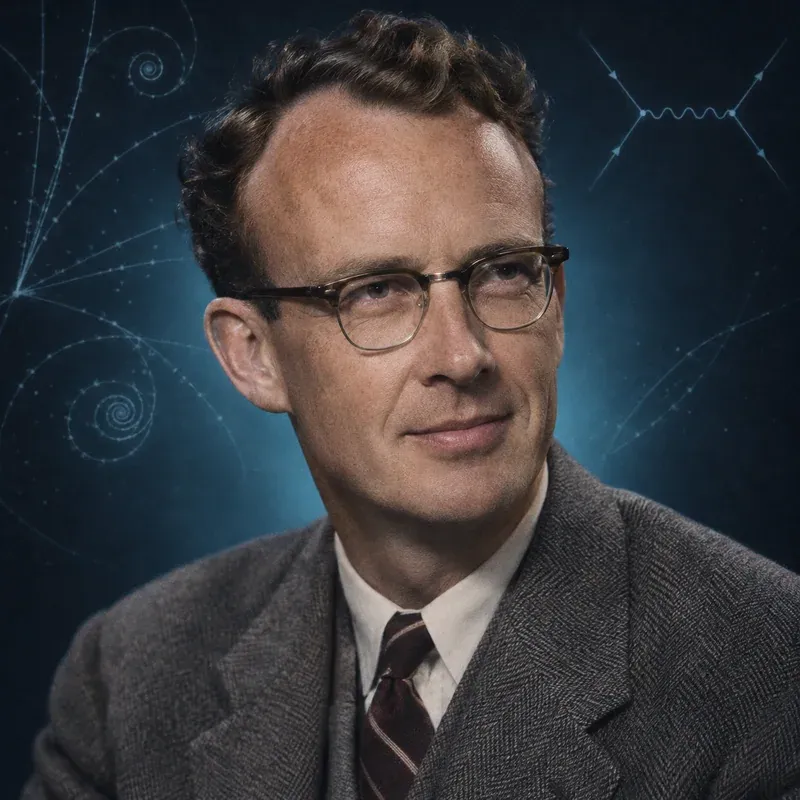
 Illustration
Luis W. Alvarez
In 1937 Alvarez gave the first experimental observation of K-electron capture, a beta process predicted by Fermi-type theory in which the nucleus captures an atomic electron and emits a neutrino. In a 1949 UCRL report he proposed an experimental test of the neutrino theory using the chlorine-argon reaction at a nuclear reactor, independently developing Pontecorvo's radiochemical idea.
- Born
- 13 June 1911
San Francisco, California, USA - Died
- 1 September 1988
Berkeley, California, USA - Nationality
- American
- Field
- experimental particle physics
- Nobel Prize
- Physics 1968 – for his decisive contributions to elementary particle physics, in particular the discovery of a large number of resonance states, made possible through his development of the technique of using hydrogen bubble chamber and data analysis
- Institutions
- University of Chicago, Radiation Laboratory, UC Berkeley, MIT Radiation Laboratory, Los Alamos
Early life and education
Luis Walter Alvarez was born on 13 June 1911 in San Francisco. He studied at the University of Chicago, receiving his bachelor's degree in 1932, master's in 1934 and PhD in 1936 under Arthur Compton. He then joined Ernest Lawrence's Radiation Laboratory at Berkeley, where he spent almost his whole career.
Electron capture: the first observation
Fermi's theory of beta decay implied a third process besides electron and positron emission: a proton-rich nucleus can capture one of its own inner atomic electrons and emit a neutrino. This electron capture had not been seen, because the only visible products are the soft X-rays emitted as the atom refills its empty K shell.
In 1937 Alvarez designed an experiment to isolate exactly that signal. Working with vanadium-48 made in the Berkeley cyclotron, he used magnets to sweep away positrons and electrons and a special Geiger counter sensitive to the characteristic X-rays of titanium, the daughter element. The X-rays proved that the nucleus had captured an electron. Electron capture later became central to neutrino physics: the recoil experiments of James S. Allen, the radiochemical chlorine and gallium detectors, and today's holmium-163 mass experiments all rely on it.
Tritium and a reactor test of the neutrino
Alvarez also showed with Robert Cornog that helium-3 is stable and that tritium is the radioactive member of the mass-3 pair, measuring its lifetime. Tritium decay later became the standard tool for direct neutrino-mass measurements at the tritium endpoint.
In 1949 he wrote a Radiation Laboratory report, 'A proposed experimental test of the neutrino theory', suggesting that neutrinos from a nuclear reactor could be detected by their conversion of chlorine-37 into radioactive argon-37. Bruno Pontecorvo had proposed the same reaction in 1946; Alvarez developed it independently. Raymond Davis built such detectors at reactors in the 1950s. Their null result showed that reactor antineutrinos do not trigger the reaction; the method went on to detect solar neutrinos at Homestake.
Later work and Nobel Prize
Alvarez received the 1968 Nobel Prize in Physics for decisive contributions to elementary particle physics, in particular the discovery of many resonance states made possible by the liquid-hydrogen bubble chamber and its data-analysis methods. In 1980, with his son Walter and colleagues, he proposed that an asteroid impact caused the extinction of the dinosaurs. He died in Berkeley on 1 September 1988.
Known for
- First observation of K-electron capture (1937)
- Proposed reactor test of the neutrino with chlorine (1949)
- Hydrogen bubble chamber and resonances
- Alvarez impact hypothesis
Chronology
- 1937Observation of K-capture
- 1949UCRL-328 'A proposed experimental test of the neutrino theory'
- 1968Nobel Prize in Physics
Original papers
- L.W. Alvarez, A proposed experimental test of the neutrino theory, UCRL-328 (1949)
Connected people
Frequently asked questions
Did Luis Alvarez win a Nobel Prize?
Yes, the 1968 Nobel Prize in Physics, for the discovery of many resonance states using the hydrogen bubble chamber.
What is his connection to neutrinos?
He made the first observation of electron capture in 1937, a neutrino-emitting process, and in 1949 proposed detecting reactor neutrinos with the chlorine–argon reaction.
On the timeline
Mentioned in 8 pages
Last updated: · Editorial standard
Cite this page
Text
Neutrino Atlas (2026). “Luis W. Alvarez”. Retrieved 22 November 2026, from https://neutrino-atlas.com/people/luis-alvarez/BibTeX
@misc{neutrinoatlas2026peopleluisalvarez,
  title        = {Luis W. Alvarez},
  author       = {{Neutrino Atlas}},
  year         = {2026},
  url          = {https://neutrino-atlas.com/people/luis-alvarez/},
  note         = {Accessed 2026-11-22},
  language     = {english}
}