1946Experiment
Pontecorvo proposes the chlorine-argon detector
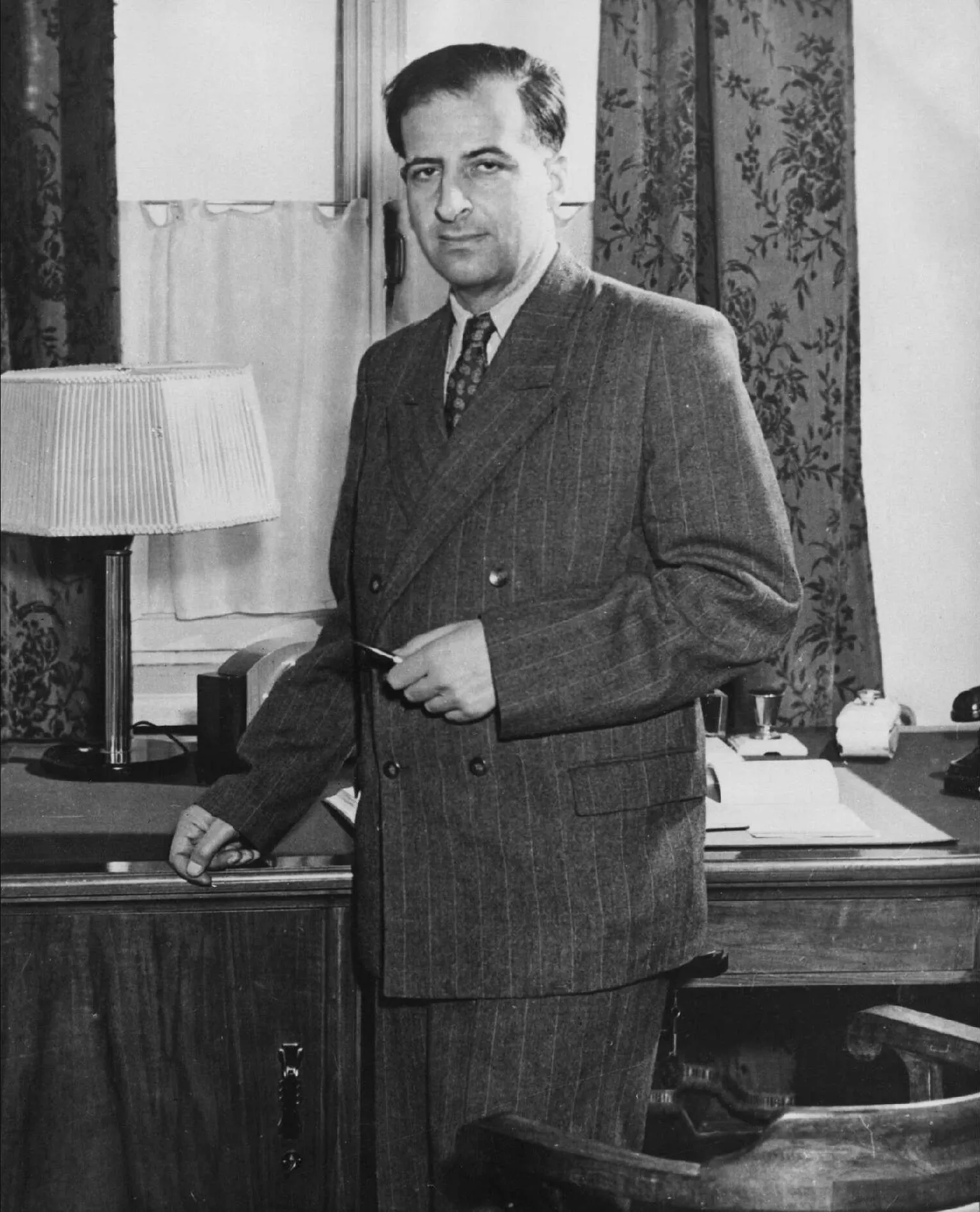
In a Chalk River report, Bruno Pontecorvo proposed detecting neutrinos through the reaction in which chlorine-37 absorbs a neutrino and becomes radioactive argon-37. The few argon atoms could be extracted chemically from a large tank and counted by their decay. Luis Alvarez developed the idea further in 1949. Raymond Davis turned it into the Homestake experiment, which made the first measurement of solar neutrinos.
- Date
- 1946
- Kind of event
- Experiment
- People involved
- Bruno Pontecorvo, Luis W. Alvarez, Raymond Davis Jr.
- Experiments
- Homestake Chlorine Experiment
The situation before
After 1934 the neutrino was generally accepted on theoretical grounds, but Hans Bethe and Rudolf Peierls had shown that its interactions are so rare that direct detection seemed impossible. The war changed the conditions. Nuclear reactors now existed, and with them sources of neutrinos many orders of magnitude stronger than any radioactive sample. Wartime nuclear chemistry had also produced techniques for handling and counting tiny numbers of radioactive atoms.
What happened
Bruno Pontecorvo, an Italian physicist who had studied under Enrico Fermi and was working at the Chalk River laboratory in Canada, wrote a report titled "Inverse beta process", issued by the National Research Council of Canada as report PD-205 and dated 13 November 1946. He argued that the problem of the tiny cross-section could be met with a very large target, provided the product of a neutrino interaction could be separated and counted efficiently. He then looked for a reaction with the right properties and singled out chlorine-37.
- Chlorine is cheap and available in large quantities, for example in cleaning fluids such as carbon tetrachloride.
- Argon is a noble gas, so the few atoms produced can be flushed out of a large tank and separated chemically.
- Argon-37 lives long enough to be extracted, about 35 days, and its decay can be counted in small gas counters.
Pontecorvo named nuclear reactors and the Sun as the most promising sources. His method is known as the chlorine-argon technique, the first of the radiochemical detectors.
Reaction
The report circulated within the nuclear research community. In 1949 Luis Alvarez at Berkeley examined the method in detail for a reactor experiment in a report "A proposed experimental test of the neutrino theory", but did not carry it out. Pontecorvo himself moved to the Soviet Union in 1950 and continued his neutrino work at Dubna.
Why it matters
The person who turned the idea into practice was Raymond Davis at Brookhaven. His reactor tests of the early 1950s found no argon, an important result in its own right, because reactors emit antineutrinos, which do not induce this reaction. Davis then pointed the method at the Sun. The Homestake experiment, with 615 tonnes of perchloroethylene deep underground, began in the late 1960s and found fewer solar neutrinos than predicted, the start of the solar neutrino problem. Radiochemical gallium detectors in the 1990s extended the same principle to lower energies. Davis shared the 2002 Nobel Prize in Physics for this work.
Frequently asked questions
Who invented the chlorine-argon method?
Bruno Pontecorvo proposed it in a Chalk River report dated 13 November 1946. Raymond Davis later built the detectors.
Why chlorine?
Chlorine is cheap and abundant, the product argon-37 is a noble gas that is easy to extract, and its 35-day half-life is convenient for counting.
Original papers
- ProposalB. Pontecorvo, Inverse beta process, Chalk River Laboratory Report PD-205 (1946)
Concepts
Mentioned in 1 page
Lessons 1
Last updated: · Editorial standard
Cite this page
Text
Neutrino Atlas (2026). “1946: Pontecorvo proposes the chlorine-argon detector”. Retrieved 22 November 2026, from https://neutrino-atlas.com/timeline/1946-pontecorvo-chlorine-method/BibTeX
@misc{neutrinoatlas2026pontecorvochlorinemethod,
  title        = {1946: Pontecorvo proposes the chlorine-argon detector},
  author       = {{Neutrino Atlas}},
  year         = {2026},
  url          = {https://neutrino-atlas.com/timeline/1946-pontecorvo-chlorine-method/},
  note         = {Accessed 2026-11-22},
  language     = {english}
}