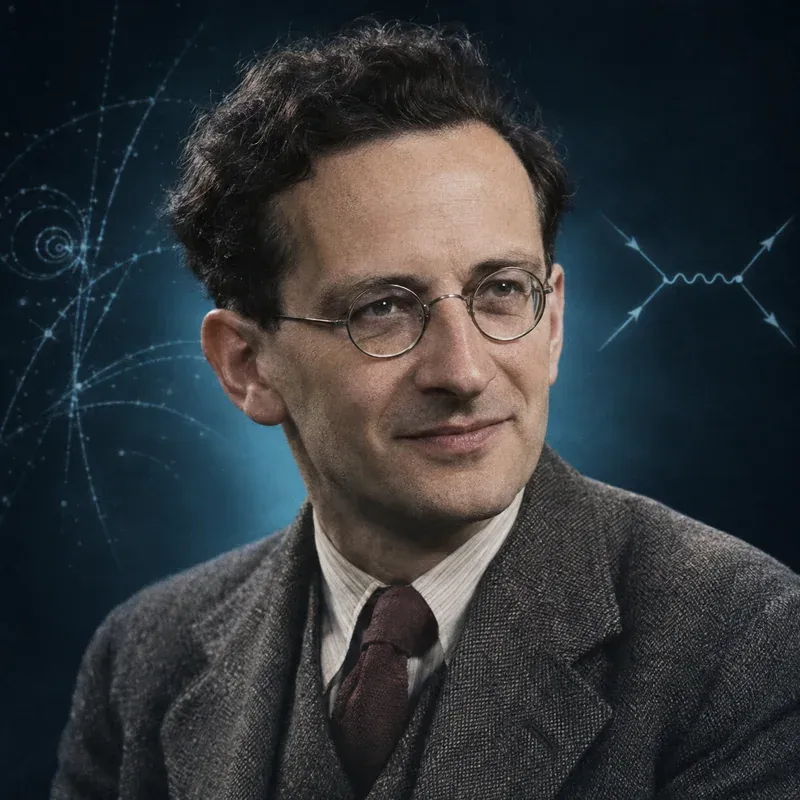
 Illustration
Rudolf Peierls
With Hans Bethe, Peierls published in Nature in 1934 the first estimate of the neutrino interaction cross-section based on Fermi's theory and the inverse beta process, finding it smaller than about 10⁻⁴⁴ cm². They concluded that the neutrino would be practically unobservable - an estimate that framed every later detection proposal until nuclear reactors provided sufficiently intense sources.
- Born
- 5 June 1907
Berlin, German Empire - Died
- 19 September 1995
Oxford, England - Nationality
- German-born British (naturalised 1940)
- Field
- theoretical physics
- Institutions
- ETH Zurich, University of Manchester, University of Cambridge, University of Birmingham
Early life and education
Rudolf Peierls was born in Berlin on 5 June 1907. He began studying physics in Berlin in 1925, moved to Munich to study under Arnold Sommerfeld, then to Leipzig under Werner Heisenberg and to ETH Zurich under Wolfgang Pauli. Leipzig awarded him his doctorate in 1929 for a thesis on heat conduction in crystals, the work in which he introduced 'Umklapp' processes. He then became Pauli's assistant in Zurich. A Rockefeller fellowship in 1932 took him to Rome, where he worked with Enrico Fermi, and on to Cambridge. When the Nazis came to power he stayed in Britain, working in Manchester with Hans Bethe and at Cambridge before taking the chair of applied mathematics at the University of Birmingham.
The 1934 neutrino estimate
Early in 1934 Fermi published his theory of beta decay, in which a neutron turns into a proton by creating an electron and a neutrino at a single point. Bethe and Peierls noticed that the same interaction, read backwards, describes a neutrino being absorbed by a nucleus, the process now called inverse beta decay. In a short letter to Nature titled 'The neutrino' they used the known lifetimes of beta emitters to estimate how likely that absorption is.
Their reasoning was dimensional. The only lengths and times available were the electron's Compton wavelength and the corresponding time, and a decay half-life of a few minutes then fixed the strength of the coupling. The result was an interaction cross-section below about 10⁻⁴⁴ cm², so small that a neutrino could pass through enormous amounts of matter untouched. They concluded that 'there is no practically possible way of observing the neutrino'.
The estimate was essentially right, and so was the pessimism under the conditions of 1934. What changed was the source. Nuclear reactors produce enormous numbers of antineutrinos, and in 1956 Frederick Reines and Clyde Cowan used one to detect inverse beta decay directly in the Cowan–Reines experiment. The Bethe–Peierls number set the scale every detection proposal had to overcome: huge fluxes and large targets. The same logic still governs neutrino detectors, see mean free path.
Later work
In 1940 Peierls and Otto Frisch wrote the Frisch–Peierls memorandum, the first argument that a bomb could be made from a small amount of uranium-235. He played a major role in the British Tube Alloys project, worked on gaseous diffusion in New York and from 1944 led the British Mission at Los Alamos. After the war he returned to Birmingham and later held the Wykeham chair of physics at Oxford (1963–1974). His later research covered solid-state physics, where the Peierls instability bears his name, nuclear theory and field theory. He was knighted in 1968 and received the Copley Medal in 1986. His books include 'Quantum Theory of Solids' (1955), 'Surprises in Theoretical Physics' (1979) and the memoir 'Bird of Passage' (1985). He died in Oxford on 19 September 1995.
Known for
- Bethe–Peierls neutrino cross-section estimate (1934)
- Frisch–Peierls memorandum (1940)
- Peierls instability
Chronology
- 1934Bethe–Peierls neutrino paper (Nature, 5 May)
- 1940Frisch–Peierls memorandum on the atomic bomb; British naturalisation
Original papers
- H. Bethe, R. Peierls, The 'neutrino', Nature 133, 532 (1934)DOI 10.1038/133532a0
Connected people
Frequently asked questions
What did Bethe and Peierls calculate about the neutrino?
Using Fermi's new theory, they estimated in 1934 that a neutrino's cross-section for being absorbed by a nucleus is below roughly 10⁻⁴⁴ cm². That is why they believed the neutrino could practically never be observed.
Were Bethe and Peierls wrong?
Their number was of the right order. They could not foresee nuclear reactors, which supply so many antineutrinos that even such tiny cross-sections give measurable rates; Reines and Cowan exploited this in 1956.
Did Rudolf Peierls win a Nobel Prize?
No. He received many other honours, including the Royal Medal (1959), the Max Planck Medal (1963), a knighthood (1968), the Enrico Fermi Award (1980) and the Copley Medal (1986).
On the timeline
Mentioned in 15 pages
Milestones 6
People 2
Last updated: · Editorial standard
Cite this page
Text
Neutrino Atlas (2026). “Rudolf Peierls”. Retrieved 22 November 2026, from https://neutrino-atlas.com/people/rudolf-peierls/BibTeX
@misc{neutrinoatlas2026peoplerudolfpeierls,
  title        = {Rudolf Peierls},
  author       = {{Neutrino Atlas}},
  year         = {2026},
  url          = {https://neutrino-atlas.com/people/rudolf-peierls/},
  note         = {Accessed 2026-11-22},
  language     = {english}
}