1956Discovery
Cowan and Reines detect the neutrino
At the Savannah River reactor in South Carolina, Clyde Cowan and Frederick Reines detected antineutrinos through inverse beta decay on protons in water tanks loaded with cadmium chloride, sandwiched between liquid scintillator. The signature was a prompt positron annihilation followed microseconds later by gamma rays from neutron capture, and the rate dropped when the reactor was off. On 14 June 1956 they telegraphed Pauli, and the result appeared in Science on 20 July 1956. It ended a 26-year wait for proof that the neutrino exists.
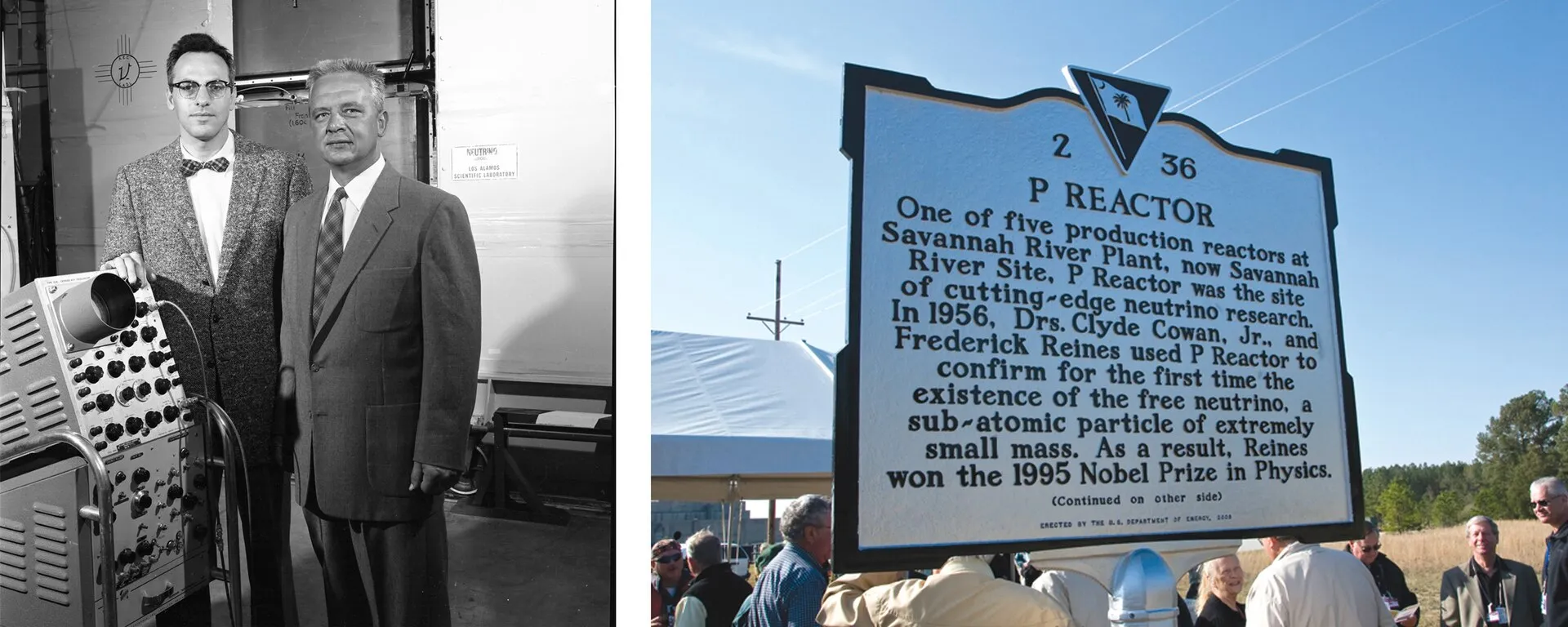
- Date
- 14 June 1956
- Kind of event
- Discovery
- People involved
- Clyde L. Cowan Jr., Frederick Reines, Wolfgang Pauli
- Experiments
- Cowan–Reines Neutrino Experiment
The situation before
Twenty-five years after Wolfgang Pauli's letter, the neutrino was a cornerstone of nuclear theory that nobody had ever observed directly. Hans Bethe and Rudolf Peierls had estimated in 1934 that it interacts so weakly that detection seemed hopeless. Nuclear reactors changed the odds by producing antineutrinos in enormous numbers. At Los Alamos, Frederick Reines and Clyde Cowan had made a first attempt at the Hanford reactor in 1953, but cosmic-ray background had swamped a faint hint of a signal.
What happened
For the second attempt they redesigned the detector and moved to the new Savannah River Plant near Aiken, South Carolina, arriving in late 1955. Their detector stood about 11 metres from the centre of a 700-megawatt reactor and some 12 metres underground, where the reactor building and earth shielded it from cosmic rays. The antineutrino flux there was about 1.2 × 10¹³ per square centimetre per second.
- Target: two flat tanks holding about 200 litres of water with up to 40 kg of dissolved cadmium chloride.
- Detection: three tanks with about 1,400 litres of liquid scintillator in total, sandwiching the targets and viewed by photomultiplier tubes.
- Signature: inverse beta decay on a proton, giving a prompt positron annihilation signal followed a few microseconds later by gamma rays from neutron capture on cadmium, recorded in two adjacent scintillator tanks.
- Checks: data with the reactor on and off, added shielding, changes of target and of cadmium content.
Over about a year the team, which also included F. B. Harrison, H. W. Kruse and A. D. McGuire, recorded data for roughly 100 days. With the reactor running they saw 3.0 ± 0.2 events per hour above the background measured with the reactor off. The signal behaved as expected in every test: it scaled with the number of target protons, required both the prompt and the delayed pulse, and vanished when the reactor stopped.
The telegram and the publication
On 14 June 1956 Reines and Cowan sent a telegram to Pauli in Zurich: "We are happy to inform you that we have definitely detected neutrinos from fission fragments by observing inverse beta decay of protons. Observed cross section agrees well with expected six times ten to minus forty four square centimeters." Pauli's reply, a night letter reading "Thanks for the message. Everything comes to him who knows how to wait. Pauli", never reached them; Reines learned of its text only decades later. The result appeared as "Detection of the free neutrino: a confirmation" in Science on 20 July 1956.
Reaction
The result was accepted quickly. The detection was clean, the team had tested many alternative explanations, and the measured rate matched theory. A complication arose a year later: after parity violation was discovered, the predicted cross-section roughly doubled, because the neutrino turned out to have only one helicity. A refined analysis by Reines and Cowan published in 1959 gave (11 ± 2.6) × 10⁻⁴⁴ cm², consistent with the new prediction.
Why it matters
The experiment ended the long period in which the neutrino existed only on paper, and it made reactor antineutrinos a tool of physics. Its signature, the prompt-plus-delayed coincidence of inverse beta decay, is still used by every reactor neutrino experiment, from KamLAND to Daya Bay and JUNO. Cowan died in 1974. In 1995 Reines shared the Nobel Prize in Physics "for the detection of the neutrino", nearly four decades after the telegram to Pauli.
Frequently asked questions
When was the neutrino first detected?
Clyde Cowan and Frederick Reines announced the detection on 14 June 1956 in a telegram to Pauli, based on measurements at the Savannah River reactor. The paper appeared in Science on 20 July 1956.
How did they detect it?
Antineutrinos from the reactor converted protons in water into neutrons and positrons. The positron gave an immediate flash and the neutron, captured by cadmium, a second flash a few microseconds later.
Did Cowan and Reines receive the Nobel Prize?
Frederick Reines received it in 1995. Clyde Cowan had died in 1974, and the prize is not awarded posthumously.
Original papers
- DiscoveryC. L. Cowan, F. Reines, F. B. Harrison, H. W. Kruse and A. D. McGuire, Detection of the Free Neutrino: a Confirmation, Science 124, 103 (1956)DOI 10.1126/science.124.3212.103
Concepts
Mentioned in 4 pages
Last updated: · Editorial standard
Cite this page
Text
Neutrino Atlas (2026). “1956: Cowan and Reines detect the neutrino”. Retrieved 22 November 2026, from https://neutrino-atlas.com/timeline/1956-cowan-reines-detection/BibTeX
@misc{neutrinoatlas20261956cowanreinesdetection,
  title        = {1956: Cowan and Reines detect the neutrino},
  author       = {{Neutrino Atlas}},
  year         = {2026},
  url          = {https://neutrino-atlas.com/timeline/1956-cowan-reines-detection/},
  note         = {Accessed 2026-11-22},
  language     = {english}
}