1957Discovery
Wu experiment shows parity violation
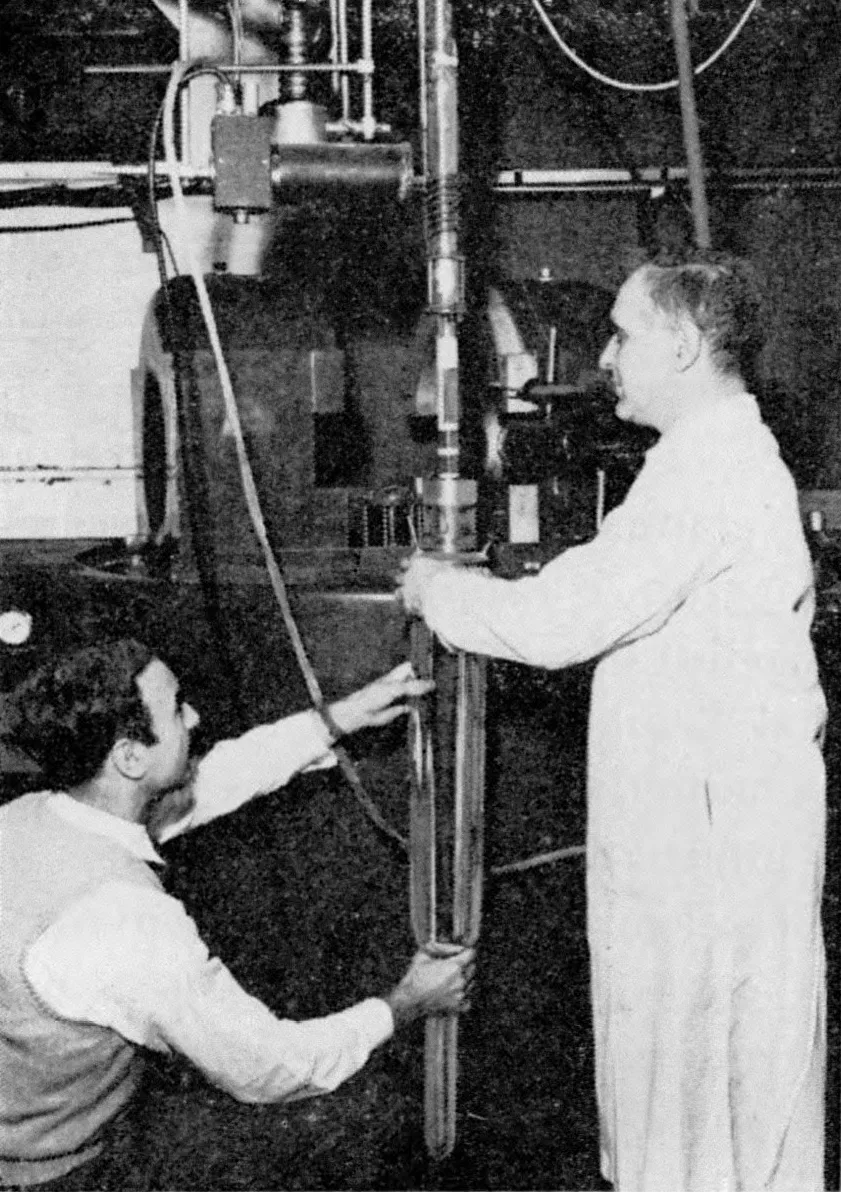
Chien-Shiung Wu and colleagues at the National Bureau of Standards cooled polarised cobalt-60 nuclei to millikelvin temperatures and found that beta electrons were emitted preferentially opposite to the nuclear spin. Weak interactions therefore distinguish left from right. Richard Garwin, Leon Lederman and Marcel Weinrich confirmed parity violation in pion and muon decays almost simultaneously. The result implied that neutrinos have a definite handedness.
- Date
- 15 February 1957
- Kind of event
- Discovery
- People involved
- Chien-Shiung Wu, Leon M. Lederman
The situation before
In October 1956 Tsung-Dao Lee and Chen-Ning Yang had pointed out that parity conservation had never been tested in weak interactions and proposed experiments to check it. The most direct one required aligning the spins of radioactive nuclei and asking whether beta electrons prefer one direction along the spin axis. If the world of beta decay were mirror-symmetric, electrons would go equally often both ways. Most physicists expected exactly that.
What happened
Chien-Shiung Wu of Columbia University, one of the leading experts on beta decay, decided to carry out the test with cobalt-60. Aligning nuclear spins requires temperatures close to absolute zero, so she teamed up with the low-temperature group of the National Bureau of Standards in Washington: Ernest Ambler, Raymond Hayward, Dale Hoppes and Ralph Hudson. A thin layer of cobalt-60 was deposited on a crystal of cerium magnesium nitrate and cooled to about 0.01 kelvin by adiabatic demagnetisation. A magnetic field then aligned the cobalt nuclei, and a small scintillation counter inside the cryostat recorded the beta electrons.
The technical difficulties were considerable: the polarisation lasted only minutes before the sample warmed, and the detector had to work at extremely low temperature inside a magnetic field. In December 1956, after months of work, the team saw a clear asymmetry. More electrons emerged opposite to the direction of the nuclear spin than along it, and the effect reversed when the magnetic field was reversed. It disappeared as the sample warmed and the alignment was lost.
- Sample: cobalt-60 on cerium magnesium nitrate, polarised at about 0.01 K.
- Result: electrons emitted preferentially opposite to the nuclear spin, with an asymmetry parameter of at least 0.7 in magnitude.
- Paper: "Experimental test of parity conservation in beta decay", received 15 January 1957, Physical Review 105, page 1413.
A second confirmation
When Leon Lederman heard of Wu's preliminary results in early January 1957, he, Richard Garwin and Marcel Weinrich devised a test at Columbia's Nevis cyclotron using the decay of pions into muons and of muons into electrons. Within days they found a large asymmetry as well. Their paper appeared directly after Wu's in the same issue of the Physical Review. Jerome Friedman and Valentine Telegdi in Chicago observed the effect in photographic emulsions. On 15 January 1957 Columbia University announced the results publicly, and the news made the front pages of newspapers.
Reaction
The result shocked the physics community, which had considered mirror symmetry a basic principle. Wolfgang Pauli, who had been convinced that parity must be conserved, is reported to have first dismissed the news as nonsense and then to have insisted that the experiment be repeated. Within months, repetitions and new experiments had established parity violation beyond doubt.
Why it matters
The weak interaction distinguishes left from right, and does so maximally. For the neutrino this had an immediate consequence. Within weeks Lee and Yang, Lev Landau and Abdus Salam proposed that the neutrino has a fixed helicity, its spin always pointing opposite to its motion. In 1958 Maurice Goldhaber, Lee Grodzins and Andrew Sunyar measured this directly and found the neutrino left-handed. The same year the V−A theory of weak interactions, developed by George Sudarshan and Robert Marshak and by Richard Feynman and Murray Gell-Mann, built the asymmetry into the foundations of what became the Standard Model.
Lee and Yang received the Nobel Prize in Physics in 1957. Wu was not included, an omission that has been widely discussed. In 1978 she received the first Wolf Prize in Physics.
Frequently asked questions
What did the Wu experiment show?
That beta electrons from polarised cobalt-60 nuclei are emitted preferentially opposite to the nuclear spin. A mirror-image experiment would give the opposite result, so the weak interaction violates parity.
When was parity violation discovered?
Wu's team saw the effect in December 1956; the results were announced on 15 January 1957 and published in the Physical Review in February 1957.
Why did Wu not receive the Nobel Prize?
The 1957 prize went only to Lee and Yang, who proposed the idea. The Nobel committee's reasons are not public, and the omission has been criticised by many physicists, including Jack Steinberger.
Original papers
- DiscoveryC. S. Wu, E. Ambler, R. W. Hayward, D. D. Hoppes and R. P. Hudson, Experimental Test of Parity Conservation in Beta Decay, Phys. Rev. 105, 1413 (1957)DOI 10.1103/PhysRev.105.1413
- MeasurementR. L. Garwin, L. M. Lederman and M. Weinrich, Observations of the Failure of Conservation of Parity and Charge Conjugation in Meson Decays: the Magnetic Moment of the Free Muon, Phys. Rev. 105, 1415 (1957)DOI 10.1103/PhysRev.105.1415
Concepts
Mentioned in 1 page
Lessons 1
Last updated: · Editorial standard
Cite this page
Text
Neutrino Atlas (2026). “1957: Wu experiment shows parity violation”. Retrieved 22 November 2026, from https://neutrino-atlas.com/timeline/1957-wu-parity-violation/BibTeX
@misc{neutrinoatlas2026ine1957wuparityviolation,
  title        = {1957: Wu experiment shows parity violation},
  author       = {{Neutrino Atlas}},
  year         = {2026},
  url          = {https://neutrino-atlas.com/timeline/1957-wu-parity-violation/},
  note         = {Accessed 2026-11-22},
  language     = {english}
}