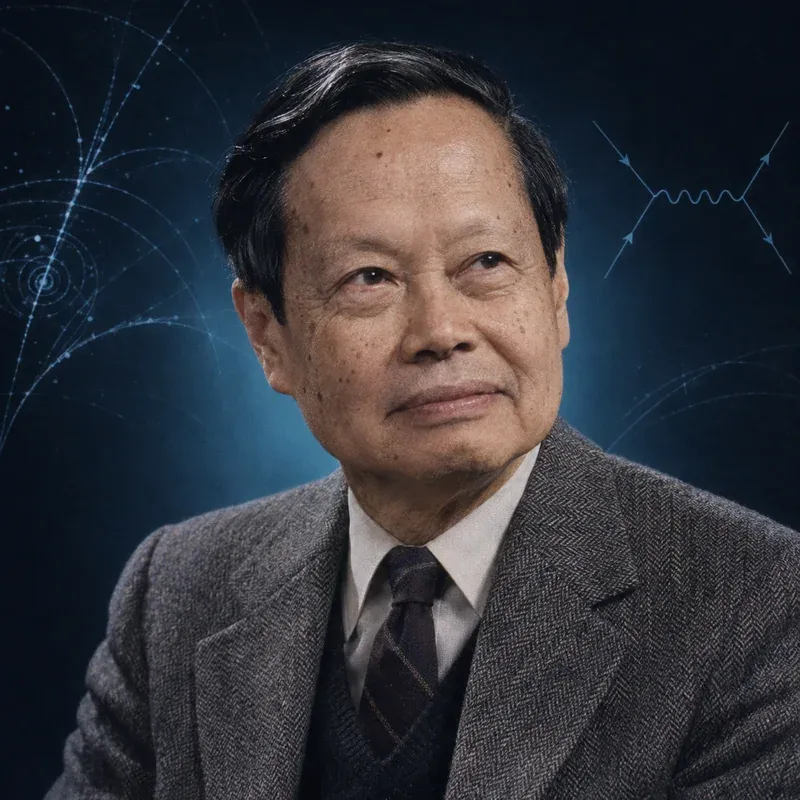
 Illustration
Chen-Ning Yang
Yang first presented the parity question at the Rochester conference in April 1956, and with T.D. Lee published the analysis showing that parity conservation in weak interactions was untested, proposing the experiments that soon demonstrated its violation. With Lee he developed the 1957 two-component theory of the massless neutrino, and in 1960 the theory of high-energy neutrino experiments. His Yang-Mills gauge theory (1954) became the framework of the electroweak theory describing neutrino interactions.
- Born
- 1 October 1922
Hefei, Anhui, China - Died
- 18 October 2025
Beijing, China - Nationality
- Chinese-American (Chinese citizen from 2015)
- Field
- theoretical physics
- Nobel Prize
- Physics 1957 (shared with T.D. Lee) – for their penetrating investigation of the so-called parity laws which has led to important discoveries regarding the elementary particles
- Institutions
- University of Chicago, Institute for Advanced Study, Princeton, Stony Brook University, Tsinghua University
Early life and education
Chen-Ning Yang was born in Hefei, in China's Anhui province, on 1 October 1922. His father was a mathematician who later taught at Tsinghua University. During the Sino-Japanese War Yang studied at the National Southwest Associated University in Kunming, where he completed his bachelor's degree in 1942 and a master's degree in 1944. In 1945 he travelled to the United States on a scholarship, hoping to work with Enrico Fermi. At the University of Chicago he received his PhD in 1948 under Edward Teller. In the United States he adopted the first name Frank, after Benjamin Franklin.
In 1949 he moved to the Institute for Advanced Study in Princeton, where he stayed until 1966. There he resumed a collaboration with Tsung-Dao Lee, a fellow student from Kunming and Chicago, that lasted for more than a decade.
Path to neutrino physics
In 1954 Yang and Robert Mills, then sharing an office at Brookhaven, generalised the gauge principle of electromagnetism to symmetries in which the 'charges' themselves do not commute. Yang–Mills theory was at first set aside because its force carriers seemed to have to be massless. In the 1960s and 1970s it became the basis of the Standard Model: with the Higgs mechanism it gives the electroweak theory, in which neutrinos interact by exchanging W and Z bosons, and the theory of the strong interaction.
Key contributions
By the mid-1950s two strange particles, the θ and τ, appeared to have the same mass and lifetime but to decay into states of opposite parity. In 1956 Lee and Yang examined the evidence and found that parity conservation had been verified in the strong and electromagnetic interactions, but never in weak decays. Their paper in Physical Review proposed concrete tests, among them the angular distribution of electrons from polarised nuclei. Chien-Shiung Wu and her collaborators carried out this measurement with cobalt-60 at the end of 1956, and a team including Leon Lederman observed the effect in pion and muon decay shortly afterwards. Both found large parity violation.
Lee and Yang received the 1957 Nobel Prize in Physics, only about a year after their paper. In 1957 they also published the two-component theory of the neutrino, which Abdus Salam and Lev Landau proposed independently. A massless neutrino can be described by a field with only one helicity; such a particle automatically violates parity maximally. The theory predicted that the neutrino is always left-handed (or always right-handed), a property that Maurice Goldhaber's group measured in 1958 and that the V−A theory built into the weak interaction.
In 1960 Lee and Yang analysed what experiments with high-energy neutrino beams from accelerators could reveal. They discussed whether the neutrino emitted with a muon is the same as the one emitted with an electron, and what intermediate boson might carry the weak force. Two years later the Brookhaven two-neutrino experiment showed that the muon neutrino is a distinct particle.
Later work and legacy
In 1966 Yang became the first director of the Institute for Theoretical Physics at Stony Brook University, which now bears his name. His work in statistical mechanics includes the Lee–Yang theorem on phase transitions and what became known as the Yang–Baxter equation. After his retirement from Stony Brook in 1999 he moved to Tsinghua University in Beijing and helped build theoretical physics in China; he gave up his US citizenship in 2015. He died in Beijing on 18 October 2025, aged 103.
For neutrino physics, Yang's work set two foundations at once: the gauge-theory framework in which neutrino interactions are calculated, and the discovery, with Lee, that weak interactions distinguish left from right. The neutrino's fixed chirality is the most extreme expression of that asymmetry.
Known for
- Parity violation in weak interactions (1956, with Lee)
- Two-component neutrino theory (1957)
- Yang–Mills gauge theory (1954)
Chronology
- 1954Yang–Mills theory
- 1956Parity paper with Lee
- 1957Two-component neutrino theory; Nobel Prize in Physics
Original papers
- T.D. Lee, C.N. Yang, Question of parity conservation in weak interactions, Phys. Rev. 104, 254 (1956)DOI 10.1103/PhysRev.104.254
- T.D. Lee, C.N. Yang, Parity nonconservation and a two-component theory of the neutrino, Phys. Rev. 105, 1671 (1957)DOI 10.1103/PhysRev.105.1671
Experiments
- Wu experiment
Connected people
Frequently asked questions
Did Yang win a Nobel Prize?
Yes. He shared the 1957 Nobel Prize in Physics with Tsung-Dao Lee for their investigation of the parity laws, which led to the discovery of parity violation in weak interactions.
What is the two-component neutrino theory?
A description of the neutrino as a massless particle with a single helicity. It explains why parity is violated maximally in processes involving neutrinos. It was proposed in 1957 by Lee and Yang, Landau and Salam.
Why is Yang–Mills theory important for neutrinos?
The electroweak theory that describes all neutrino interactions is a Yang–Mills gauge theory. Its W and Z bosons are the gauge particles of that theory.
On the timeline
- 1956Lee and Yang question parity in weak decays
- 1957Nobel Prize for Lee and Yang
- 1957Two-component theory of a massless neutrino
Mentioned in 23 pages
Lessons 1
Milestones 6
People 8
Last updated: · Editorial standard
Cite this page
Text
Neutrino Atlas (2026). “Chen-Ning Yang”. Retrieved 22 November 2026, from https://neutrino-atlas.com/people/chen-ning-yang/BibTeX
@misc{neutrinoatlas2026peoplechenningyang,
  title        = {Chen-Ning Yang},
  author       = {{Neutrino Atlas}},
  year         = {2026},
  url          = {https://neutrino-atlas.com/people/chen-ning-yang/},
  note         = {Accessed 2026-11-22},
  language     = {english}
}