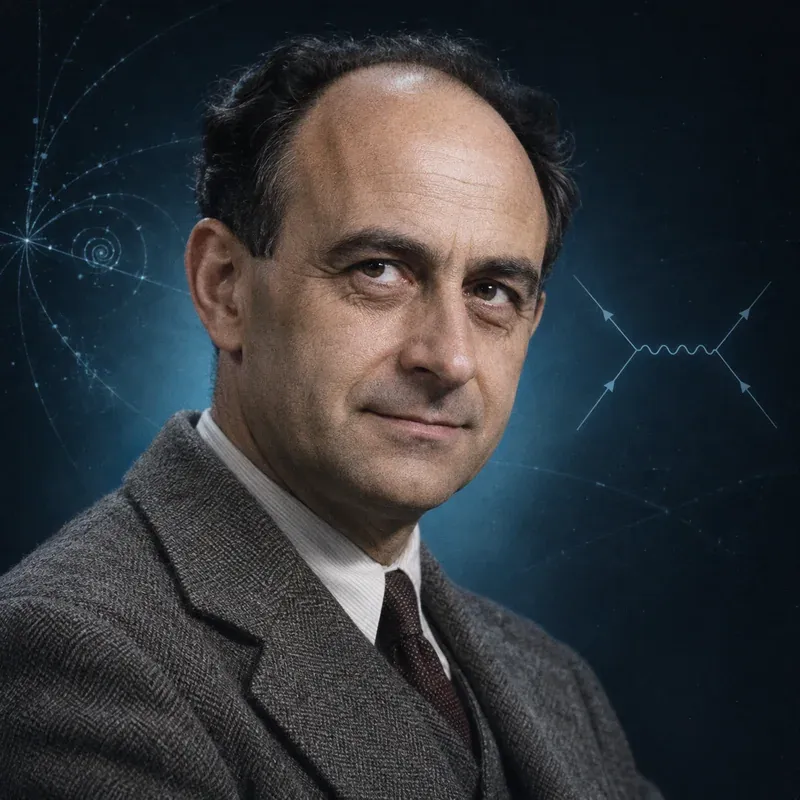
 Illustration
Enrico Fermi
At the end of 1933 Fermi formulated the first quantitative theory of beta decay, in which an electron and a neutrino are created at the moment of the nuclear transition by a point-like four-fermion interaction - the first field theory of the creation and annihilation of material particles and the ancestor of the weak interaction. He coined the name 'neutrino' ('little neutral one'). Nature rejected the paper as 'too remote from physical reality', so it appeared in Ricerca Scientifica (1933), Nuovo Cimento and Zeitschrift für Physik (1934). He also pointed out that the neutrino mass could be determined from the shape of the electron spectrum near its endpoint.
- Born
- 29 September 1901
Rome, Italy - Died
- 28 November 1954
Chicago, Illinois, USA - Nationality
- Italian (naturalized US citizen 1944)
- Field
- theoretical and experimental physics
- Nobel Prize
- Physics 1938 – for his demonstrations of the existence of new radioactive elements produced by neutron irradiation, and for his related discovery of nuclear reactions brought about by slow neutrons
- Institutions
- University of Florence, Sapienza University of Rome, Columbia University, University of Chicago
Early life and education
Enrico Fermi was born in Rome on 29 September 1901. As a teenager he taught himself mathematical physics from second-hand books, and in 1918 he won a place at the Scuola Normale Superiore in Pisa with an entrance essay on vibrating strings that an examiner judged worthy of a doctoral thesis. He graduated in Pisa in 1922, spent time with Max Born in Göttingen and with Paul Ehrenfest in Leiden, and in 1926 became professor of theoretical physics at the University of Rome, still in his mid-twenties.
In Rome, on the Via Panisperna, he gathered a small group of young physicists that included Ettore Majorana, Edoardo Amaldi, Emilio Segrè and, later, Bruno Pontecorvo. In 1926 he had already worked out the statistics of particles obeying the exclusion principle, independently of Dirac; particles of this kind are now called fermions.
Path to neutrino physics
In December 1930 Wolfgang Pauli had suggested that a light, neutral particle is emitted together with the electron in beta decay, carrying away the energy missing from the continuous electron spectrum. After James Chadwick discovered the heavy neutron in 1932, Fermi began calling Pauli's particle the neutrino, Italian for 'little neutral one', to tell the two apart. At the Solvay Conference of October 1933 Pauli presented the idea in public, and Fermi, who attended, turned it into a theory within weeks.
Key contributions
Fermi's 'Tentativo di una teoria dei raggi β' treated beta decay by analogy with the emission of light by an atom. Just as a photon does not exist inside the atom before it is emitted, the electron and the neutrino do not sit inside the nucleus: they are created at the moment a neutron turns into a proton. The four particles meet at a single point, and the strength of this contact interaction is set by one number, today written as the Fermi constant. This was the first quantum field theory in which matter particles, not only photons, are created and destroyed.
The theory explained the shape of the electron energy spectrum and connected the lifetimes of beta emitters with the energy released. Fermi also noted that a non-zero neutrino mass would change the shape of the spectrum close to its upper end. This remark is the basis of every direct measurement of the absolute neutrino mass, from the early tritium experiments to KATRIN, which study the endpoint region.
Fermi's point-like coupling became the template of the weak interaction. Within two years George Gamow and Edward Teller extended it to transitions in which the nuclear spin changes. In 1934–35 Hans Bethe and Rudolf Peierls used it to estimate how rarely a neutrino interacts with matter. In the 1950s the discovery of parity violation fixed the precise form of the coupling as V−A. The electroweak theory later showed that Fermi's contact interaction is the low-energy limit of the exchange of a heavy W boson; Fermi's constant is still measured precisely from the muon lifetime.
Later work
From 1934 Fermi's group in Rome bombarded elements with neutrons and found that slowed-down neutrons are far more effective at inducing radioactivity. This work earned him the 1938 Nobel Prize in Physics. He used the trip to Stockholm to emigrate with his family to the United States, as Italy's new racial laws threatened his Jewish wife, Laura. At Columbia and then at the University of Chicago he led the construction of Chicago Pile-1, which reached the first self-sustaining nuclear chain reaction on 2 December 1942.
Nuclear reactors later became the first practical neutrino source: Frederick Reines and Clyde Cowan detected reactor antineutrinos in 1956 by inverse beta decay, a reaction whose rate follows from Fermi's theory. After the war Fermi worked in Chicago on pion–nucleon scattering and on the origin of cosmic rays, and trained a generation of physicists. He died of cancer in Chicago on 28 November 1954. The element fermium, the unit fermi (10⁻¹⁵ m), Fermilab and the Fermi Gamma-ray Space Telescope carry his name.
Legacy
In neutrino physics, Fermi's legacy is the language itself: the name 'neutrino', the idea that particles are created in interactions, the four-fermion coupling that still describes low-energy neutrino cross-sections, and the endpoint method for weighing the neutrino. The Fermi theory page of this site describes the theory in more detail.
Known for
- Theory of beta decay (Fermi interaction)
- Naming the neutrino
- Fermi–Dirac statistics
- Slow-neutron reactions
- First nuclear reactor (Chicago Pile-1)
Chronology
- 1933Beta-decay theory published in Ricerca Scientifica; name 'neutrino'
- 1934Full theory in Nuovo Cimento and Zeitschrift für Physik
- 1938Nobel Prize in Physics
- 1942First self-sustaining nuclear chain reaction, Chicago
Original papers
- E. Fermi, Tentativo di una teoria dell'emissione dei raggi beta, Ricerca Scientifica 4, 491 (1933)
- E. Fermi, Tentativo di una teoria dei raggi beta, Nuovo Cimento 11, 1 (1934)DOI 10.1007/BF02959820
- E. Fermi, Versuch einer Theorie der β-Strahlen. I, Zeitschrift für Physik 88, 161 (1934)DOI 10.1007/BF01351864
Connected people
- Bruno Pontecorvo
- Chien-Shiung Wu
- Edward Teller
- Ettore Majorana
- Francis Perrin
- George Gamow
- Wolfgang Pauli
- Hans Bethe
- Rudolf Peierls
- Emil Konopinski
- Giulio Racah
- Wang Ganchang
Frequently asked questions
Did Fermi invent the neutrino?
No. Wolfgang Pauli proposed the particle in 1930. Fermi gave it its name and, in 1933–34, the first theory describing how it is created in beta decay.
Why was Fermi's beta-decay paper rejected by Nature?
According to Fermi's colleagues, the editors considered it too speculative and too far from physical reality. The theory appeared instead in Ricerca Scientifica, Il Nuovo Cimento and Zeitschrift für Physik.
Did Fermi receive the Nobel Prize for neutrino physics?
No. His 1938 Nobel Prize recognised new radioactive elements produced by neutron irradiation and nuclear reactions caused by slow neutrons.
On the timeline
- 1932Discovery of the neutron renames Pauli's particle
- 1933Pauli presents the neutrino at the Solvay Conference
- 1933Fermi's theory of beta decay
Mentioned in 66 pages
Lessons 5
FAQ 5
Milestones 10
- 1914 · Chadwick finds the beta spectrum is continuous
- 1930 · Pauli proposes a new neutral particle
- 1932 · Discovery of the neutron renames Pauli's particle
- 1933 · Fermi's theory of beta decay
- 1933 · Pauli presents the neutrino at the Solvay Conference
- 1934 · Bethe and Peierls estimate a tiny cross-section
- 1937 · Majorana: a neutrino could be its own antiparticle
- 1942 · First indirect evidence from nuclear recoil
People 32
- Alexander Ilyich Leipunsky
- Antonino Zichichi
- Bruno Pontecorvo
- Chen-Ning Yang
- Chien-Shiung Wu
- Edward Blucher
- Edward Teller
- Emil Konopinski
24 more
- Ettore Fiorini
- Ettore Majorana
- Francis Perrin
- George Gamow
- Gianpaolo Bellini
- Giulio Racah
- H. Richard Crane
- Hans Bethe
- Jack Steinberger
- James Chadwick
- James S. Allen
- John Norris Bahcall
- Juan I. Collar
- Leon M. Lederman
- Lincoln Wolfenstein
- Lise Meitner
- Maurice Goldhaber
- Murray Gell-Mann
- Niels Bohr
- Rudolf Peierls
- Tsung-Dao Lee
- Veniamin Sergeevich Berezinsky
- Wang Ganchang
- Wolfgang Pauli
Terms 14
Last updated: · Editorial standard
Cite this page
Text
Neutrino Atlas (2026). “Enrico Fermi”. Retrieved 22 November 2026, from https://neutrino-atlas.com/people/enrico-fermi/BibTeX
@misc{neutrinoatlas2026peopleenricofermi,
  title        = {Enrico Fermi},
  author       = {{Neutrino Atlas}},
  year         = {2026},
  url          = {https://neutrino-atlas.com/people/enrico-fermi/},
  note         = {Accessed 2026-11-22},
  language     = {english}
}