1914Discovery
Chadwick finds the beta spectrum is continuous
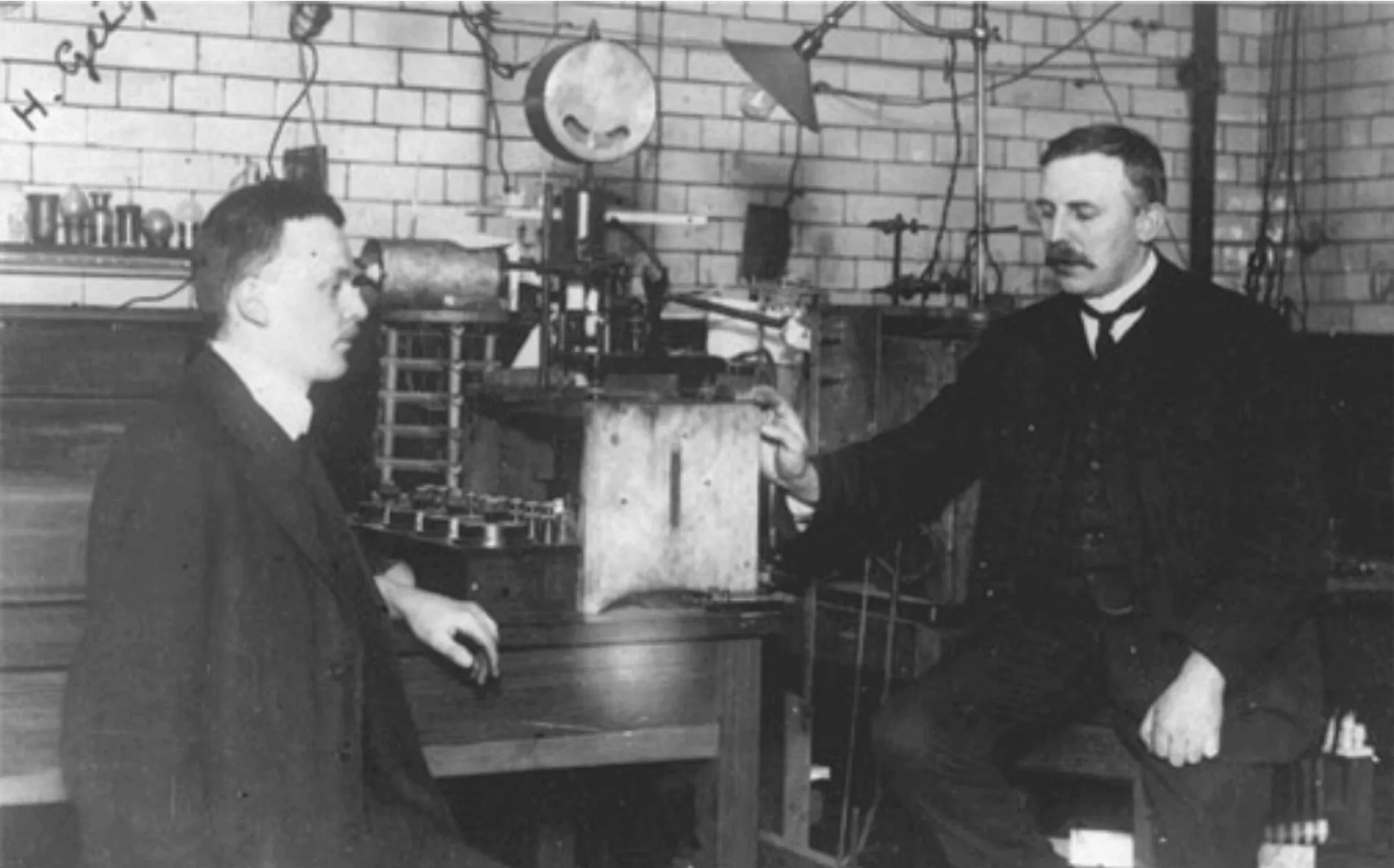
Working in Hans Geiger's laboratory in Berlin, James Chadwick used a magnetic spectrometer with a counter and showed that electrons from radium B and C emerge with a continuous range of energies rather than discrete lines. Alpha and gamma rays, by contrast, show sharp lines. A two-body decay should give a single electron energy, so the result seemed to violate energy conservation. Explaining this puzzle took almost two decades and ultimately required the neutrino.
- Date
- 1914
- Kind of event
- Discovery
- People involved
- James Chadwick, Otto Hahn, Lise Meitner
The situation before
By 1913 beta rays were known to be electrons emitted by radioactive nuclei, and the obvious expectation was that, like alpha particles, they would leave each nucleus with one definite energy. Photographic work in Berlin by Otto Hahn, Lise Meitner and Otto von Baeyer seemed to confirm this: when beta rays were spread out by a magnetic field onto a photographic plate, sharp lines appeared, suggesting a set of discrete electron energies. The lines, however, sat on a faint background whose meaning was unclear, and photographic plates are poor at measuring how many electrons arrive.
What happened
In 1913 the young James Chadwick, a former student of Ernest Rutherford in Manchester, went to Berlin on a scholarship to work with Hans Geiger at the Physikalisch-Technische Reichsanstalt. He combined a magnetic spectrometer with one of Geiger's new electrical counters, which registered individual electrons instead of blackening a plate. Moving the counter across the spectrum, he could count how many electrons arrived at each energy from the decay products then called radium B and radium C.
The result surprised him. The sharp lines were there, but they contained only a small fraction of the electrons. Most of the intensity formed a broad, continuous distribution stretching from low energies up to a maximum. Chadwick reported this in 1914 in the Verhandlungen der Deutschen Physikalischen Gesellschaft. He wrote to Rutherford that he had found the continuous spectrum but could not yet explain it.
- Place: Physikalisch-Technische Reichsanstalt, Berlin-Charlottenburg, 1913–1914.
- Instrument: magnetic spectrometer with a Geiger counter instead of a photographic plate.
- Sources: radium B and C (today lead-214 and bismuth-214).
- Finding: a continuous electron spectrum, with a few weak lines on top.
Within months the First World War began. Chadwick was interned as a British civilian in the Ruhleben camp near Berlin and spent the war there, so the question rested for several years.
Reaction
The result was not accepted immediately. Meitner in particular argued through the early 1920s that each nucleus emits electrons of one energy and that the spread arose afterwards, as electrons lost energy on their way out of the atom. Charles Ellis in Cambridge took the opposite view, that the continuous spectrum was primary. Ellis also showed that the sharp lines are a separate effect: electrons ejected from the atomic shell by gamma rays, not the beta electrons from the nucleus. The dispute was settled only by the calorimetric experiment of Ellis and William Wooster in 1927, confirmed by Meitner and Wilhelm Orthmann in 1930.
Why it matters
A nucleus that changes into another nucleus by emitting just one electron is a two-body decay. Energy and momentum conservation then fix the electron's energy to a single value. A continuous spectrum meant either that energy was not conserved in individual nuclear events or that something unseen was sharing it. In 1929–1930 Niels Bohr was prepared to consider the first option. Wolfgang Pauli chose the second in his letter of December 1930, proposing a light neutral particle emitted with the electron.
The shape Chadwick measured remains a working tool. In Enrico Fermi's theory of 1933–1934 it follows from sharing the energy among three particles, and its upper end, the beta spectrum endpoint, is where experiments such as KATRIN look for the tiny effect of the neutrino mass.
Frequently asked questions
Who discovered the continuous beta spectrum?
James Chadwick, working in Hans Geiger's laboratory in Berlin, in 1914. He used an electrical counter rather than a photographic plate, which let him measure the full distribution of electron energies.
Why was a continuous spectrum a problem?
If a nucleus emits only an electron, conservation of energy and momentum fixes the electron's energy to one value. A broad range of energies suggested that energy was missing, which was eventually explained by the neutrino.
Were the sharp lines seen earlier wrong?
No, but they had a different origin. Charles Ellis showed in the 1920s that they come from electrons knocked out of the atomic shell by gamma rays, not from beta decay itself.
Original papers
- DiscoveryJ. Chadwick, Intensitätsverteilung im magnetischen Spektrum der β-Strahlen von Radium B + C, Verh. Dtsch. Phys. Ges. 16, 383 (1914)
Concepts
Mentioned in 1 page
Lessons 1
Last updated: · Editorial standard
Cite this page
Text
Neutrino Atlas (2026). “1914: Chadwick finds the beta spectrum is continuous”. Retrieved 22 November 2026, from https://neutrino-atlas.com/timeline/1914-chadwick-continuous-spectrum/BibTeX
@misc{neutrinoatlas2026adwickcontinuousspectrum,
  title        = {1914: Chadwick finds the beta spectrum is continuous},
  author       = {{Neutrino Atlas}},
  year         = {2026},
  url          = {https://neutrino-atlas.com/timeline/1914-chadwick-continuous-spectrum/},
  note         = {Accessed 2026-11-22},
  language     = {english}
}