 Illustration
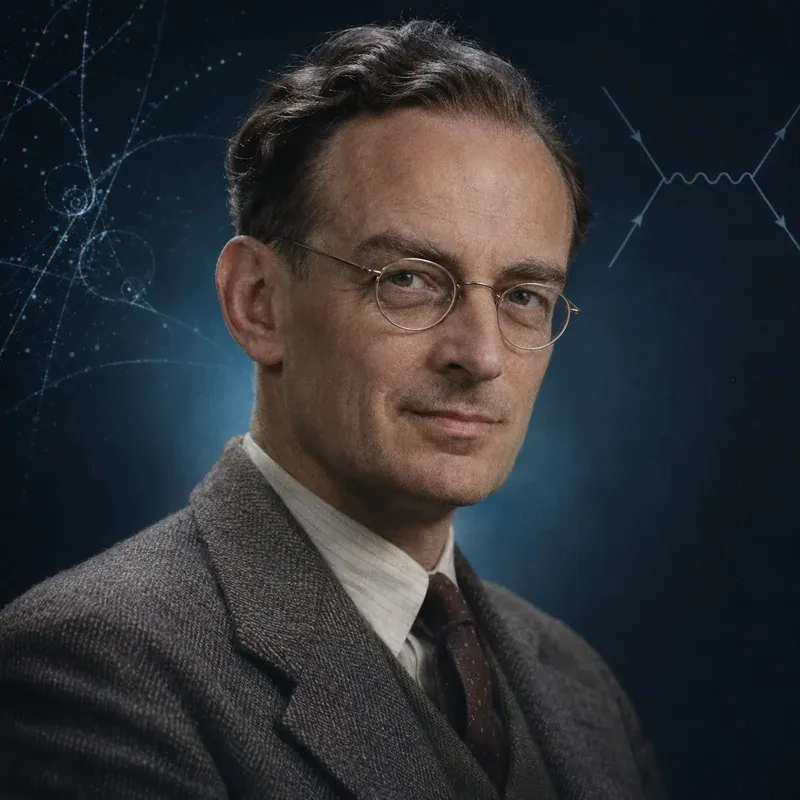
William Alfred Wooster
As a PhD student of Rutherford working on the radioactivity of radium B, C and E, Wooster performed with Charles Ellis the 1927 calorimetric measurement of the heat released by radium E beta decays. The result - average energy per decay equal to the mean of the continuous spectrum - established that beta electrons leave the nucleus with a continuous energy distribution, setting the stage for the neutrino hypothesis. He later became a crystallographer.
- Born
- 1903
- Died
- 1984
- Nationality
- British
- Field
- experimental physics, crystallography
- Institutions
- Peterhouse, Cambridge, Cavendish Laboratory, Department of Mineralogy and Petrology, Cambridge, Crystal Structure Ltd.
Early life and education
William Alfred Wooster was born in Islington, London, on 18 August 1903; friends knew him as Peter. He went up to Cambridge in 1921 and, on his supervisor's advice, took mineralogy as his third subject, a choice that would later shape his career. He graduated as a physicist in 1924 and stayed on at the Cavendish Laboratory as a research student of Ernest Rutherford, working on the natural radioactivity of radium B, C and E.
The calorimeter that measured missing energy
Wooster's doctoral work brought him into the most contested question in nuclear physics of the 1920s. Magnetic spectrometers showed that the electrons of beta decay have a continuous range of energies. Lise Meitner argued that the nucleus emits them with one fixed energy and that the spread arises afterwards; Charles Ellis, Wooster's supervisor at the Cavendish, believed the spread was produced in the nucleus.
Together they designed a direct test. A radium E (bismuth-210) source was sealed inside a small calorimeter whose walls were thick enough to stop every electron, so that all the energy released, whatever its form, ended up as heat. The result, published in 1927 as "The average energy of disintegration of radium E", was about 0.34 MeV per decay: the mean energy of the continuous spectrum, not the maximum of about 1 MeV that a single-energy emission would have required.
The experiment established that beta decay really does release different amounts of energy from one decay to the next, unless some energy escapes undetected. After Meitner and Wilhelm Orthmann confirmed the result in 1930, Wolfgang Pauli proposed the neutrino as the carrier of the missing energy. Wooster completed his PhD the same year as the experiment, 1927.
A career in crystallography
Wooster then left nuclear physics. In 1927 he became a demonstrator in the Cambridge Department of Mineralogy and Petrology, where he built up lectures and practical classes in crystal physics, and he was promoted to lecturer in 1935. In 1928 he married Nora Martin, herself a crystallographer. His books include "A Textbook on Crystal Physics" (1938), "Experimental Crystal Physics" (1957) and "Tensors and Group Theory for Physical Properties of Crystals" (1973).
He also designed X-ray instruments, among them the de Jong–Wooster rotation retigraph (1947) and a four-circle diffractometer (1964). In 1947 he and Nora founded Crystal Structures Ltd in Cambridge, which made X-ray diffraction equipment and crystal-structure models; he left his university post in 1960 to run it. Before the Second World War both were active in the Cambridge Scientists' Anti-War Group, and during the war he sat on a group of scientists advising on war production. Wooster died in Cambridge on 12 April 1984.
Legacy
Wooster is remembered in neutrino history for a single measurement, made as a doctoral student, that turned the beta-spectrum puzzle into a hard fact. The logic of the experiment, catching every bit of deposited energy in one absorber, lives on in modern calorimetric detectors such as the bolometers used to search for neutrinoless double beta decay.
Known for
- Ellis–Wooster calorimetric experiment (1927)
- X-ray crystallography and crystal physics
Chronology
- 1921Begins studies at Peterhouse, Cambridge
- 1927Ellis–Wooster experiment; PhD under Rutherford
Original papers
- C.D. Ellis, W.A. Wooster, The average energy of disintegration of radium E, Proc. R. Soc. Lond. A 117, 109 (1927)DOI 10.1098/rspa.1927.0168
Experiments
- Ellis–Wooster experiment
Connected people
Frequently asked questions
What did Wooster contribute to the discovery of the neutrino?
With Charles Ellis he measured the total heat released by radium E decays in 1927. The average energy per decay matched the mean of the continuous beta spectrum, proving that energy seemed to disappear in individual decays. Pauli's neutrino hypothesis of 1930 was the answer to this result.
Did Wooster stay in nuclear physics?
No. From 1927 he worked in the Cambridge Department of Mineralogy and Petrology and became a crystallographer, writing textbooks on crystal physics and founding the instrument company Crystal Structures Ltd in 1947.
On the timeline
Mentioned in 12 pages
Lessons 1
Milestones 3
Last updated: · Editorial standard
Cite this page
Text
Neutrino Atlas (2026). “William Alfred Wooster”. Retrieved 22 November 2026, from https://neutrino-atlas.com/people/william-alfred-wooster/BibTeX
@misc{neutrinoatlas2026oplewilliamalfredwooster,
  title        = {William Alfred Wooster},
  author       = {{Neutrino Atlas}},
  year         = {2026},
  url          = {https://neutrino-atlas.com/people/william-alfred-wooster/},
  note         = {Accessed 2026-11-22},
  language     = {english}
}