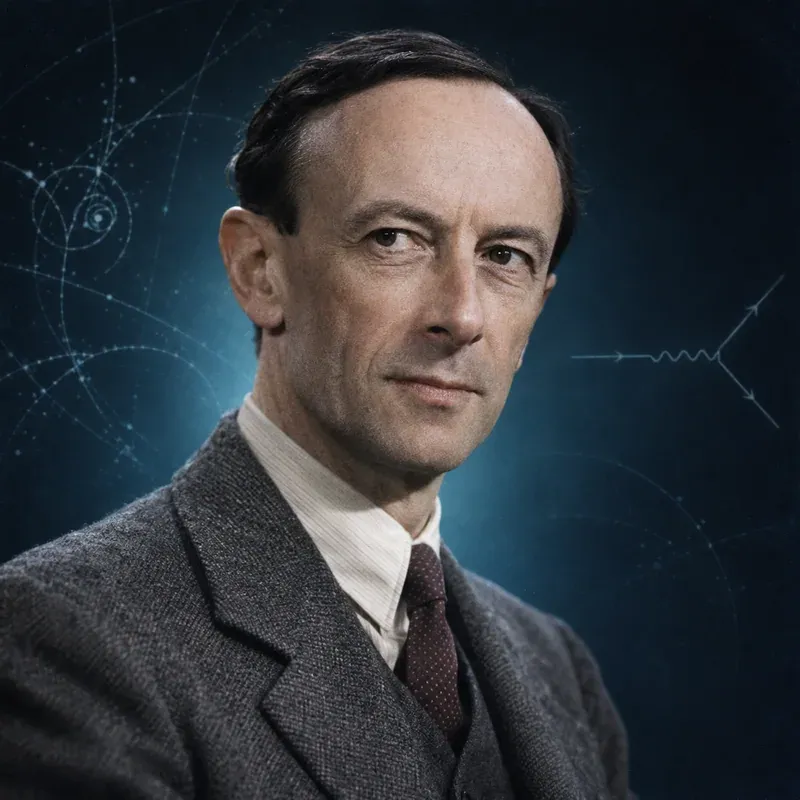
 Illustration
James Chadwick
Working under Hans Geiger in Berlin in 1914, Chadwick used a counter to show that beta-decay electrons have a continuous energy spectrum rather than discrete lines - the puzzle that eventually led to the neutrino hypothesis. His 1932 discovery of the neutron removed one of the problems of Pauli's original idea and allowed Fermi to formulate beta decay with protons and neutrons. In 1934, with D.E. Lea, he attempted to detect a neutral particle of small mass.
- Born
- 20 October 1891
Bollington, Cheshire, England - Died
- 24 July 1974
Cambridge, England - Nationality
- British
- Field
- experimental physics
- Nobel Prize
- Physics 1935 – for the discovery of the neutron
- Institutions
- Victoria University of Manchester, Physikalisch-Technische Reichsanstalt, Berlin, Cavendish Laboratory, Cambridge, University of Liverpool
Early life and education
James Chadwick was born on 20 October 1891 in Bollington, Cheshire, into a working-class family. He won a place at the Victoria University of Manchester, where he studied physics under Ernest Rutherford from 1908 and graduated with first-class honours in 1911. After an MSc in 1913 he won an 1851 Exhibition scholarship that allowed him to work with Hans Geiger at the Physikalisch-Technische Reichsanstalt in Berlin.
The continuous beta spectrum
In Berlin Chadwick took up the question of how much energy the electrons of beta decay carry. Earlier work in Berlin by Otto Hahn, Lise Meitner and Otto von Baeyer had sent beta rays through a magnetic field onto photographic plates and found a series of sharp lines, which suggested that each radioactive substance emits electrons of a few fixed energies, like alpha particles. Chadwick replaced the photographic plate with one of Geiger's new electrical counters, which registers individual electrons and responds in proportion to their number.
His 1914 paper on the magnetic spectrum of beta rays from radium B and C showed that the lines are only a small feature on top of a broad, continuous distribution of energies. Photographic plates had exaggerated the lines because they record sharp concentrations far more readily than a smooth background. The continuous spectrum Chadwick revealed was the puzzle that, over the next sixteen years, led to the idea of the neutrino.
When the First World War broke out he was interned as a British civilian at Ruhleben camp near Berlin, where he spent four years. There he met Charles Ellis, a young army cadet, and introduced him to physics; the two improvised a laboratory in a stable. Ellis later carried out the decisive calorimetric test of Chadwick's continuous spectrum with William Wooster.
Discovery of the neutron
After the war Chadwick followed Rutherford to the Cavendish Laboratory in Cambridge, took his PhD in 1921 and became Rutherford's assistant director of research in 1923. Rutherford had suggested in 1920 that the nucleus might contain a neutral particle of roughly the proton's mass, and Chadwick searched for it for more than a decade.
The breakthrough came in early 1932. Walther Bothe and Herbert Becker had found that beryllium bombarded with alpha particles emits a very penetrating radiation, and Irène Joliot-Curie and Frédéric Joliot had shown that it knocks protons out of paraffin wax; they interpreted it as gamma rays. Chadwick saw that gamma rays could not transfer so much momentum to protons. Within weeks he measured recoils in several gases and showed that the radiation consisted of neutral particles with a mass close to that of the proton. His letter "Possible existence of a neutron" appeared in Nature in February 1932. In 1934, with Maurice Goldhaber, he measured the neutron's mass precisely through the photodisintegration of the deuteron.
Why the neutron mattered for the neutrino
Wolfgang Pauli had originally called his hypothetical light particle a "neutron" and imagined it as a constituent of the nucleus. Chadwick's heavy neutron removed that role: nuclei could now be built from protons and neutrons, and the electron and the light neutral particle could be created at the moment of decay. Enrico Fermi adopted the name "neutrino" for Pauli's particle and in 1933–34 formulated his theory of beta decay, in which a neutron turns into a proton, an electron and a neutrino. In 1934 Chadwick and D. E. Lea also tried directly to detect a neutral particle of small mass in beta decay, without success.
The neutron remains part of neutrino physics today. Nuclear reactors, which rely on neutron-induced fission, are the most intense man-made sources of antineutrinos, and the neutron released in inverse beta decay gives the delayed signal by which reactor antineutrino detectors identify their events.
Later work
Chadwick received the Hughes Medal of the Royal Society in 1932 and the Nobel Prize in Physics in 1935. That year he moved to the University of Liverpool, where he built a cyclotron that was completed in 1939. During the Second World War he wrote the final draft of the MAUD Report in 1941, which helped launch the American atomic bomb programme, and from 1943 he led the British Mission to the Manhattan Project. He was knighted in 1945. From 1948 to 1958 he was Master of Gonville and Caius College, Cambridge. He died in Cambridge on 24 July 1974.
Known for
- Continuous beta spectrum (1914)
- Discovery of the neutron (1932)
- Search for a neutral particle of small mass (1934)
Chronology
- 1914Shows beta spectrum of radium B+C is continuous
- 1914Interned at Ruhleben camp near Berlin for the duration of WWI
- 1932Discovers the neutron
- 1935Nobel Prize in Physics
Original papers
- J. Chadwick, Intensitätsverteilung im magnetischen Spektrum der β-Strahlen von Radium B+C, Verh. Dtsch. Phys. Ges. 16, 383 (1914)
- J. Chadwick, Possible existence of a neutron, Nature 129, 312 (1932)DOI 10.1038/129312a0
- J. Chadwick, D.E. Lea, Attempt to detect a neutral particle of small mass, Proc. Cambridge Phil. Soc. 30, 59 (1934)DOI 10.1017/S030500410001238X
Connected people
Frequently asked questions
What did Chadwick discover about beta decay?
In 1914, using a Geiger counter instead of photographic plates, he showed that beta-decay electrons have a continuous spread of energies, with only a few weak lines on top. That continuous spectrum was the problem Pauli's neutrino later solved.
Did Chadwick win a Nobel Prize?
Yes. He received the 1935 Nobel Prize in Physics for the discovery of the neutron.
Is the neutron the same as the neutrino?
No. The neutron, found by Chadwick in 1932, has nearly the proton's mass and is a building block of nuclei. The neutrino is far lighter and interacts only weakly. Pauli first called his particle a "neutron"; Fermi renamed it "neutrino" to distinguish the two.
On the timeline
- 1914Chadwick finds the beta spectrum is continuous
- 1932Discovery of the neutron renames Pauli's particle
Mentioned in 19 pages
Lessons 1
Milestones 6
- 1899 · Rutherford distinguishes alpha and beta rays
- 1914 · Chadwick finds the beta spectrum is continuous
- 1927 · Calorimetry confirms missing energy in beta decay
- 1930 · Pauli proposes a new neutral particle
- 1932 · Discovery of the neutron renames Pauli's particle
- 1933 · Pauli presents the neutrino at the Solvay Conference
People 7
Last updated: · Editorial standard
Cite this page
Text
Neutrino Atlas (2026). “James Chadwick”. Retrieved 22 November 2026, from https://neutrino-atlas.com/people/james-chadwick/BibTeX
@misc{neutrinoatlas2026peoplejameschadwick,
  title        = {James Chadwick},
  author       = {{Neutrino Atlas}},
  year         = {2026},
  url          = {https://neutrino-atlas.com/people/james-chadwick/},
  note         = {Accessed 2026-11-22},
  language     = {english}
}