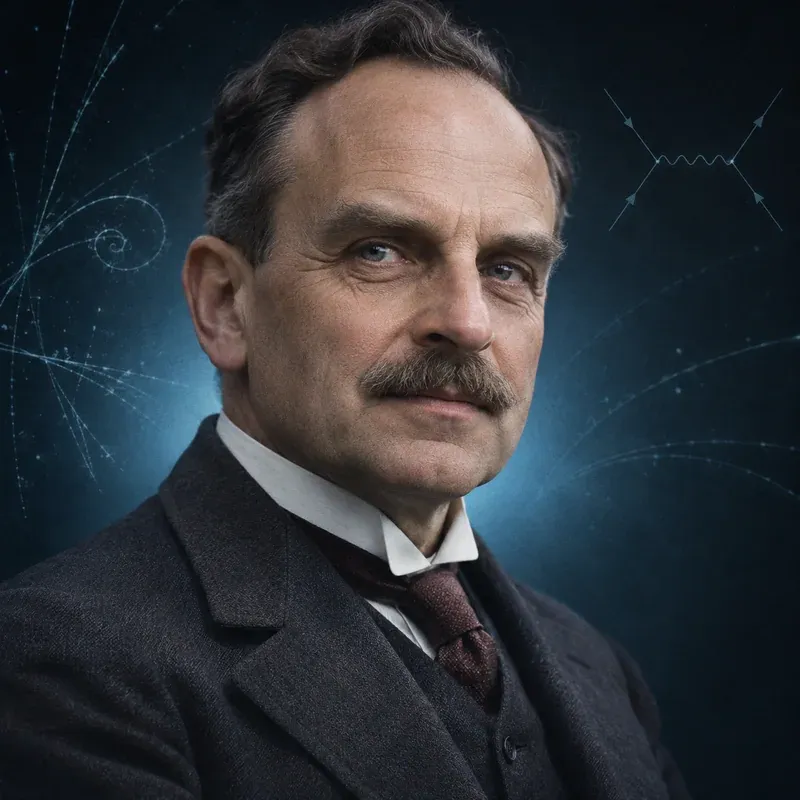
 Illustration
Otto Hahn
In the years before 1914 Hahn's Berlin laboratory, working with Lise Meitner, studied beta rays and – like Rutherford's group – concluded that beta spectra consisted of discrete lines. James Chadwick's 1914 measurement showed this to be an artefact of photographic detection and that the primary beta spectrum is continuous, the puzzle that eventually led Pauli to postulate the neutrino in 1930.
- Born
- 8 March 1879
Frankfurt am Main, German Empire - Died
- 28 July 1968
Göttingen, West Germany - Nationality
- German
- Field
- Radiochemistry
- Nobel Prize
- Chemistry 1944 – for his discovery of the fission of heavy atomic nuclei
- Institutions
- University of Marburg (PhD 1901), University College London, McGill University, Friedrich Wilhelm University of Berlin
From organic chemistry to radioactivity
Otto Hahn was born in Frankfurt am Main on 8 March 1879. He took his doctorate in organic chemistry at the University of Marburg in 1901 and in 1904 went to University College London to work with William Ramsay, where he discovered a new radioactive substance, radiothorium. A year with Ernest Rutherford at McGill University in Montreal (1905–1906) made him a radiochemist. Back in Berlin, on 28 September 1907 he met the physicist Lise Meitner; their collaboration lasted thirty years.
Beta-ray spectra in Berlin
Hahn's contact with the neutrino story came through the beta-ray work he did with Meitner and Otto von Baeyer before 1914. Using a magnetic field to spread the electrons of beta decay onto photographic plates, they found sharp lines and concluded that each radioactive substance emits electrons of a few fixed energies. In 1914 James Chadwick, working in Berlin with an electrical counter, showed that the lines sit on top of a broad continuous spectrum that the plates had underrated. The continuous spectrum became the central puzzle of beta decay, resolved only by Wolfgang Pauli's neutrino hypothesis of 1930.
Radiochemistry and fission
From 1912 Hahn headed the radioactivity department of the Kaiser Wilhelm Institute for Chemistry. With Meitner he identified protactinium (1918). In December 1938, after Meitner's flight from Germany, Hahn and Fritz Strassmann found barium among the products of uranium bombarded with neutrons. Meitner and Otto Frisch explained it as nuclear fission.
Fission eventually gave neutrino physics its most important artificial source. The fragments of a split nucleus carry too many neutrons and decay through a chain of beta decays, so every reactor emits a huge flux of electron antineutrinos. The first detection of the neutrino in 1956 and many later reactor experiments rely on these reactor antineutrinos.
Later life
Hahn received the 1944 Nobel Prize in Chemistry, announced in November 1945 while he was interned with other German scientists at Farm Hall in England. From 1948 to 1960 he was founding president of the Max Planck Society. He died in Göttingen on 28 July 1968.
Known for
- Discovery of nuclear fission (1938, with Strassmann; interpreted by Meitner and Frisch)
- Thirty-year collaboration with Lise Meitner
- Early beta-ray spectroscopy in Berlin
Chronology
- 1901Doctorate, University of Marburg
- 1907Begins collaboration with Lise Meitner in Berlin
- 1912Head of Radioactivity Department, Kaiser Wilhelm Institute for Chemistry
- 1914Chadwick shows the beta spectrum is continuous, contradicting the Berlin and Manchester line picture
- 1938Discovery of nuclear fission with Fritz Strassmann
- 1945Nobel Prize in Chemistry 1944 announced
Connected people
Frequently asked questions
What role did Otto Hahn play in the history of the neutrino?
With Lise Meitner and Otto von Baeyer he recorded beta-ray spectra that seemed to consist of sharp lines. Chadwick's 1914 measurement showed that the true spectrum is continuous, the puzzle that led to the neutrino. Hahn's later discovery of fission also created reactors, the strongest man-made neutrino sources.
Did Otto Hahn win a Nobel Prize?
Yes, the 1944 Nobel Prize in Chemistry for the discovery of the fission of heavy nuclei. Lise Meitner, who interpreted the result with Otto Frisch, was not included.
On the timeline
Mentioned in 4 pages
Last updated: · Editorial standard
Cite this page
Text
Neutrino Atlas (2026). “Otto Hahn”. Retrieved 22 November 2026, from https://neutrino-atlas.com/people/otto-hahn/BibTeX
@misc{neutrinoatlas2026peopleottohahn,
  title        = {Otto Hahn},
  author       = {{Neutrino Atlas}},
  year         = {2026},
  url          = {https://neutrino-atlas.com/people/otto-hahn/},
  note         = {Accessed 2026-11-22},
  language     = {english}
}