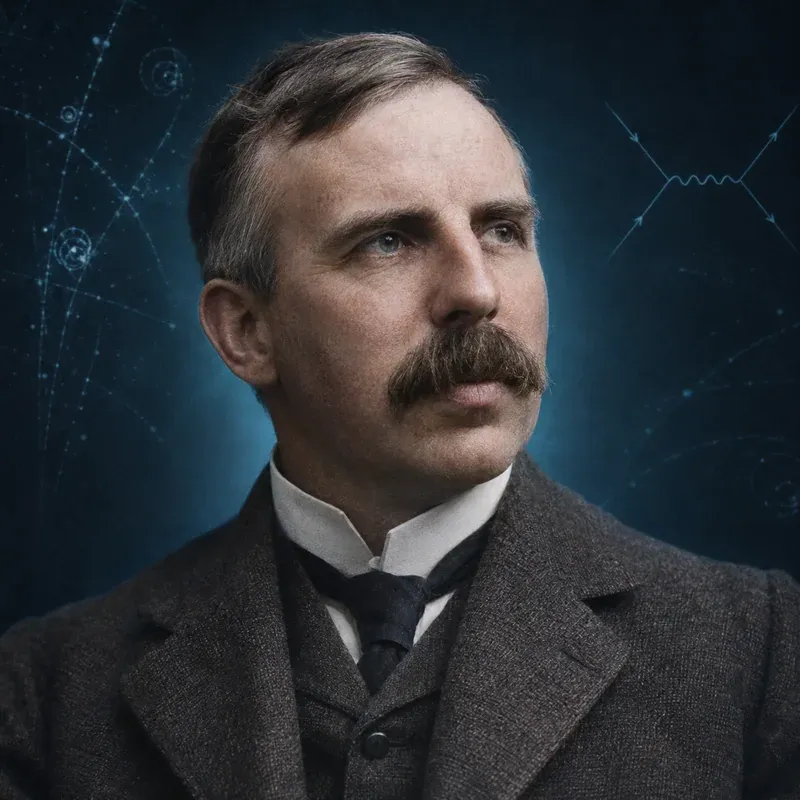
 Illustration
Ernest Rutherford
In 1899 Rutherford distinguished and named two kinds of uranium radiation, alpha and beta rays, establishing beta radiation as a subject of study. His work with Soddy at McGill showed that radioactivity is the spontaneous transmutation of atoms. As mentor of Chadwick, Ellis and Wooster and director of the Cavendish Laboratory, he oversaw the British side of the beta-spectrum investigations that led to the neutrino problem.
- Born
- 30 August 1871
Brightwater, New Zealand - Died
- 19 October 1937
Cambridge, England - Nationality
- New Zealander / British
- Field
- experimental physics
- Nobel Prize
- Chemistry 1908 – for his investigations into the disintegration of the elements, and the chemistry of radioactive substances
- Institutions
- McGill University, Victoria University of Manchester, University of Cambridge (Cavendish Laboratory)
Early life and education
Ernest Rutherford was born on 30 August 1871 in Brightwater, near Nelson, New Zealand, one of twelve children of a farming family. He studied at Canterbury College in Christchurch, earning BA, MA and BSc degrees between 1892 and 1894. In 1895 an 1851 Exhibition scholarship took him to the Cavendish Laboratory in Cambridge to work under J. J. Thomson, where he turned from radio waves to the newly discovered X-rays and uranium rays.
Naming beta rays
In 1898 Rutherford became professor of physics at McGill University in Montreal. In a long paper on uranium radiation published in 1899 he passed the radiation through increasing numbers of thin aluminium foils and found two distinct components: one stopped almost at once, the other far more penetrating. He called them alpha and beta rays; in 1903 he named a third, still more penetrating component gamma rays. Within a year Henri Becquerel showed that beta rays are bent by a magnetic field like cathode rays and are fast electrons.
Naming the radiations was more than a label. It separated beta decay as a phenomenon of its own, and the question of how much energy beta electrons carry became, three decades later, the problem that led to the neutrino.
Transmutation and the nucleus
At McGill, Rutherford and Frederick Soddy showed between 1900 and 1903 that radioactivity is the spontaneous transformation of one element into another and introduced the idea of the half-life. For this work Rutherford received the 1908 Nobel Prize in Chemistry. In 1907 he moved to Manchester, where the scattering experiments of Hans Geiger and Ernest Marsden led him in 1911 to propose that the atom's mass and positive charge sit in a tiny nucleus. Between 1917 and 1919 he produced the first artificial nuclear reaction, turning nitrogen into oxygen with alpha particles and releasing protons.
The Cavendish and the beta-spectrum problem
In 1919 Rutherford succeeded Thomson as Cavendish Professor in Cambridge, a post he held until his death. He made the laboratory the centre of British nuclear physics. In his 1920 Bakerian Lecture he suggested that the nucleus might contain a neutral particle of about the proton's mass, the neutron that his former student James Chadwick found in 1932.
The beta-spectrum investigations of the 1920s were carried out largely by his group. Charles Ellis explained the line spectra as internal conversion and, with Rutherford's research student William Wooster, measured in 1927 the average energy released in radium E decays. Their result showed that beta electrons leave the nucleus with a continuous range of energies, the observation that prompted Wolfgang Pauli to propose the neutrino in 1930. In the same year Rutherford, Chadwick and Ellis published "Radiations from Radioactive Substances", which summarised the state of the field.
Legacy
Rutherford was made Baron Rutherford of Nelson in 1931. He died in Cambridge on 19 October 1937 and was buried in Westminster Abbey. Many of his students, among them Chadwick, John Cockcroft, Ernest Walton, Patrick Blackett and Mark Oliphant, went on to shape twentieth-century physics, and element 104, rutherfordium, bears his name. For neutrino physics, his legacy is the experimental framework in which the puzzle of beta decay was first posed and then sharpened into a contradiction that only a new particle could resolve.
Known for
- Naming alpha and beta rays (1899)
- Theory of radioactive transmutation (with Soddy)
- Nuclear model of the atom (1911)
Chronology
- 1899Names alpha and beta rays
- 1903Names gamma rays
- 1908Nobel Prize in Chemistry
- 1911Nuclear model of the atom
- 1919Becomes director of the Cavendish Laboratory
Connected people
- Charles Drummond Ellis
- Henri Becquerel
- James Chadwick
- William Alfred Wooster
- Otto Hahn
- Alexander Ilyich Leipunsky
Frequently asked questions
What did Rutherford contribute to neutrino physics?
He did not work on the neutrino itself, but in 1899 he identified and named beta rays, and as director of the Cavendish Laboratory he oversaw the beta-spectrum experiments of Chadwick, Ellis and Wooster that led to Pauli's neutrino hypothesis.
Did Rutherford win a Nobel Prize?
Yes, the 1908 Nobel Prize in Chemistry, for his investigations into the disintegration of the elements and the chemistry of radioactive substances. His most famous discovery, the atomic nucleus, came three years later.
On the timeline
Mentioned in 14 pages
Lessons 1
Milestones 4
People 8
Terms 1
Last updated: · Editorial standard
Cite this page
Text
Neutrino Atlas (2026). “Ernest Rutherford”. Retrieved 22 November 2026, from https://neutrino-atlas.com/people/ernest-rutherford/BibTeX
@misc{neutrinoatlas2026peopleernestrutherford,
  title        = {Ernest Rutherford},
  author       = {{Neutrino Atlas}},
  year         = {2026},
  url          = {https://neutrino-atlas.com/people/ernest-rutherford/},
  note         = {Accessed 2026-11-22},
  language     = {english}
}