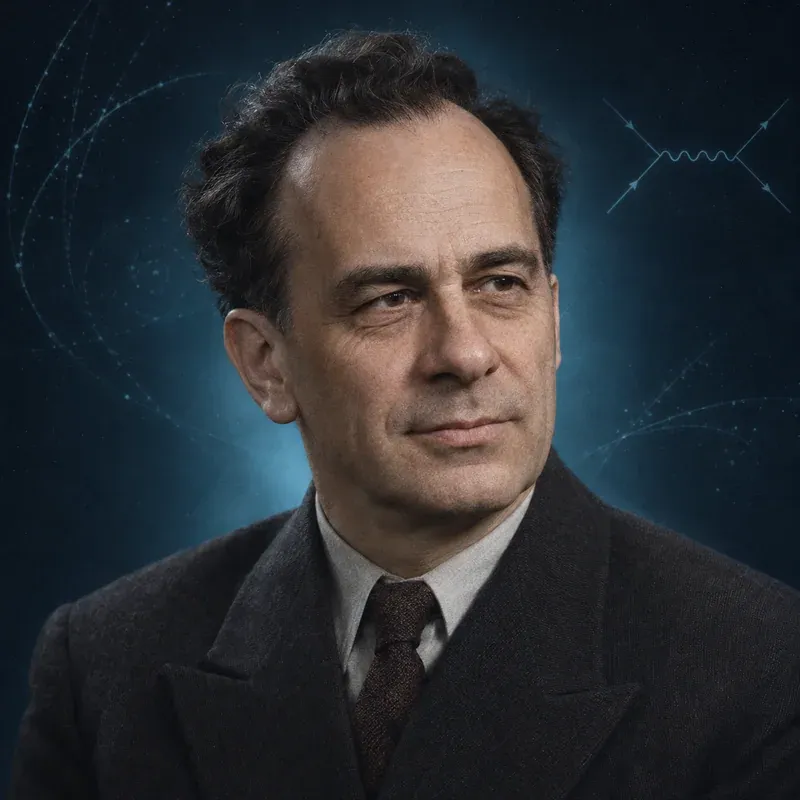
 Illustration
Alexander Ilyich Leipunsky
While visiting Rutherford's Cavendish Laboratory in 1934–1935, Leipunsky carried out the first experiment that tried to detect the neutrino through the recoil it gives to the emitting nucleus. Studying the positron decay of carbon-11, he compared the energy distribution of the recoiling nuclei with that expected if only the positron carried momentum away, and found the recoils inconsistent with a two-body decay. The result, published in 1936 in the Proceedings of the Cambridge Philosophical Society, was crude but is regarded as the first experimental evidence, indirect, for Pauli's neutrino. It opened a line of recoil experiments that culminated in James Allen's beryllium-7 measurement of 1942.
- Born
- 7 December 1903
Drahli, Grodno Governorate, Russian Empire - Died
- 14 August 1972
Moscow, USSR - Nationality
- Soviet
- Field
- Nuclear physics and reactor physics
- Institutions
- Leningrad Polytechnic Institute, Ukrainian Physical-Technical Institute (UFTI), Kharkiv, Cavendish Laboratory, Cambridge, Institute of Physics, Ukrainian Academy of Sciences, Kyiv
Early life and Kharkiv
Alexander Leipunsky was born on 7 December 1903 in the village of Drahli in the Grodno governorate of the Russian Empire, into a Jewish family. He studied at the Petrograd (later Leningrad) Polytechnic Institute from 1921, graduated in 1926 and did his first research at the Leningrad Physical-Technical Institute on collisions of electrons with atoms and molecules. In 1928–1929 he moved to Kharkiv to help build up the new Ukrainian Physical-Technical Institute (UFTI), the institute where Lev Landau soon headed the theoretical department. In 1932 Leipunsky, Anton Walter, Kirill Sinelnikov and Georgii Latyshev became the first in the USSR to split lithium nuclei with accelerated protons, repeating the Cockcroft–Walton experiment of the same year. He was director of UFTI from 1933 until September 1937 and a full member of the Ukrainian Academy of Sciences from 1934.
The recoil experiment
By the early 1930s Wolfgang Pauli had proposed and Enrico Fermi had built into a theory a light neutral particle that would carry off the missing energy of beta decay. Such a particle could not be detected directly, but it should leave a trace in the motion of the nucleus left behind. If an electron or positron were the only particle emitted, the daughter nucleus would recoil with exactly the opposite momentum; if a neutrino shares the momentum, recoil and electron momenta no longer match.
During a stay in Ernest Rutherford's laboratory in Cambridge in 1934–1935, Leipunsky tested this with the positron emitter carbon-11, which decays into boron-11. He measured the energy distribution of the recoiling boron atoms and compared it with the distribution expected from the measured positron spectrum alone. The recoils did not match a two-body decay, and he concluded that an additional particle must be emitted. His paper, published in 1936 under the title "Determination of the energy distribution of recoil atoms during β decay and the existence of the neutrino", is generally cited as the first experiment to give evidence, indirect and with large uncertainties, for the neutrino.
Recoil studies became the main experimental approach to the neutrino for the next two decades. H. Richard Crane and J. Halpern studied recoils in the decay of chlorine-38 with a cloud chamber in the late 1930s, Wang Ganchang proposed in 1941–1942 to use electron capture in beryllium-7, which gives a single recoil energy, and James Allen carried out that measurement in 1942. Direct detection had to wait for the reactor experiment of Cowan and Reines in 1956.
Arrest, war and reactors
Leipunsky was removed as director of UFTI in 1937 during the purges that struck the institute, arrested in June 1938 and released for lack of evidence about two months later. After the war he directed the Institute of Physics of the Ukrainian Academy in Kyiv in 1944 and worked there until 1952. From 1949 he helped build the Institute for Physics and Power Engineering in Obninsk, where he led the Soviet programme of liquid-metal fast breeder reactors that produced the BN-350 reactor; the institute now bears his name. He died on 14 August 1972 and was buried in Obninsk.
Known for
- First recoil experiment on beta decay supporting the neutrino (published 1936)
- First disintegration of lithium by accelerated protons in the USSR (1932)
- Director of UFTI in Kharkiv (1933–1937)
- Founder of the Soviet fast-breeder reactor programme at Obninsk
Chronology
- 1926Graduates from the Leningrad Polytechnic Institute
- 1932Lithium disintegration with accelerated protons at UFTI
- 1933Director of UFTI, Kharkiv (to 1937)
- 1934Visiting scientist at the Cavendish Laboratory; full member of the Ukrainian Academy of Sciences
- 1936Publishes the recoil study of carbon-11 beta decay
- 1938Arrested and released after about two months
- 1949Begins work at Obninsk on fast reactors
Original papers
- A. I. Leipunski, Determination of the energy distribution of recoil atoms during β decay and the existence of the neutrino, Proc. Cambridge Philos. Soc. 32, 301 (1936)
Experiments
- Carbon-11 recoil experiment
Connected people
Frequently asked questions
What did Alexander Leipunsky show about the neutrino?
His 1936 study of recoiling nuclei in the positron decay of carbon-11 indicated that a third particle shares the momentum in beta decay, early indirect evidence for the neutrino.
Why is he also known in nuclear engineering?
From 1949 he led the Soviet fast-breeder reactor programme at Obninsk, and the Institute for Physics and Power Engineering there is named after him.
Mentioned in 1 page
Terms 1
Last updated: · Editorial standard
Cite this page
Text
Neutrino Atlas (2026). “Alexander Ilyich Leipunsky”. Retrieved 22 November 2026, from https://neutrino-atlas.com/people/alexander-leipunsky/BibTeX
@misc{neutrinoatlas2026peoplealexanderleipunsky,
  title        = {Alexander Ilyich Leipunsky},
  author       = {{Neutrino Atlas}},
  year         = {2026},
  url          = {https://neutrino-atlas.com/people/alexander-leipunsky/},
  note         = {Accessed 2026-11-22},
  language     = {english}
}