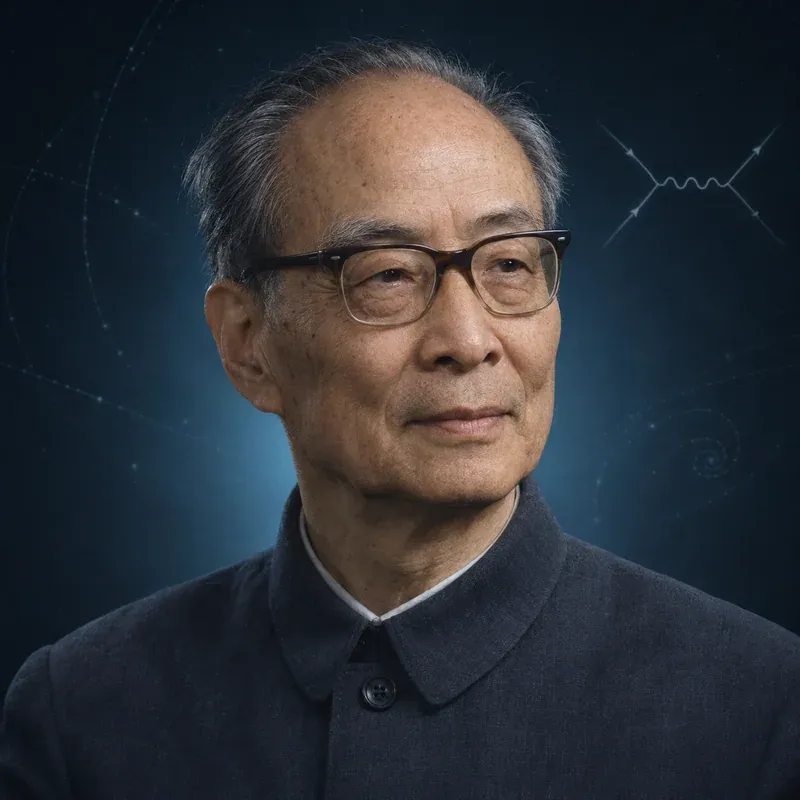
 Illustration
Wang Ganchang
In 1941, working in wartime China, Wang proposed the first practical test of the neutrino's existence: in K-electron capture, for example in beryllium-7, only a nucleus and a neutrino are emitted, so the recoiling nucleus must carry a fixed, measurable momentum equal and opposite to the neutrino's. He published the idea as 'A suggestion on the detection of the neutrino' in Physical Review in January 1942. James S. Allen carried out a first measurement along these lines the same year, and later recoil experiments confirmed the expected single recoil energy. These were the first experiments showing that the neutrino carries momentum, more than a decade before Cowan and Reines detected free neutrinos.
- Born
- 28 May 1907
Changshu, Jiangsu, China - Died
- 10 December 1998
Beijing, China - Nationality
- Chinese
- Field
- Experimental nuclear and particle physics
- Institutions
- Tsinghua University, University of Berlin (Kaiser Wilhelm Institute for Chemistry), Shandong University, Zhejiang University
Early life and education
Wang Ganchang (also written Kan-Chang Wang) was born in 1907 in Changshu in Jiangsu province. He graduated in physics from Tsinghua University in 1929 and in 1930 went to Berlin, where he worked with Lise Meitner at the Kaiser Wilhelm Institute for Chemistry. His doctoral thesis of 1934 dealt with the beta spectra of thorium decay products, exactly the continuous spectra that had led Wolfgang Pauli to postulate the neutrino. He returned to China the same year and taught at Shandong University and, from 1936, at Zhejiang University, which during the Sino-Japanese War moved repeatedly to escape the fighting.
How to catch a neutrino's recoil
By the late 1930s Fermi's theory of beta decay was widely accepted, but the neutrino had never been observed. In ordinary beta decay three bodies share the energy, so the recoil of the nucleus has no fixed value and is hard to interpret. Wang saw that electron capture avoids this problem. When a nucleus such as beryllium-7 captures one of its own K-shell electrons and becomes lithium-7, only two particles leave: the daughter atom and a neutrino. Conservation of momentum then demands that the atom recoils with a single, well-defined energy, small but measurable, opposite to the neutrino's direction. Observing that recoil would show that something invisible carries away momentum as well as energy.
Wartime conditions in China made the experiment impossible for him. He therefore sent the idea to Physical Review, where 'A suggestion on the detection of the neutrino' appeared in January 1942. Within months James S. Allen used beryllium-7 to make the first measurement of the recoil and found energies consistent with neutrino emission, although the resolution was limited. An improved experiment by Rodeback and Allen in 1952, using electron capture in argon-37, observed the expected single recoil energy. These recoil studies were the main experimental evidence for the neutrino until the Cowan–Reines experiment detected free antineutrinos in 1956.
Particle physics at Dubna
After 1950 Wang helped build up nuclear physics at the Institute of Modern Physics of the Chinese Academy of Sciences, of which he became deputy director. In 1956 he went to the newly founded Joint Institute for Nuclear Research in Dubna, serving as its vice-director from 1958 to 1960. There his group used a propane bubble chamber at the 10 GeV synchrophasotron and, after analysing some 40,000 photographs, identified the anti-sigma-minus hyperon, an early example of a newly observed antiparticle. The discovery was announced in 1960.
Nuclear weapons and fusion
Returning to China at the end of 1960, Wang left particle physics for about seventeen years to join the nuclear weapons programme. He directed large numbers of implosion experiments and led China's first underground nuclear test in 1969. In 1964 he proposed using high-power lasers to compress fusion fuel, an idea developed independently by Nikolai Basov in the Soviet Union, and he is regarded as the founder of laser-driven inertial confinement fusion research in China. In 1986 he was one of four senior scientists whose proposal led to China's national high-technology programme. He died in Beijing in 1998 and was posthumously awarded the Two Bombs, One Satellite Merit Medal in 1999.
Known for
- Proposal to detect the neutrino through K-capture recoil (1941/42)
- Discovery of the anti-sigma-minus hyperon at Dubna (1959–60)
- Leading role in China's nuclear weapons programme
- Proposal of laser-driven inertial confinement fusion in China (1964)
Chronology
- 1934PhD in Berlin under Lise Meitner on beta spectra
- 1941Proposes detecting the neutrino via K-capture recoil
- 1942Proposal published in Physical Review; Allen's first recoil measurement
- 1959Group at Dubna finds the anti-sigma-minus hyperon
- 1964Proposes laser-driven inertial confinement fusion
- 1969Leads China's first underground nuclear test
Original papers
- K. C. Wang, A suggestion on the detection of the neutrino, Phys. Rev. 61, 97 (1942)DOI 10.1103/PhysRev.61.97
Experiments
- Allen recoil experiment
Connected people
Frequently asked questions
What did Wang Ganchang propose about the neutrino?
That its existence could be tested by measuring the recoil of a nucleus after K-electron capture, a two-body decay in which the nucleus must recoil against a single neutrino with a fixed energy. He published the proposal in Physical Review in 1942.
Who carried out the experiment?
James S. Allen made the first measurement with beryllium-7 in 1942. A more precise recoil measurement with argon-37 followed in 1952.
Was this the discovery of the neutrino?
It was indirect evidence: it showed that an unseen particle carries momentum. The neutrino itself was first detected in 1956 by Cowan and Reines through inverse beta decay.
Mentioned in 4 pages
Last updated: · Editorial standard
Cite this page
Text
Neutrino Atlas (2026). “Wang Ganchang”. Retrieved 22 November 2026, from https://neutrino-atlas.com/people/wang-ganchang/BibTeX
@misc{neutrinoatlas2026peoplewangganchang,
  title        = {Wang Ganchang},
  author       = {{Neutrino Atlas}},
  year         = {2026},
  url          = {https://neutrino-atlas.com/people/wang-ganchang/},
  note         = {Accessed 2026-11-22},
  language     = {english}
}