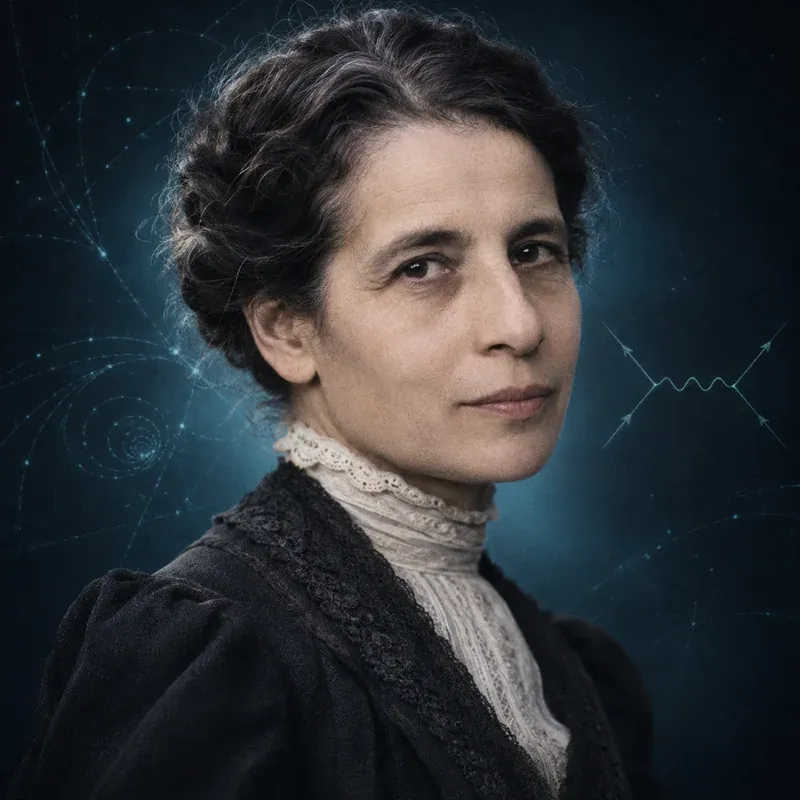
 Illustration
Lise Meitner
Meitner was the leading opponent of a primary continuous beta spectrum, arguing that electrons were emitted with discrete energies and lost energy by secondary processes. After Ellis and Wooster's 1927 calorimetric result, she repeated the measurement with Wilhelm Orthmann using an improved method and confirmed it in 1930, also showing that no compensating continuous gamma radiation existed. This made the 'missing energy' undeniable, and Pauli addressed his December 1930 neutrino letter to her and Hans Geiger.
- Born
- 7 November 1878
Vienna, Austria-Hungary - Died
- 27 October 1968
Cambridge, England - Nationality
- Austrian (Swedish from 1949)
- Field
- experimental nuclear physics
- Institutions
- University of Vienna, Kaiser Wilhelm Institute for Chemistry, Berlin, University of Berlin, KTH Royal Institute of Technology, Stockholm
Early life and education
Lise Meitner was born in Vienna on 7 November 1878. Girls in Austria could not then attend the academic secondary schools that led to university, so she prepared privately for the school-leaving examination and entered the University of Vienna in 1901, where Ludwig Boltzmann's lectures drew her to physics. In 1906 she became only the second woman to earn a doctorate in physics there.
Berlin and the study of beta rays
In 1907 Meitner went to Berlin to attend Max Planck's lectures and began working with the chemist Otto Hahn, a collaboration that lasted three decades. Women were not yet admitted to the chemistry institute's laboratories, so they began in a converted carpentry workshop. In 1912 both moved to the new Kaiser Wilhelm Institute for Chemistry, where Meitner headed her own physics section from 1917. With Hahn she identified protactinium in 1918; in 1922 she described the radiationless emission of atomic electrons now called the Auger–Meitner effect, and she became the first woman in Prussia to habilitate in physics. In 1926 she was appointed extraordinary professor at the University of Berlin, the first woman physics professor in Germany.
Much of her work concerned beta decay. With Hahn and Otto von Baeyer she recorded magnetic spectra of beta rays on photographic plates and found sharp lines. When James Chadwick showed in 1914 that these lines sit on a continuous distribution, Meitner remained convinced that the nucleus emits electrons of a single, definite energy, as quantum theory seemed to require. In her view the continuum was secondary, the result of electrons losing energy after leaving the nucleus. Through the 1920s she was the principal opponent of Charles Ellis in Cambridge, who held that the continuum was primary.
Confirming the missing energy
In 1927 Ellis and William Wooster measured the total heat released by radium E decays and found it equal to the mean energy of the continuous spectrum, not its maximum. Meitner did not accept this at once. With Wilhelm Orthmann she built an improved calorimeter, repeated the measurement and in 1930 confirmed the Cambridge result (Zeitschrift für Physik 60, 143). They also checked whether a continuous gamma radiation might carry the missing energy and found none.
Because the result came from the leading sceptic, it ended the debate: in a single beta decay, energy really did seem to disappear. On 4 December 1930 Wolfgang Pauli wrote his famous open letter beginning "Dear radioactive ladies and gentlemen" to a physics meeting in Tübingen, addressed to Meitner and Hans Geiger. In it he proposed a light, neutral particle emitted together with the electron, so that energy is conserved after all. That particle is the neutrino.
Exile and the explanation of fission
After 1933 Meitner, of Jewish descent, lost her teaching right, and the annexation of Austria in 1938 left her without protection. In July 1938 she escaped to the Netherlands and went on to Stockholm. In December, Hahn and Fritz Strassmann wrote to her that bombarding uranium with neutrons produced barium. Over Christmas, with her nephew Otto Frisch, she worked out that the uranium nucleus had split into two and released about 200 MeV, an energy that matched the mass difference. Their paper in Nature in February 1939 named the process fission.
Fission links her twice to neutrino physics. The neutron-rich fragments decay by beta emission, so every nuclear reactor is an intense source of electron antineutrinos, about six per fission. It was with a reactor that Clyde Cowan and Frederick Reines first detected the neutrino in 1956, and reactor antineutrinos remain central to oscillation measurements.
Recognition
Hahn alone received the 1944 Nobel Prize in Chemistry for fission; Meitner was nominated many times for both chemistry and physics but never awarded. She worked at the Royal Institute of Technology in Stockholm until 1960, took Swedish citizenship in 1949, and received the Max Planck Medal (1949) and, with Hahn and Strassmann, the Enrico Fermi Award (1966). She died in Cambridge on 27 October 1968. Element 109, meitnerium, was named after her in 1997. Her gravestone, with words chosen by Frisch, reads: "Lise Meitner: a physicist who never lost her humanity."
Known for
- Beta- and gamma-ray spectroscopy with Otto Hahn
- Meitner–Orthmann calorimetry (1930)
- Theoretical explanation of nuclear fission (1938–39)
- Addressee of Pauli's neutrino letter
Chronology
- 1912Joins Kaiser Wilhelm Institute for Chemistry with Otto Hahn
- 1922Debate with Ellis over primary vs. secondary beta electrons (1920s)
- 1930Meitner–Orthmann calorimetry confirms Ellis–Wooster
- 1930Addressee of Pauli's 4 December letter
- 1938Flees Nazi Germany; with Frisch explains fission
Original papers
- L. Meitner, W. Orthmann, Z. Phys. 60, 143 (1930)
Connected people
- Charles Drummond Ellis
- James Chadwick
- Otto Hahn
- William Alfred Wooster
- Wolfgang Pauli
- Niels Bohr
- Wang Ganchang
Frequently asked questions
Why did Pauli address his neutrino letter to Lise Meitner?
Meitner was the leading expert on beta rays in Germany and the most prominent defender of the view that beta electrons have a single energy. Her 1930 measurement with Orthmann had just confirmed that energy seemed to be missing, so she was the natural person to receive Pauli's proposed solution.
Did Lise Meitner win a Nobel Prize?
No. Otto Hahn alone received the 1944 Nobel Prize in Chemistry for nuclear fission, which Meitner and Frisch had explained. She was nominated many times but never awarded.
Was Meitner right or wrong about the beta spectrum?
She was wrong in thinking the continuum was secondary, but her careful repetition of the Ellis–Wooster experiment settled the question. Her insistence on a single decay energy was right in spirit: the total energy is fixed, and the neutrino takes the share the electron does not.
On the timeline
- 1914Chadwick finds the beta spectrum is continuous
- 1927Calorimetry confirms missing energy in beta decay
- 1930Pauli proposes a new neutral particle
Mentioned in 15 pages
Lessons 1
Milestones 4
People 8
Last updated: · Editorial standard
Cite this page
Text
Neutrino Atlas (2026). “Lise Meitner”. Retrieved 22 November 2026, from https://neutrino-atlas.com/people/lise-meitner/BibTeX
@misc{neutrinoatlas2026peoplelisemeitner,
  title        = {Lise Meitner},
  author       = {{Neutrino Atlas}},
  year         = {2026},
  url          = {https://neutrino-atlas.com/people/lise-meitner/},
  note         = {Accessed 2026-11-22},
  language     = {english}
}