1930Theory
Pauli proposes a new neutral particle
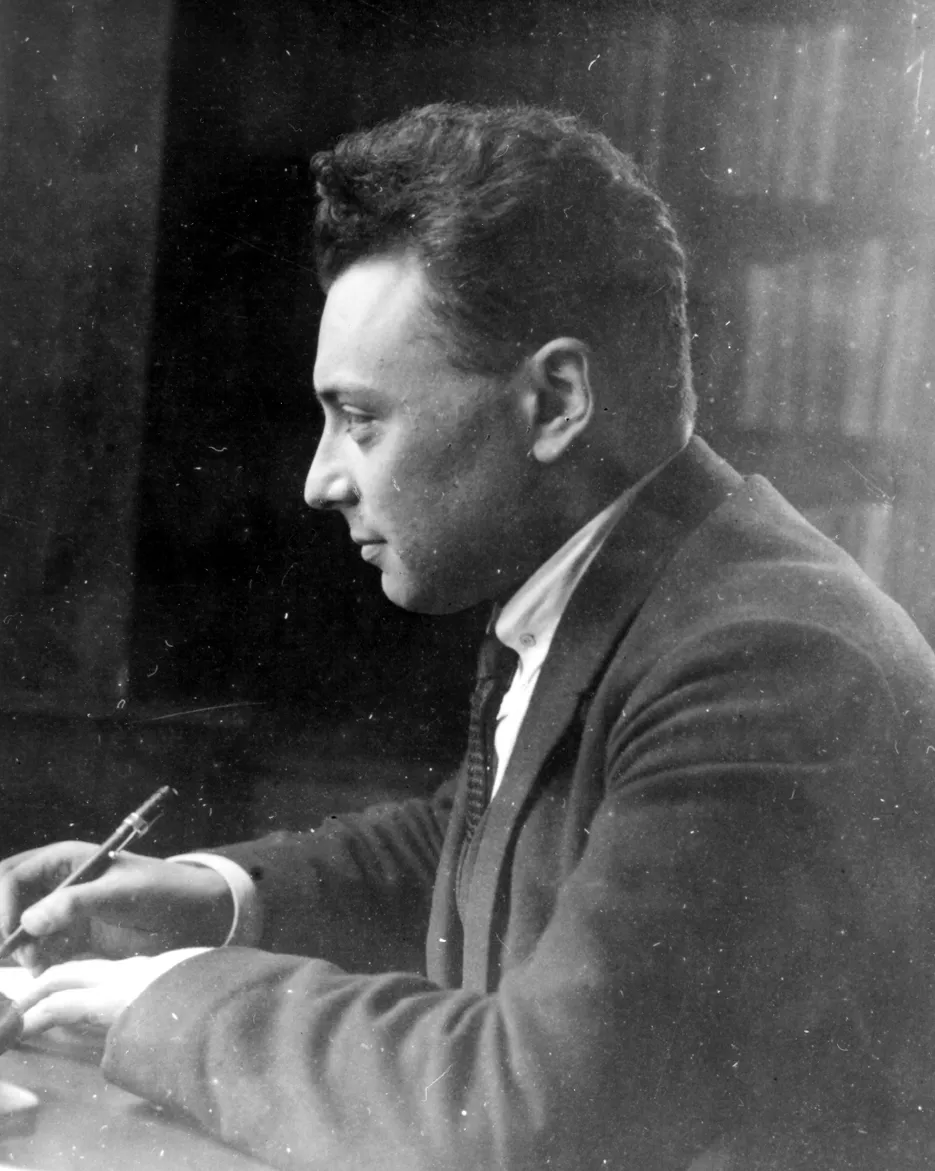
In a letter dated 4 December 1930 to the 'radioactive ladies and gentlemen' meeting in Tübingen, Wolfgang Pauli proposed a 'desperate remedy': a light, electrically neutral spin-1/2 particle emitted together with the electron in beta decay. It would carry away the missing energy and save both energy conservation and the spin-statistics of nuclei. Pauli called it the 'neutron' and doubted it could ever be detected. The proposal was an alternative to Niels Bohr's suggestion that energy might not be conserved in nuclear processes.
- Date
- 4 December 1930
- Kind of event
- Theory
- People involved
- Wolfgang Pauli, Lise Meitner, Niels Bohr
The situation before
By 1930 two experimental facts had become impossible to ignore. Beta electrons emerge with a continuous range of energies, and the calorimetric measurements of Charles Ellis and William Wooster, just confirmed by Lise Meitner, showed that the missing energy truly vanishes. A second problem concerned spin. In the nuclear model of the time, built from protons and electrons, nitrogen-14 would contain 21 particles of spin 1/2 and should therefore have half-integer spin; molecular spectra showed it has integer spin. Niels Bohr was willing to give up exact energy conservation in nuclear processes.
What happened
On 4 December 1930 Wolfgang Pauli, then professor at the ETH Zurich, wrote an open letter to a group of physicists meeting in Tübingen, sent via Meitner and Hans Geiger. It began "Liebe Radioaktive Damen und Herren" ("Dear radioactive ladies and gentlemen"). Pauli explained that he could not attend because of a ball in Zurich, and then described what he called a desperate remedy.
He proposed that nuclei contain electrically neutral particles of spin 1/2 that obey the exclusion principle. Their mass should be of the same order as the electron mass and in any case not larger than 0.01 proton masses. In beta decay one of them would be emitted together with the electron, so that the sum of the two energies is constant. That would explain the continuous spectrum without giving up energy conservation, and the extra spin-1/2 particles in the nucleus would also fix the spin of nitrogen-14. He called the particles "neutrons" and admitted that he did not yet dare to publish the idea.
- Date: 4 December 1930, letter from Zurich to the meeting in Tübingen.
- Properties proposed: neutral, spin 1/2, mass not above 1 percent of the proton mass.
- Purpose: rescue energy conservation in beta decay and the spin-statistics of nuclei.
Reaction
The letter circulated privately, and Pauli presented the idea in talks, including at a meeting of the American Physical Society in Pasadena in June 1931, but he published nothing. Bohr remained sceptical. The picture changed in 1932, when James Chadwick discovered the heavy neutron, which took over the name. Enrico Fermi began calling Pauli's light particle the neutrino, and at the Solvay Conference of October 1933 Pauli finally stated his hypothesis in public.
Why it matters
The letter is the birth certificate of the neutrino. Its central idea, that a light neutral particle shares the energy in beta decay, survived intact; the claim that the particle sits inside the nucleus did not, because Fermi's theory of 1933–1934 showed that neutrino and electron are created at the moment of decay. Pauli doubted his particle could ever be observed. Clyde Cowan and Frederick Reines detected it at the Savannah River reactor in 1956 and sent Pauli a telegram.
Frequently asked questions
When did Pauli propose the neutrino?
In a letter dated 4 December 1930 to physicists meeting in Tübingen.
What did Pauli call the particle?
He called it the "neutron". After Chadwick discovered the heavy neutron in 1932, Fermi's name "neutrino" took over.
Why was it called a desperate remedy?
Postulating an unseen particle was a drastic step in 1930. The alternative under discussion, giving up energy conservation in nuclear processes, seemed even worse to Pauli.
Original papers
- ProposalW. Pauli, Open letter to the group of radioactive people at the Gauverein meeting in Tübingen ("Liebe Radioaktive Damen und Herren"), 4 December 1930; reprinted in L. M. Brown, Physics Today 31(9), 23 (1978)
Concepts
Mentioned in 3 pages
Last updated: · Editorial standard
Cite this page
Text
Neutrino Atlas (2026). “1930: Pauli proposes a new neutral particle”. Retrieved 22 November 2026, from https://neutrino-atlas.com/timeline/1930-pauli-letter/BibTeX
@misc{neutrinoatlas2026timeline1930pauliletter,
  title        = {1930: Pauli proposes a new neutral particle},
  author       = {{Neutrino Atlas}},
  year         = {2026},
  url          = {https://neutrino-atlas.com/timeline/1930-pauli-letter/},
  note         = {Accessed 2026-11-22},
  language     = {english}
}