1933Theory
Fermi's theory of beta decay
In December 1933 Enrico Fermi published a quantitative theory of beta decay in which a neutron turns into a proton while creating an electron and a neutrino at a single point, modelled on the emission of photons in electromagnetism. Fuller versions appeared in 1934 in Il Nuovo Cimento and Zeitschrift für Physik after Nature declined the paper. The theory predicted the shape of beta spectra and introduced the weak coupling constant now called the Fermi constant. It remains the low-energy limit of the modern electroweak theory.
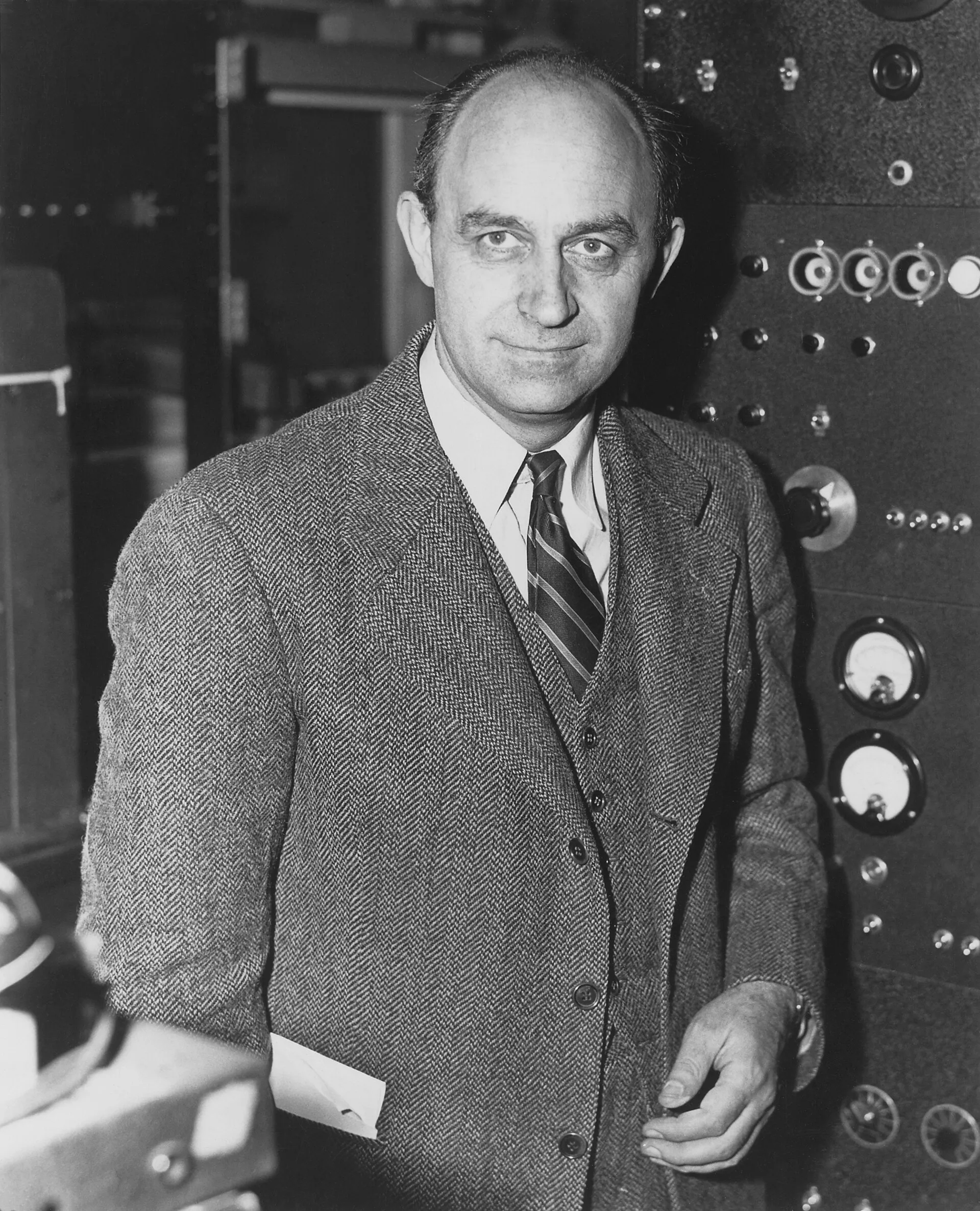
- Date
- 1933
- Kind of event
- Theory
- People involved
- Enrico Fermi
The situation before
After the Solvay Conference of October 1933, Wolfgang Pauli's neutrino was a plausible idea but not a theory. Nobody could calculate how fast a given nucleus should decay or what its electron spectrum should look like. A conceptual obstacle remained as well: if electrons and neutrinos are not stored inside nuclei, where do they come from? In Rome, Enrico Fermi, then 32 and leading a small group at the physics institute on Via Panisperna, took up the problem directly after returning from Brussels.
What happened
Fermi took his model from the quantum theory of light. An excited atom does not contain a photon; it creates one at the moment of the transition. In the same way, he proposed, a neutron inside the nucleus turns into a proton and at that instant creates an electron and a neutrino. He wrote the interaction as four particle fields meeting at a single point, with one new constant setting its strength. This is now called the Fermi constant; its smallness compared with electromagnetism is why beta decays are slow and neutrinos interact so rarely. The approach became the Fermi theory of the weak interaction.
A short note, "Tentativo di una teoria dell'emissione dei raggi β", appeared in La Ricerca Scientifica in December 1933. Nature declined an English version as too speculative. Full papers followed in early 1934 in Il Nuovo Cimento and, in German, as "Versuch einer Theorie der β-Strahlen" in the Zeitschrift für Physik, volume 88.
Reaction
The theory explained the continuous spectrum as the result of sharing energy among electron, neutrino and recoiling nucleus, and it related decay rates to the maximum energy, matching empirical patterns found by Bernard Sargent. Within months it was in use across nuclear physics. In 1936 George Gamow and Edward Teller extended it to transitions in which the nuclear spin changes. Fermi himself turned almost immediately to experiments and in 1934 discovered radioactivity induced by neutrons, work that brought him the Nobel Prize in 1938.
Why it matters
Fermi's theory turned the neutrino from a bookkeeping device into a particle with calculable behaviour. It allowed Hans Bethe and Rudolf Peierls to estimate in 1934 how rarely a neutrino would interact, and it underlies every later prediction of neutrino rates from reactors, the Sun and supernovae. The point-like interaction later had to be modified to include parity violation (1956–1958), and in the electroweak theory of the 1960s it emerged as the low-energy limit of W-boson exchange. Its constant, measured today with high precision in muon decay, is still the basic scale of weak processes.
Frequently asked questions
When did Fermi publish his theory of beta decay?
A short note appeared in La Ricerca Scientifica in December 1933, followed by full papers in Il Nuovo Cimento and the Zeitschrift für Physik in 1934.
Why did Nature reject the paper?
The editors considered it too speculative and remote from physical reality, so Fermi published in Italian and German journals instead.
Is Fermi's theory still used?
Yes, as an effective theory valid at energies far below the W-boson mass. Calculations of reactor antineutrino detection and many beta spectra still start from it.
Original papers
- TheoryE. Fermi, Tentativo di una teoria dei raggi β, Nuovo Cimento 11, 1 (1934)DOI 10.1007/BF02959820
- TheoryE. Fermi, Versuch einer Theorie der β-Strahlen. I, Z. Phys. 88, 161 (1934)DOI 10.1007/BF01351864
Concepts
Mentioned in 2 pages
Last updated: · Editorial standard
Cite this page
Text
Neutrino Atlas (2026). “1933: Fermi's theory of beta decay”. Retrieved 22 November 2026, from https://neutrino-atlas.com/timeline/1933-fermi-beta-decay-theory/BibTeX
@misc{neutrinoatlas20261933fermibetadecaytheory,
  title        = {1933: Fermi's theory of beta decay},
  author       = {{Neutrino Atlas}},
  year         = {2026},
  url          = {https://neutrino-atlas.com/timeline/1933-fermi-beta-decay-theory/},
  note         = {Accessed 2026-11-22},
  language     = {english}
}