1932Discovery
Discovery of the neutron renames Pauli's particle
James Chadwick identified a heavy neutral particle in the nucleus, the neutron, and announced it in Nature in February 1932. Because the name Pauli had used was now taken by a particle far too heavy to explain beta decay, Enrico Fermi began calling Pauli's light particle the 'neutrino', Italian for 'little neutral one'. The neutron also made it possible to view beta decay as the transformation of a neutron into a proton inside the nucleus.
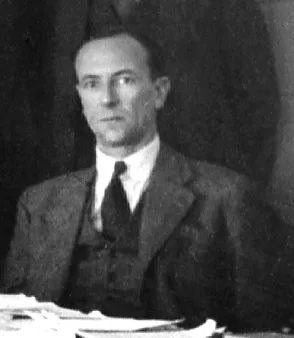
- Date
- 27 February 1932
- Kind of event
- Discovery
- People involved
- James Chadwick, Enrico Fermi, Wolfgang Pauli
The situation before
Around 1930 the atomic nucleus was thought to consist of protons and electrons. The model had obvious problems: electrons confined in a nucleus would need enormous energies, and nuclear spins such as that of nitrogen-14 came out wrong. Ernest Rutherford had speculated in 1920 about a neutral particle formed by a proton and an electron, and his colleague James Chadwick had searched for it at the Cavendish Laboratory for years without success. Wolfgang Pauli's light neutral particle of December 1930 was a separate idea, still unpublished, which he too called a "neutron".
What happened
In 1930 Walther Bothe and Herbert Becker in Germany found that beryllium bombarded with alpha particles from polonium emits a very penetrating, neutral radiation, which they took to be gamma rays. In January 1932 Irène Curie and Frédéric Joliot in Paris reported that this radiation knocks protons out of paraffin wax with high energy. To explain that with gamma rays, the photons would need energies of around 50 MeV, far more than any known nuclear process could provide.
Chadwick read the Paris report and repeated the experiment within about two weeks. With an ionisation chamber and amplifier he measured the recoils that the radiation produced not only in hydrogen but also in helium, nitrogen and other light nuclei. The gamma-ray hypothesis could not explain the recoil energies consistently. A neutral particle with roughly the mass of the proton could. In a letter to Nature dated 17 February 1932 and published on 27 February under the title "Possible existence of a neutron", he proposed exactly that. A full account, "The existence of a neutron", followed in the Proceedings of the Royal Society A in May 1932.
- 1930: Bothe and Becker find a penetrating neutral radiation from beryllium.
- January 1932: Curie and Joliot show it ejects energetic protons from paraffin.
- February 1932: Chadwick's letter to Nature identifies a neutral particle of about the proton mass.
- 1935: Nobel Prize in Physics for Chadwick "for the discovery of the neutron".
Reaction
The interpretation was accepted quickly, because it resolved the beryllium puzzle and the old difficulties of the proton-electron nucleus. In the same year Werner Heisenberg, and independently Dmitri Ivanenko, described nuclei as built from protons and neutrons. Whether the neutron itself was an elementary particle or a tightly bound proton-electron pair remained under discussion for a few years.
A new name for Pauli's particle
Chadwick's neutron weighed about as much as a proton, roughly a hundred times more than the upper limit Pauli had set for his own particle. It could not explain the missing energy in beta decay. In discussions in Rome, Enrico Fermi began to call Pauli's light particle the neutrino, an Italian diminutive meaning roughly "little neutral one". The name was in use by the time Pauli presented his idea publicly at the Solvay Conference in October 1933.
Why it matters
The neutron gave beta decay a clear mechanism. Instead of electrons stored inside nuclei, beta decay could now be understood as a neutron turning into a proton, with an electron and a neutrino created in the process. Fermi built his theory of beta decay on this picture at the end of 1933. The neutron also became the key to nuclear fission in 1938 and hence to nuclear reactors, which in 1956 provided the intense antineutrino flux with which Clyde Cowan and Frederick Reines first detected Pauli's particle. In their detector the signal was again a neutron, produced by inverse beta decay.
Frequently asked questions
When was the neutron discovered?
James Chadwick announced it in a letter to Nature published on 27 February 1932, based on experiments carried out in the preceding weeks at the Cavendish Laboratory in Cambridge.
Is Chadwick's neutron the same as Pauli's particle?
No. Pauli's particle was meant to be very light; Chadwick's neutron has about the mass of a proton. Fermi's name "neutrino" distinguished the light particle from the heavy neutron.
Why was the neutron important for neutrino physics?
It turned beta decay into the transformation of a neutron into a proton, the basis of Fermi's theory, and it led to the fission reactors that supplied the first detected neutrinos.
Original papers
- DiscoveryJ. Chadwick, Possible Existence of a Neutron, Nature 129, 312 (1932)DOI 10.1038/129312a0
- DiscoveryJ. Chadwick, The existence of a neutron, Proc. R. Soc. Lond. A 136, 692 (1932)DOI 10.1098/rspa.1932.0112
Concepts
Mentioned in 1 page
Lessons 1
Last updated: · Editorial standard
Cite this page
Text
Neutrino Atlas (2026). “1932: Discovery of the neutron renames Pauli's particle”. Retrieved 22 November 2026, from https://neutrino-atlas.com/timeline/1932-chadwick-neutron/BibTeX
@misc{neutrinoatlas2026eline1932chadwickneutron,
  title        = {1932: Discovery of the neutron renames Pauli's particle},
  author       = {{Neutrino Atlas}},
  year         = {2026},
  url          = {https://neutrino-atlas.com/timeline/1932-chadwick-neutron/},
  note         = {Accessed 2026-11-22},
  language     = {english}
}