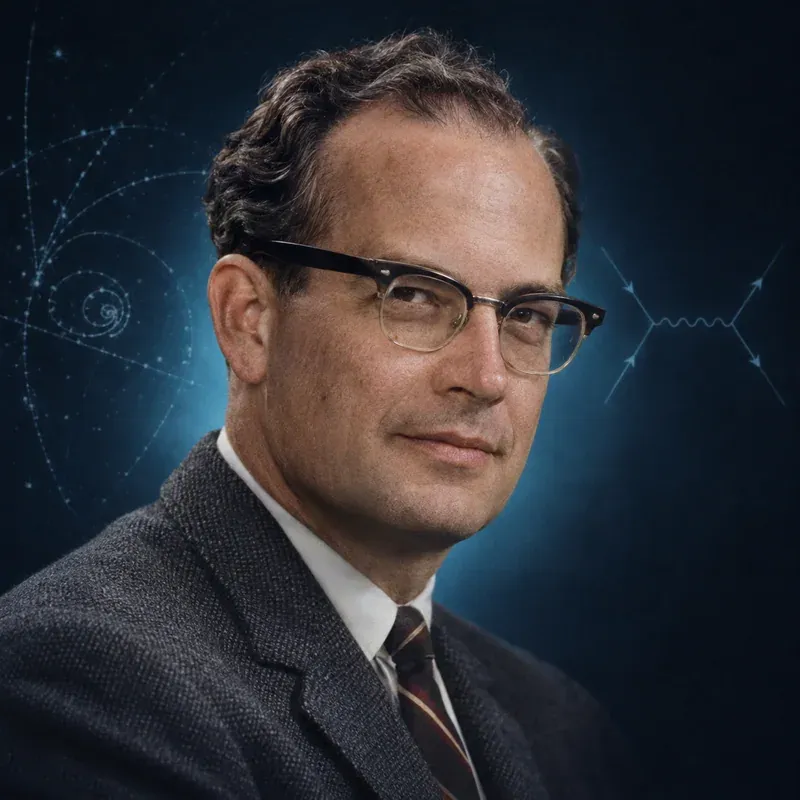
 Illustration
Clyde L. Cowan Jr.
Cowan was Reines's partner at Los Alamos from 1951 in the project to detect the free neutrino through inverse beta decay of reactor antineutrinos. After the inconclusive 1953 Hanford run, they observed the signal at the Savannah River reactor and published the confirmation in Science on 20 July 1956. In 1957 they also tested whether neutrino and antineutrino are identical. He died in 1974 and so could not share the 1995 Nobel Prize awarded to Reines.
- Born
- 6 December 1919
Detroit, Michigan, USA - Died
- 24 May 1974
Bethesda, Maryland, USA - Nationality
- American
- Field
- experimental physics
- Institutions
- Washington University in St. Louis, Los Alamos Scientific Laboratory, George Washington University, The Catholic University of America
Early life and education
Clyde Lorrain Cowan Jr. was born in Detroit in 1919, the eldest of four children, and grew up in St. Louis, Missouri. He studied chemical engineering at the Missouri School of Mines and Metallurgy in Rolla, where he also edited the student newspaper, and graduated in 1940. His training was practical and industrial rather than theoretical, and that background later shaped the way he approached one of the hardest measurements in twentieth-century physics: as an engineering problem of signal, noise and shielding.
When the United States entered the Second World War, Cowan joined the Army Chemical Warfare Service. He was posted to England with the Eighth Air Force in 1942, worked from 1944 with the British branch of the MIT Radiation Laboratory on radar, and served as a liaison officer with the Royal Air Force. He left active duty in 1946 as a captain, having received the Bronze Star. With support from the G.I. Bill he then took a master’s degree and, in 1949, a PhD at Washington University in St. Louis.
Path to neutrino physics
After his doctorate Cowan joined the Los Alamos Scientific Laboratory, where he met Frederick Reines. In 1951 the two decided to attempt something that Wolfgang Pauli himself had thought might be impossible: to catch a free neutrino. The particle had been proposed in 1930 to save energy conservation in beta decay, but its interaction probability is so small that it can cross a light-year of lead with a good chance of not interacting at all.
Their first idea was to use the intense neutrino flash from a nuclear explosion. They soon switched to a fission reactor, which produces a steady, enormous flux of electron antineutrinos. The process they chose to look for was inverse beta decay: an antineutrino strikes a proton and produces a positron and a neutron.
Key contributions
The central trick of the Cowan–Reines experiment was a double signature. The positron annihilates almost immediately and produces a prompt flash of gamma rays; the neutron wanders for a few microseconds before it is captured, here on cadmium dissolved in the target water, and releases a second gamma flash. Requiring both signals in the right time window, a delayed coincidence, separates real neutrino events from most of the background. The gamma rays were recorded in tanks of liquid scintillator viewed by photomultipliers.
A first run at the Hanford reactor in 1953 gave only a hint, because cosmic rays produced too many false coincidences. Cowan and Reines rebuilt the apparatus, moved it to the new Savannah River reactor in South Carolina in 1955, and placed it deeper underground and better shielded. By June 1956 the signal was clear: it depended on whether the reactor was running, and it behaved as inverse beta decay should. On 14 June they cabled Pauli that they had definitely detected neutrinos from fission fragments, with a cross-section in good agreement with the expected value of about 6 × 10⁻⁴⁴ cm². The confirmation paper, with F. B. Harrison, H. W. Kruse and A. D. McGuire, appeared in Science on 20 July 1956.
In 1957 Cowan and Reines also used reactor data to test whether the neutrino and the antineutrino are the same particle, a question closely related to lepton number and later to the Dirac versus Majorana debate.
Later work
Cowan left Los Alamos in 1957 for George Washington University and in 1958 moved to The Catholic University of America in Washington, D.C., where he taught and did research until his death. He held a Guggenheim Fellowship in 1957 and consulted for the Atomic Energy Commission, the Naval Ordnance Laboratory and the Smithsonian Institution, among others.
Legacy
Cowan died of a heart attack in Bethesda, Maryland, on 24 May 1974, at the age of 54, and was buried in Arlington National Cemetery. When the 1995 Nobel Prize in Physics was awarded to Reines for the detection of the neutrino, Cowan could not be included, because the prize is not awarded posthumously. The method the two developed is still the standard way of detecting reactor antineutrinos: KamLAND, Daya Bay and JUNO all rely on inverse beta decay and a delayed neutron signal.
Known for
- Co-discoverer of the neutrino (1956)
- Cowan–Reines experiment
- Test of neutrino–antineutrino identity (1957)
Chronology
- 1951Begins neutrino-detection project with Reines
- 1953Hanford reactor experiment
- 1956Detection at Savannah River; Science paper 20 July
- 1958Joins The Catholic University of America
Original papers
- C.L. Cowan et al., Detection of the free neutrino: a confirmation, Science 124, 103 (1956)DOI 10.1126/science.124.3212.103
- C.L. Cowan, F. Reines, Test of neutrino-antineutrino identity, Phys. Rev. 106, 825 (1957)DOI 10.1103/PhysRev.106.825
Experiments
Connected people
Frequently asked questions
Why did Clyde Cowan not receive the Nobel Prize?
The 1995 Nobel Prize for the detection of the neutrino went to Frederick Reines. Cowan had died in 1974, and Nobel Prizes are not awarded posthumously.
How did Cowan and Reines detect the neutrino?
They placed a target of water and cadmium between liquid-scintillator tanks next to the Savannah River reactor and looked for inverse beta decay: a prompt positron signal followed microseconds later by a neutron-capture signal. The signal rose and fell with the reactor’s power.
When was the discovery published?
The result was cabled to Pauli on 14 June 1956 and published in Science on 20 July 1956 under the title “Detection of the free neutrino: a confirmation”.
On the timeline
- 1953Project Poltergeist at the Hanford reactor
- 1956Cowan and Reines detect the neutrino
- 1995Nobel Prize for neutrino detection
Mentioned in 40 pages
Lessons 5
Milestones 10
- 1930 · Pauli proposes a new neutral particle
- 1932 · Discovery of the neutron renames Pauli's particle
- 1934 · Bethe and Peierls estimate a tiny cross-section
- 1942 · First indirect evidence from nuclear recoil
- 1953 · Project Poltergeist at the Hanford reactor
- 1955 · Davis shows antineutrinos do not make argon
- 1956 · Cowan and Reines detect the neutrino
- 1960 · Proposals for accelerator neutrino beams
People 9
- Enrico Fermi
- Frederick Reines
- H. Richard Crane
- Hans Bethe
- Lise Meitner
- Niels Bohr
- Raymond Davis Jr.
- Rudolf Peierls
1 more
Terms 13
Last updated: · Editorial standard
Cite this page
Text
Neutrino Atlas (2026). “Clyde L. Cowan Jr.”. Retrieved 22 November 2026, from https://neutrino-atlas.com/people/clyde-cowan/BibTeX
@misc{neutrinoatlas2026peopleclydecowan,
  title        = {Clyde L. Cowan Jr.},
  author       = {{Neutrino Atlas}},
  year         = {2026},
  url          = {https://neutrino-atlas.com/people/clyde-cowan/},
  note         = {Accessed 2026-11-22},
  language     = {english}
}