Daya Bay
The Chinese–US reactor experiment that discovered non-zero θ₁₃ in 2012 and measured it most precisely.
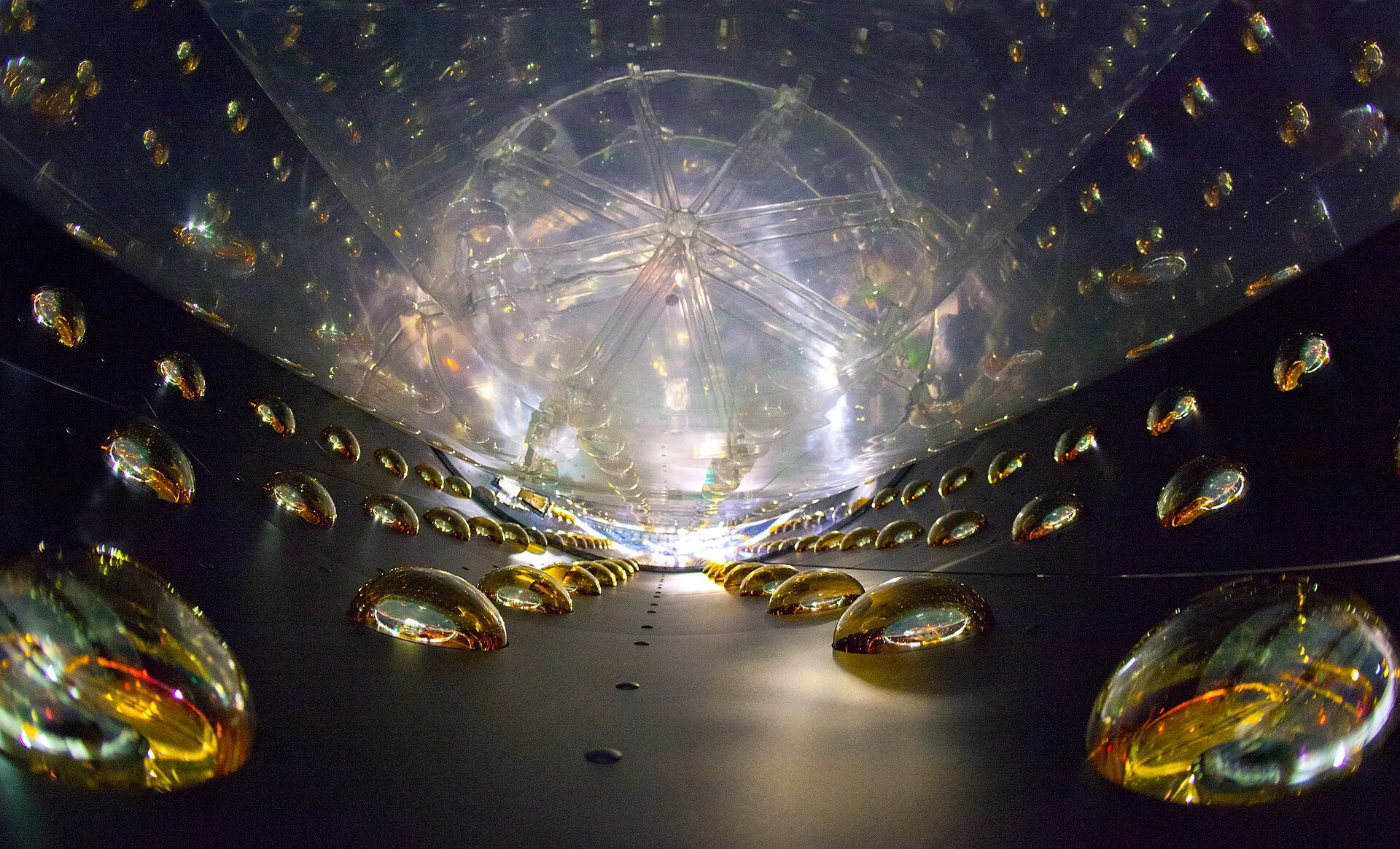
Eight identical 20-tonne Gd-doped scintillator detectors in three underground halls near six reactor cores measured relative ν̄e disappearance. In March 2012 it announced sin²2θ₁₃ ≠ 0 at 5.2σ. The final result is sin²2θ₁₃ = 0.0851 ± 0.0024. This discovery opened the way to CP-violation searches.
Compare all experiments → · World map →
In plain words
Daya Bay is the experiment that settled whether the third neutrino mixing angle is zero. It surrounded a cluster of powerful reactors on the coast of southern China with identical detectors, some near and some far, and compared their counts with a precision of a few parts per thousand. The far detectors saw about 6 percent fewer antineutrinos than the near ones predicted.
How the detector works
Six reactor cores of the Daya Bay and Ling Ao plants, each about 2.9 GW thermal, fed three underground experimental halls dug into the hills: two near halls a few hundred metres from the cores and a far hall at about 1.6 km under roughly 860 metres water equivalent of rock. Each antineutrino detector held 20 tonnes of gadolinium-doped liquid scintillator inside a 20-tonne undoped layer and a mineral-oil buffer with 192 photomultipliers. The detectors were immersed in water pools that served as Cherenkov muon vetoes and shielding. Because all detectors were built and filled the same way, their efficiencies matched to about 0.1 percent.
Key results
- 8 March 2012: discovery of electron-antineutrino disappearance, sin²2θ₁₃ = 0.092 ± 0.016 (stat) ± 0.005 (syst), excluding zero at 5.2σ (Physical Review Letters 108, 171803).
- Final result from 3158 days of data (2023): sin²2θ₁₃ = 0.0851 ± 0.0024, the most precise measurement of any mixing angle, and |Δm²₃₂| = (2.466 ± 0.060) × 10⁻³ eV² for normal ordering.
- Precise measurements of the reactor flux and spectrum, including the dependence on fuel composition and the 5 MeV bump.
- Searches for light sterile neutrinos, in part combined with MINOS+ and Bugey-3.
Why it matters for neutrino physics
A relatively large θ₁₃ was good news. Leptonic CP violation can only appear in oscillations if all three angles are non-zero, and its size scales with sin θ₁₃. The result made experiments like T2K, NOvA and DUNE feasible in their current form. The collaboration was led by Wang Yifang and Kam-Biu Luk, with Cao Jun among the leaders of detector design and analysis; Daya Bay shared the 2016 Breakthrough Prize in Fundamental Physics.
Status today
Data taking ended on 12 December 2020. Expertise and some techniques moved on to JUNO.
Frequently asked questions
Why did Daya Bay succeed before Double Chooz and RENO?
It combined the highest reactor power, large target masses and a deep far hall, and it ran near and far detectors from the start. That gave it more events and smaller systematic errors early on.
Is θ₁₃ now known well enough?
Yes for most purposes. Its uncertainty of under 3 percent is small compared with the remaining uncertainties on δCP and the octant of θ₂₃.
Original papers
- DiscoveryF. P. An et al. (Daya Bay Collaboration), Observation of electron-antineutrino disappearance at Daya Bay, Phys. Rev. Lett. 108, 171803 (2012)DOI 10.1103/PhysRevLett.108.171803
- Final resultF. P. An et al. (Daya Bay Collaboration), Precision Measurement of Reactor Antineutrino Oscillation at Kilometer-Scale Baselines by Daya Bay, Phys. Rev. Lett. 130, 161802 (2023)DOI 10.1103/PhysRevLett.130.161802
Related terms
People
- Arthur B. McDonald
- Atsuto Suzuki
- Kam-Biu Luk
- Kōichirō Nishikawa
- Takaaki Kajita
- Wang Yifang
- Gianluigi Fogli
- Yōichirō Suzuki
- Stephen J. Parke
- Cao Jun (Jun Cao)
- Guido Altarelli
Latest research on this topic
- On the Nonlinear Dependence of Underground Muon Rate on Atmospheric Temperature Observed at Daya BayLiao, Lei, Ge, Taichong, Wang, Zhe · 8 June 2026
- Refined Global Fit of KamLAND Data and the Daya Bay Antineutrino Energy SpectrumHuang, Guihong · 16 May 2026
- Leptonic first-row correlation and unitarity waiting for further JUNO testsXing, Zhi-zhong · 20 October 2025
On the timeline
- 2012Daya Bay discovers a non-zero θ₁₃
- 2015Breakthrough Prize honours five oscillation experiments
- 2026JUNO sees a first hint of the mass ordering
Mentioned in 92 pages
Lessons 8
Comparisons 2
Milestones 11
- 1956 · Cowan and Reines detect the neutrino
- 1962 · Maki, Nakagawa and Sakata introduce neutrino mixing
- 1995 · Nobel Prize for neutrino detection
- 1998 · CHOOZ sees no reactor antineutrino disappearance
- 2011 · Double Chooz gives the first reactor hint of θ₁₃
- 2011 · T2K finds hints of electron-neutrino appearance
- 2012 · Daya Bay discovers a non-zero θ₁₃
- 2012 · RENO confirms θ₁₃
People 14
Terms 54
- 5 MeV bump
- Appearance vs disappearance
- Atmospheric mass splitting Δm²31
- Baseline
- Blind analysis
- Calibration
- CHOOZ
- Coincidence / Delayed-signal technique
46 more
- Cosmogenic activation & spallation isotopes
- Cowan–Reines Neutrino Experiment
- Cross section
- Detection efficiency & acceptance
- Disappearance measurement
- Double Chooz
- Experiments & detectors
- Flavour symmetries
- Gadolinium loading
- Inverse beta decay
- Inverse beta decay (IBD)
- L/E (baseline over energy)
- Liquid scintillator detector
- MINOS / MINOS+
- Mixing angle θ13
- Muon veto
- Near and far detectors
- Near-to-far extrapolation
- NEOS
- Neutrino oscillation physics
- Nuclear reactors as neutrino sources
- Oscillation length
- Oscillation observables
- Oscillation parameter degeneracies
- Palo Verde
- PROSPECT
- Quantum coherence in oscillations
- Rate vs shape analysis
- Reactor antineutrino anomaly
- Reactor antineutrino spectrum
- Reactor antineutrino spectrum & fission fractions
- Reactor antineutrinos
- Reactor neutrino experiments
- RENO
- Scintillation
- Shielding
- Short-baseline anomalies
- SNEWS (SuperNova Early Warning System)
- Statistical significance (σ)
- Statistical uncertainty
- Supernova early warning
- Systematic uncertainty
- Two-flavour approximation
- Vacuum oscillations
- Wave-packet decoherence
- θ23 octant
Last updated: · Editorial standard
Cite this page
Text
Neutrino Atlas (2026). “Daya Bay”. Retrieved 22 November 2026, from https://neutrino-atlas.com/terms/daya-bay/BibTeX
@misc{neutrinoatlas2026termsdayabay,
  title        = {Daya Bay},
  author       = {{Neutrino Atlas}},
  year         = {2026},
  url          = {https://neutrino-atlas.com/terms/daya-bay/},
  note         = {Accessed 2026-11-22},
  language     = {english}
}