1962Theory
Maki, Nakagawa and Sakata introduce neutrino mixing
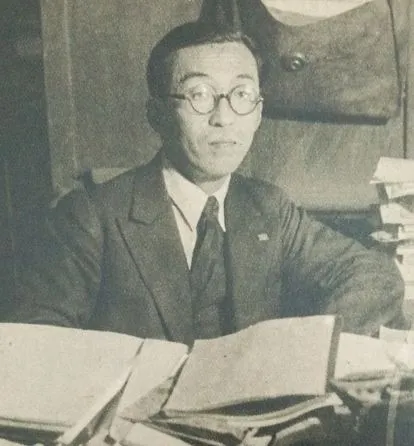
In a paper in Progress of Theoretical Physics, Ziro Maki, Masami Nakagawa and Shoichi Sakata proposed that the neutrinos coupling to the electron and the muon are mixtures of two neutrino states with definite mass. They noted that such mixing could cause transitions between flavours. Combined with Pontecorvo's work, this became the PMNS mixing matrix that describes all observed oscillation phenomena today.
- Date
- 1962
- Kind of event
- Theory
- People involved
- Ziro Maki, Masami Nakagawa, Shoichi Sakata, Bruno Pontecorvo
The situation before
In 1962 the Brookhaven experiment showed that there are two kinds of neutrino, one paired with the electron and one with the muon. In Nagoya, Shoichi Sakata and his group had for years been working on composite models of hadrons, and in the so-called Nagoya model they tried to relate baryons to leptons. In that framework the question arose naturally whether the neutrinos that appear in weak interactions are themselves the fundamental particles, or combinations of them.
What happened
In November 1962 Ziro Maki, Masami Nakagawa and Sakata published "Remarks on the unified model of elementary particles" in Progress of Theoretical Physics. They distinguished between the "weak neutrinos", which couple to the electron and the muon in weak interactions, and "true neutrinos", states with definite mass. The weak neutrinos, they proposed, are orthogonal combinations of the true ones, rotated by a mixing angle, in close analogy with the angle that Nicola Cabibbo would introduce for quarks a year later.
The authors also noted a consequence: if the two mass states differ, a neutrino produced as one flavour could later show up as the other, a "virtual transmutation". They suggested that a muon-neutrino beam could be checked for electron neutrinos to test this. The paper did not develop a full oscillation formula, and the mass differences then imagined were much larger than the real ones.
Reaction
For years the paper attracted little attention outside Japan. The idea of neutrino mixing was developed in parallel by Bruno Pontecorvo, who in 1967 discussed flavour oscillations and their effect on solar neutrinos and, with Vladimir Gribov, in 1969 gave the oscillation formalism for two flavours. The mixing matrix gained wide currency only from the late 1970s, when the three-flavour version became the framework for oscillation searches.
Why it matters
The 2×2 mixing of 1962 grew into the 3×3 PMNS matrix, named after Pontecorvo, Maki, Nakagawa and Sakata. It relates the three flavour states to three mass eigenstates through three angles, θ12, θ23 and θ13, and a CP-violating phase. All later oscillation discoveries are measurements of its entries: atmospheric oscillations at Super-Kamiokande in 1998, solar flavour conversion at SNO in 2001–2002, and the last mixing angle at Daya Bay and RENO in 2012. Determining the CP phase is now a central goal of T2K, NOvA, DUNE and Hyper-Kamiokande.
Frequently asked questions
What did Maki, Nakagawa and Sakata propose?
That the electron and muon neutrinos are mixtures of two neutrino states with definite mass, which allows one flavour to turn into the other.
Where was the paper published?
In Progress of Theoretical Physics, volume 28, in November 1962.
What is the PMNS matrix?
The 3×3 matrix that relates neutrino flavour states to mass states. It is named after Pontecorvo, Maki, Nakagawa and Sakata.
Original papers
- TheoryZ. Maki, M. Nakagawa and S. Sakata, Remarks on the Unified Model of Elementary Particles, Prog. Theor. Phys. 28, 870 (1962)DOI 10.1143/PTP.28.870
Concepts
Mentioned in 1 page
Lessons 1
Last updated: · Editorial standard
Cite this page
Text
Neutrino Atlas (2026). “1962: Maki, Nakagawa and Sakata introduce neutrino mixing”. Retrieved 22 November 2026, from https://neutrino-atlas.com/timeline/1962-maki-nakagawa-sakata/BibTeX
@misc{neutrinoatlas2026ne1962makinakagawasakata,
  title        = {1962: Maki, Nakagawa and Sakata introduce neutrino mixing},
  author       = {{Neutrino Atlas}},
  year         = {2026},
  url          = {https://neutrino-atlas.com/timeline/1962-maki-nakagawa-sakata/},
  note         = {Accessed 2026-11-22},
  language     = {english}
}