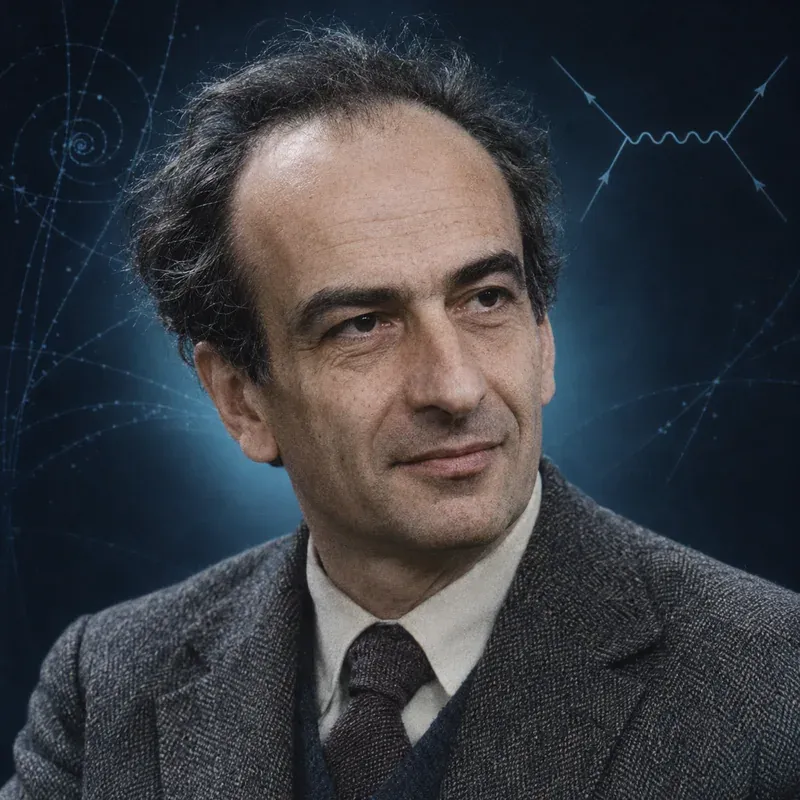
 Illustration
Vladimir Naumovich Gribov
In 1969 Gribov and Pontecorvo wrote 'Neutrino astronomy and lepton charge', a two-flavour treatment of solar neutrino oscillations that predicted a reduced electron-neutrino flux at Earth, published shortly after the first Homestake result. The rest of his work was mainly in strong-interaction theory.
- Born
- 25 March 1930
Leningrad, USSR - Died
- 13 August 1997
Budapest, Hungary - Nationality
- Russian (Soviet)
- Field
- Theoretical particle physics; quantum field theory
- Institutions
- Ioffe Physical-Technical Institute, Leningrad Institute for Nuclear Physics, Landau Institute for Theoretical Physics, Central Research Institute for Physics, Budapest
Early life and education
Vladimir Naumovich Gribov was born in Leningrad on 25 March 1930. His father died in 1938, and during the Second World War the family was evacuated from the city, returning in 1945. Gribov entered the Physics Faculty of Leningrad University in 1947 and graduated with distinction in 1952. For two years he taught physics at an evening school for adults before joining the Physical-Technical Institute (later the Ioffe Institute) in Leningrad in 1954. His formal supervisor there was Ilya Shmushkevich, but the decisive influence came from Lev Landau's seminars in Moscow and his collaboration with Isaak Pomeranchuk.
The paper with Pontecorvo
Gribov's one paper on neutrino oscillations had an outsized influence. In 1969 he and Bruno Pontecorvo published 'Neutrino astronomy and lepton charge' in Physics Letters B. Pontecorvo had argued for years that neutrinos might oscillate; Gribov supplied a clean field-theoretical formulation. They assumed that lepton number is not exactly conserved, so that the neutrino fields acquire small Majorana-type mass terms that mix electron and muon neutrinos, and they wrote down the resulting two-flavour oscillation formalism.
They then applied it to the Sun. Electron neutrinos produced in the solar core would oscillate on their way to Earth, and because the distance is huge compared with the oscillation length, the oscillations would average out. A chlorine detector, sensitive only to electron neutrinos, would therefore see a reduced flux; for maximal mixing the average survival probability is one half. The paper appeared just after Raymond Davis Jr. reported the first Homestake result, which was well below the predictions of John Bahcall's solar model. Gribov and Pontecorvo explicitly linked the two, giving the first oscillation interpretation of what became the solar neutrino problem.
The full answer turned out to need matter effects in the Sun and three flavours, confirmed by SNO and KamLAND around 2002. But the 1969 paper set the template: vacuum oscillations of mixed neutrino states as an explanation for missing solar neutrinos.
Work in strong-interaction theory
Most of Gribov's work concerned the strong interaction. In the late 1950s and 1960s he developed Reggeon field theory and the pomeron, the description of high-energy hadron scattering. In 1971, with Lev Lipatov, he derived evolution equations for hadron structure functions, later extended by Altarelli, Parisi and Dokshitzer and now known as the DGLAP equations. He also discovered that gauge fixing in non-abelian theories is ambiguous, the so-called Gribov copies. He moved to the Landau Institute in Moscow in 1980 and in the 1990s worked in Budapest and Bonn. His honours include the Landau Gold Medal and the Sakurai Prize (1991). He died in Budapest on 13 August 1997.
Known for
- Gribov–Pontecorvo analysis of solar neutrino oscillations
- Reggeon field theory and the pomeron
- Gribov–Lipatov (DGLAP) evolution
- Gribov copies
Chronology
- 1969Gribov–Pontecorvo paper on solar neutrino oscillations
- 1971Gribov–Lipatov evolution equations; Landau Gold Medal
- 1991Sakurai Prize
Original papers
- V. Gribov, B. Pontecorvo, Neutrino astronomy and lepton charge, Phys. Lett. B 28, 493 (1969)
Experiments
Connected people
Frequently asked questions
What did Gribov contribute to neutrino physics?
In 1969, with Bruno Pontecorvo, he gave a field-theoretical treatment of two-flavour neutrino oscillations and proposed that oscillations could reduce the flux of solar electron neutrinos reaching a detector, the first oscillation explanation of the solar neutrino deficit.
Was Gribov–Pontecorvo the correct solution of the solar neutrino problem?
Partly. Oscillations are the cause, but the dominant effect for high-energy solar neutrinos is the MSW matter effect inside the Sun, with three flavours. The 1969 paper introduced the basic idea.
What else is Gribov known for?
For Reggeon field theory and the pomeron, the Gribov–Lipatov evolution equations of quantum chromodynamics, and Gribov copies in gauge theories.
On the timeline
Mentioned in 9 pages
Lessons 1
Milestones 5
People 1
Last updated: · Editorial standard
Cite this page
Text
Neutrino Atlas (2026). “Vladimir Naumovich Gribov”. Retrieved 22 November 2026, from https://neutrino-atlas.com/people/vladimir-gribov/BibTeX
@misc{neutrinoatlas2026peoplevladimirgribov,
  title        = {Vladimir Naumovich Gribov},
  author       = {{Neutrino Atlas}},
  year         = {2026},
  url          = {https://neutrino-atlas.com/people/vladimir-gribov/},
  note         = {Accessed 2026-11-22},
  language     = {english}
}