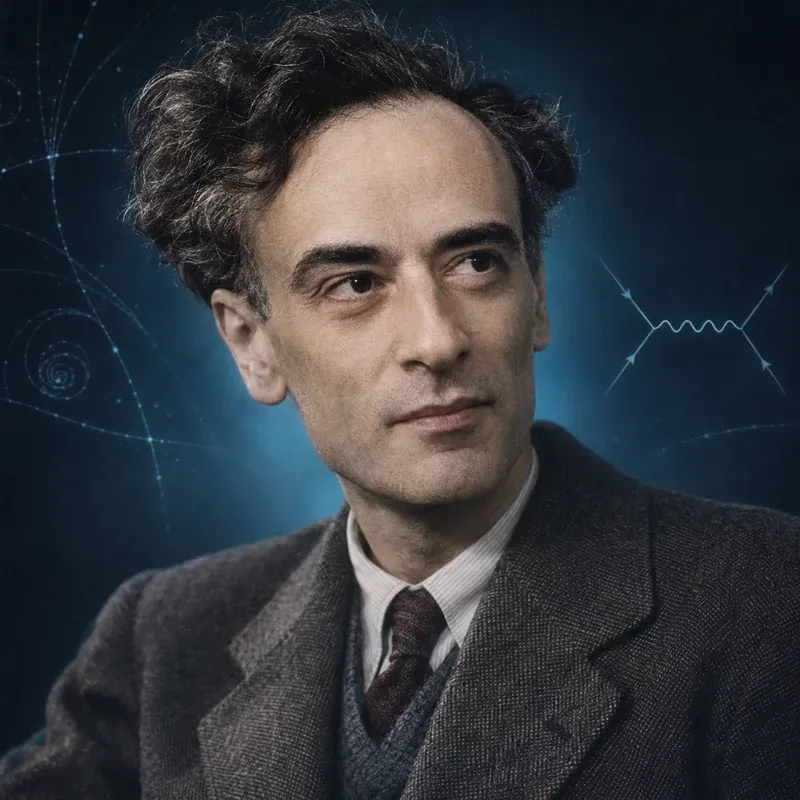
 Illustration
Lev Landau
In a paper received by Nuclear Physics on 9 January 1957, Landau proposed that weak interactions, while violating P and C separately, conserve their product - 'combined parity' (CP) - and showed that this leads naturally to a massless two-component neutrino of definite helicity. This was one of the three independent formulations (with Lee-Yang and Salam) of the two-component neutrino theory confirmed by the Goldhaber experiment.
- Born
- 22 January 1908
Baku, Russian Empire (now Azerbaijan) - Died
- 1 April 1968
Moscow, Soviet Union - Nationality
- Soviet
- Field
- theoretical physics
- Nobel Prize
- Physics 1962 – for his pioneering theories for condensed matter, especially liquid helium
- Institutions
- Ukrainian Physico-Technical Institute, Kharkov, Institute for Physical Problems, Moscow, Moscow State University
Early life and education
Lev Davidovich Landau was born on 22 January 1908 in Baku, then part of the Russian Empire. A prodigy in mathematics, he entered Baku State University at fourteen and transferred to Leningrad University, from which he graduated in 1927. In 1929–31 a travel fellowship took him to Göttingen, Leipzig, Cambridge, Zurich and above all to Niels Bohr in Copenhagen, whom he regarded as his true teacher. In 1932 he became head of the theory department of the Ukrainian Physico-Technical Institute in Kharkov.
In 1937 he moved to Pyotr Kapitsa's Institute for Physical Problems in Moscow. In April 1938 he was arrested by the NKVD during the Stalinist purges and spent a year in prison; he was released in April 1939 after Kapitsa, and also Bohr, appealed to Stalin on his behalf. With his student Evgeny Lifshitz he wrote the multi-volume Course of Theoretical Physics, and his “theoretical minimum” examination became the entry test for his school.
Key contributions
Most of Landau's work concerns condensed matter: the theory of superfluid helium, for which he received the 1962 Nobel Prize in Physics, the general theory of phase transitions, Landau damping in plasmas, the Ginzburg–Landau theory of superconductivity and the theory of Fermi liquids. He also contributed to quantum electrodynamics and to astrophysics, including early ideas about neutron cores in stars.
His contribution to neutrino physics came in the weeks after the discovery of parity violation. In late 1956 Tsung-Dao Lee and Chen-Ning Yang had pointed out that parity conservation had never been tested in weak interactions, and in January 1957 Chien-Shiung Wu and her colleagues reported that it is violated in beta decay. The experiments also showed that charge conjugation is violated. Landau found it hard to accept that nature has no mirror symmetry at all. In his paper “On the conservation laws for weak interactions”, received by Nuclear Physics on 9 January 1957, he proposed that the true symmetry is the combined operation of mirror reflection and particle–antiparticle exchange, which he called combined parity and which is now known as CP.
Landau showed that CP invariance combined with a massless neutrino leads naturally to a two-component neutrino described by the equation of Hermann Weyl, with a fixed helicity: the neutrino spins in one sense relative to its motion, the antineutrino in the other. Lee and Yang and Abdus Salam reached the same two-component theory independently. In 1958 Maurice Goldhaber, Lee Grodzins and Andrew Sunyar measured the helicity and found the neutrino to be left-handed, as the theory allowed.
Later years and legacy
Landau's view that CP is an exact symmetry held until 1964, when James Cronin and Val Fitch observed CP violation in the decays of neutral kaons. Whether CP is also violated by neutrinos is today one of the main questions of neutrino physics, studied through the phase δCP in experiments such as T2K, NOvA and the future DUNE and Hyper-Kamiokande.
On 7 January 1962 Landau was severely injured in a car accident near Moscow. He survived after two months in a coma, but never recovered his ability to do research. Because he could not travel, the Nobel Prize was presented to him in Moscow later that year. He died on 1 April 1968.
Known for
- Two-component neutrino theory and CP ('combined parity') invariance (1957)
- Theory of superfluidity
- Landau–Lifshitz Course of Theoretical Physics
Chronology
- 1957'On the conservation laws for weak interactions' (CP invariance, two-component neutrino)
- 1962Nobel Prize in Physics; severe car accident (7 January)
Original papers
- L.D. Landau, On the conservation laws for weak interactions, Nucl. Phys. 3, 127 (1957)DOI 10.1016/0029-5582(57)90061-5
Experiments
- Goldhaber experiment
Connected people
Frequently asked questions
What did Landau contribute to neutrino physics?
In January 1957 he proposed that weak interactions conserve CP, the combination of mirror reflection and particle–antiparticle exchange, and showed that this naturally leads to a massless two-component neutrino of fixed helicity.
Did Landau win the Nobel Prize for his neutrino work?
No. His 1962 Nobel Prize in Physics recognised his theories of condensed matter, especially liquid helium.
Was Landau right that CP is conserved?
Not exactly. CP violation was found in kaon decays in 1964, and in quarks it is now well established. Whether neutrinos violate CP is still being measured.
On the timeline
Mentioned in 16 pages
Milestones 3
People 9
Last updated: · Editorial standard
Cite this page
Text
Neutrino Atlas (2026). “Lev Landau”. Retrieved 22 November 2026, from https://neutrino-atlas.com/people/lev-landau/BibTeX
@misc{neutrinoatlas2026peoplelevlandau,
  title        = {Lev Landau},
  author       = {{Neutrino Atlas}},
  year         = {2026},
  url          = {https://neutrino-atlas.com/people/lev-landau/},
  note         = {Accessed 2026-11-22},
  language     = {english}
}