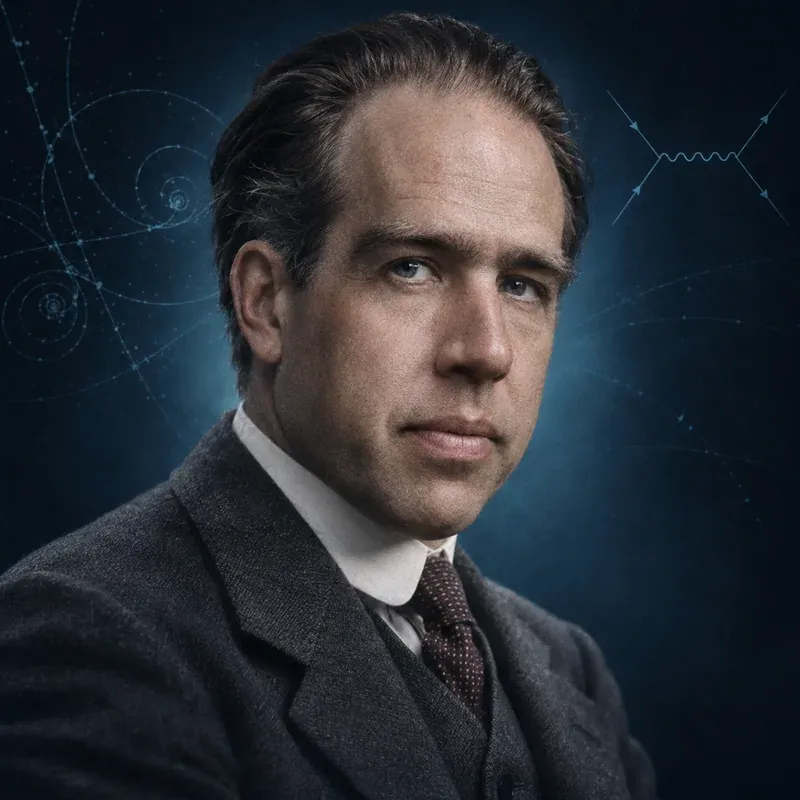
 Illustration
Niels Bohr
Faced with the continuous beta spectrum confirmed by Ellis and Wooster, Bohr suggested around 1929-1930 that energy might not be conserved in individual nuclear beta-decay processes, or only statistically on average. Pauli's neutrino was explicitly conceived as an alternative to this radical proposal. The energy non-conservation hypothesis lost support after Fermi's successful theory and faded away in the mid-1930s.
- Born
- 7 October 1885
Copenhagen, Denmark - Died
- 18 November 1962
Copenhagen, Denmark - Nationality
- Danish
- Field
- theoretical physics
- Nobel Prize
- Physics 1922 – for his services in the investigation of the structure of atoms and of the radiation emanating from them
- Institutions
- University of Copenhagen (Institute for Theoretical Physics, now Niels Bohr Institute)
Early life and education
Niels Henrik David Bohr was born in Copenhagen on 7 October 1885. He studied physics at the University of Copenhagen, where he received his doctorate in 1911 with a thesis on the electron theory of metals. In 1912 he worked with Ernest Rutherford in Manchester, shortly after Rutherford had discovered the atomic nucleus. Back in Copenhagen he published in 1913 his model of the hydrogen atom, in which electrons occupy fixed orbits and emit light only when they jump from one orbit to another. For this work on the structure of atoms he received the Nobel Prize in Physics in 1922.
In 1921 his Institute for Theoretical Physics opened in Copenhagen, today the Niels Bohr Institute. In the 1920s and 1930s it drew Werner Heisenberg, Wolfgang Pauli, George Gamow and Lev Landau.
Energy non-conservation in beta decay
Bohr's place in neutrino history comes from a proposal that turned out to be wrong but forced others to take a radical step. In 1927 Charles Drummond Ellis and William Alfred Wooster measured the total heat released by the beta decay of radium E and confirmed that the electrons emerge with a continuous range of energies rather than one fixed value. Lise Meitner repeated the measurement with the same result. Since the nucleus changes from one definite state to another, a single electron should always carry the same energy. The missing energy had apparently disappeared.
Bohr was willing to consider that energy might not be conserved in individual nuclear processes, but only on average, as a statistical law. He had flirted with a similar idea in 1924 for the interaction of light and matter in a proposal with Hendrik Kramers and John Slater, which experiments by Walther Bothe and Hans Geiger and by Arthur Compton refuted within a year. From 1929 he discussed energy non-conservation in beta decay in letters, in an unpublished manuscript he sent to Pauli, and in public lectures, including his Faraday Lecture to the Chemical Society in London in 1930.
Pauli's alternative
Pauli found the idea unacceptable. In his letter of 4 December 1930 to the physicists gathered in Tübingen he proposed a “desperate remedy”: a light, neutral, undetected particle emitted together with the electron, which shares the decay energy and so produces the continuous spectrum. The particle he described is the neutrino. For several years the two explanations coexisted, and Bohr kept energy non-conservation open as a possibility. The decisive turn came with Enrico Fermi's theory of beta decay in 1933–34, which assumed Pauli's particle and reproduced the shapes of the measured spectra. By the mid-1930s Bohr's hypothesis had quietly been dropped.
Later work and legacy
In nuclear physics Bohr developed the compound-nucleus model and in 1939, with John Wheeler, the liquid-drop theory of nuclear fission. In 1943 he escaped from occupied Denmark and worked as an adviser to the Manhattan Project; after the war he campaigned for openness in nuclear matters and helped to found CERN, whose theory group was first based at his institute in Copenhagen. He died in Copenhagen on 18 November 1962.
The beta-decay episode shows how seriously the energy problem was taken: the alternative to the neutrino was giving up one of the basic laws of physics. When Frederick Reines and Clyde Cowan detected the neutrino in 1956, they confirmed the answer that Bohr's challenge had helped to provoke.
Known for
- Bohr model of the atom
- Complementarity
- Proposal of energy non-conservation in beta decay
- Liquid-drop model of fission
Chronology
- 1922Nobel Prize in Physics
- 1929Suggests abandoning strict energy conservation in beta decay
- 1930Pauli proposes the neutrino as alternative to Bohr's idea
Connected people
Frequently asked questions
What was Niels Bohr's role in the history of the neutrino?
Faced with the continuous beta spectrum, Bohr suggested that energy might be conserved only on average in nuclear processes. Pauli proposed the neutrino in 1930 as an alternative that kept energy conservation exact.
Did Bohr win a Nobel Prize?
Yes, the Nobel Prize in Physics 1922, for his investigations of the structure of atoms and of the radiation emanating from them. It was not related to neutrinos.
On the timeline
Mentioned in 15 pages
Lessons 1
Milestones 4
People 9
- Charles Drummond Ellis
- Edward Teller
- Francis Perrin
- George Gamow
- Lev Landau
- Petr Vogel
- Sheldon Lee Glashow
- Steven Weinberg
1 more
Terms 1
Last updated: · Editorial standard
Cite this page
Text
Neutrino Atlas (2026). “Niels Bohr”. Retrieved 22 November 2026, from https://neutrino-atlas.com/people/niels-bohr/BibTeX
@misc{neutrinoatlas2026peoplenielsbohr,
  title        = {Niels Bohr},
  author       = {{Neutrino Atlas}},
  year         = {2026},
  url          = {https://neutrino-atlas.com/people/niels-bohr/},
  note         = {Accessed 2026-11-22},
  language     = {english}
}