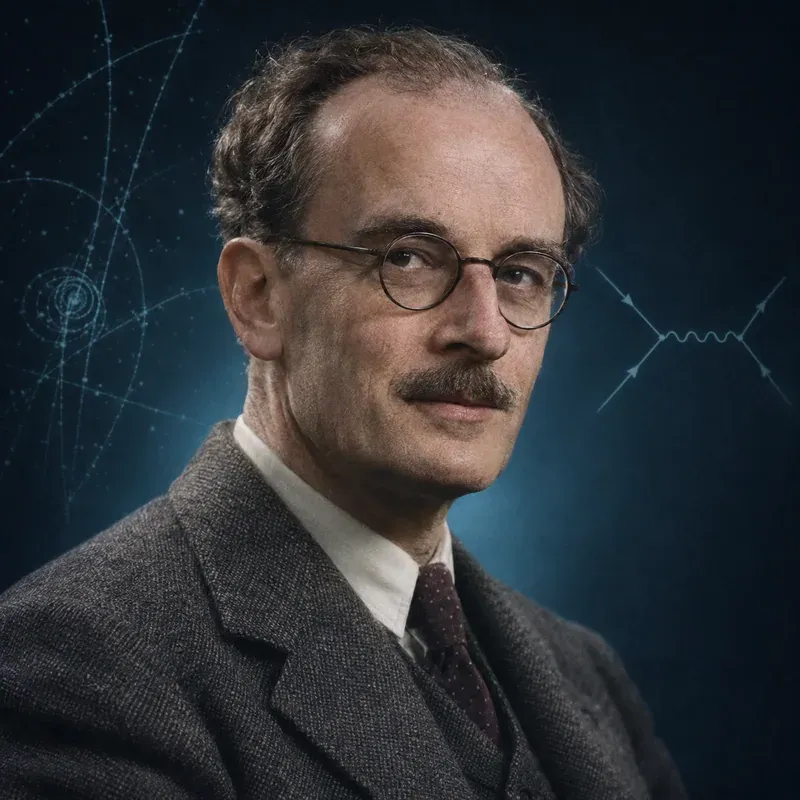
 Illustration
Charles Drummond Ellis
Ellis showed that the discrete lines superimposed on beta spectra are due to internal conversion of gamma rays in atomic shells, and that the underlying continuous spectrum is primary. In 1927, with William Wooster, he measured calorimetrically the total heat deposited by radium E (Bi-210) decays and found it equal to the mean energy of the continuous spectrum (about 0.34 MeV) rather than the endpoint energy, proving that the electrons are emitted from the nucleus with a continuous range of energies. This result directly prompted Bohr's energy non-conservation idea and Pauli's neutrino; Nevill Mott said Ellis had 'practically discovered the neutrino'.
- Born
- 11 August 1895
Hampstead, London, England - Died
- 10 January 1980
Cookham, England - Nationality
- British
- Field
- experimental physics
- Institutions
- Trinity College, Cambridge (Cavendish Laboratory), King's College London
Early life and education
Charles Drummond Ellis was born in Hampstead, London, on 11 August 1895, the son of Abraham Charles Ellis, general manager of the Metropolitan Railway. He won a scholarship to Harrow School and in 1913 entered the Royal Military Academy at Woolwich as a cadet, preparing for a career in the Royal Engineers.
An education in an internment camp
In the summer of 1914 Ellis was on holiday in Germany when the First World War broke out, and he was interned with other British civilians at the Ruhleben camp near Berlin. Among the prisoners was James Chadwick, who had just shown in Hans Geiger's laboratory that the electrons of beta decay have a continuous energy spectrum. The two men set up a small laboratory in a stable, where they experimented on photochemical reactions with whatever materials they could obtain. Chadwick's influence turned the young cadet into a physicist.
After the war Ellis gave up his military career, read natural sciences at Trinity College, Cambridge, graduating in 1920, and began research at the Cavendish Laboratory under Ernest Rutherford.
Key contributions
While Rutherford and Chadwick concentrated on alpha particles, Ellis made beta and gamma rays his speciality. The central question of the 1920s was whether beta electrons leave the nucleus with one definite energy, as alpha particles do, or with a spread of energies. Magnetic spectrometers showed sharp lines sitting on top of a broad continuum. Ellis showed that the lines are secondary: gamma rays from the nucleus knock electrons out of the atom's own inner shells (internal conversion), so each line sits at the gamma energy minus an atomic binding energy.
That left the continuum. Lise Meitner in Berlin argued that the nucleus emits electrons of a single energy, which then lose varying amounts on the way out. Ellis held that the continuum itself is produced in the nucleus. The way to settle the dispute was to capture all the energy, whatever form it took. In 1927 Ellis and his student William Wooster placed a radium E (bismuth-210) source inside a calorimeter with walls thick enough to absorb every electron and measured the heat. Instead of the spectrum's maximum, of the order of 1 MeV, they found about 0.34 MeV per decay, the mean of the continuous spectrum. Their paper "The average energy of disintegration of radium E" (Proceedings of the Royal Society A 117, 1927) proved that individual decays release different amounts of energy.
The result was unwelcome enough that Meitner and Wilhelm Orthmann repeated it with an improved instrument and confirmed it in 1930. Faced with energy that seemed to vanish, Niels Bohr was prepared to abandon exact energy conservation in nuclear processes, while Wolfgang Pauli proposed in December 1930 that an undetected neutral particle carries off the difference, the particle later named the neutrino. Nevill Mott, who worked with Ellis on the energetics of beta decay, later said that Ellis had "practically discovered the neutrino". With Rutherford and Chadwick, Ellis also wrote "Radiations from Radioactive Substances" (1930), the standard reference on radioactivity for a generation.
Later work
Ellis was elected a Fellow of the Royal Society in 1929. In 1936 he succeeded Edward Appleton in the Wheatstone chair of physics at King's College London. In 1940 he joined the MAUD Committee, which examined whether nuclear fission could be used for a weapon, and from 1943 to 1946 he was scientific adviser to the Army Council. He was knighted in 1946 for this war service.
He did not return to research. After the war he worked in industry and public administration: he was president of the British Coal Utilisation Research Association (1946–1955), an adviser to the National Coal Board on its research, and served on the Gas Council until 1966. He was also scientific adviser to British American Tobacco at a time when the link between smoking and disease was only beginning to be suspected, retiring from that role in 1972. Ellis died in a nursing home in Cookham on 10 January 1980.
Legacy
Ellis's place in neutrino history rests on one clear idea: if you cannot see where energy goes, measure all of it at once. Calorimetry turned a dispute about how to read spectra into a question with a numerical answer, and that answer forced physicists to choose between giving up energy conservation and accepting an invisible particle. The shape of the continuous beta spectrum near its endpoint is still the most direct route to the neutrino mass, the method used today by KATRIN.
Known for
- Ellis–Wooster calorimetric experiment (1927)
- Internal conversion explanation of beta line spectra
- Radiations from Radioactive Substances (1930, with Rutherford and Chadwick)
Chronology
- 1914Interned at Ruhleben with Chadwick during WWI
- 1921Fellow at Trinity College, Cambridge
- 1927Ellis–Wooster calorimetry of radium E
- 1929Fellow of the Royal Society
- 1946Knighted
Original papers
- C.D. Ellis, W.A. Wooster, The average energy of disintegration of radium E, Proc. R. Soc. Lond. A 117, 109 (1927)DOI 10.1098/rspa.1927.0168
Experiments
- Ellis–Wooster experiment
Connected people
Frequently asked questions
Why is Ellis said to have "practically discovered the neutrino"?
The phrase is Nevill Mott's. Ellis and Wooster's 1927 calorimetry proved that beta-decay electrons are emitted with a continuous range of energies, so energy appeared to be missing in each decay. Pauli's neutrino hypothesis of 1930 was invented to explain exactly this observation.
What was the Ellis–Wooster experiment?
A calorimetric measurement of the heat released by a radium E (bismuth-210) source. The average energy per decay, about 0.34 MeV, matched the mean of the continuous beta spectrum rather than its maximum, so the continuum had to originate in the nucleus itself.
Did Ellis win a Nobel Prize?
No. He was elected a Fellow of the Royal Society in 1929 and knighted in 1946. His friend and colleague James Chadwick received the 1935 Nobel Prize in Physics for discovering the neutron.
On the timeline
Mentioned in 14 pages
Lessons 1
Milestones 3
People 8
Last updated: · Editorial standard
Cite this page
Text
Neutrino Atlas (2026). “Charles Drummond Ellis”. Retrieved 22 November 2026, from https://neutrino-atlas.com/people/charles-drummond-ellis/BibTeX
@misc{neutrinoatlas2026oplecharlesdrummondellis,
  title        = {Charles Drummond Ellis},
  author       = {{Neutrino Atlas}},
  year         = {2026},
  url          = {https://neutrino-atlas.com/people/charles-drummond-ellis/},
  note         = {Accessed 2026-11-22},
  language     = {english}
}