KATRIN
The Karlsruhe Tritium Neutrino experiment, which holds the best direct upper limit on neutrino mass.
A 70 m beamline combines a windowless gaseous tritium source of about 10¹¹ Bq with a 23 m long, 10 m diameter MAC-E spectrometer. Results: mβ < 1.1 eV (2019), < 0.8 eV (2022), and < 0.45 eV (90% CL) from 259 days of data (Science, April 2025).
Calculator: beta spectrum and neutrino mass →
Compare all experiments → · World map →
In plain words
KATRIN is the world's largest scale for the smallest known mass. At the Karlsruhe Institute of Technology a 70 m long chain of vacuum vessels and magnets guides electrons from decaying tritium gas into a spectrometer the size of a house. There, a precisely tuned electric field acts as an energy hurdle. By counting how many electrons clear the hurdle just below the maximum possible energy, KATRIN tells how much energy the escaping neutrino must have taken with it as mass.
How the detector works
- A windowless gaseous tritium source, adopted from Troitsk, with an activity of about 10¹¹ decays per second; tritium is circulated in a closed loop.
- Differential and cryogenic pumping sections that remove tritium by a factor of about 10¹⁴ before the electrons reach the spectrometers, while superconducting magnets guide the electrons onward.
- A pre-spectrometer and the main spectrometer, a 23 m long, 10 m diameter vessel working as a MAC-E filter with an energy resolution of about 1 eV at 18.6 keV.
- A segmented silicon detector that counts the electrons that pass the filter.
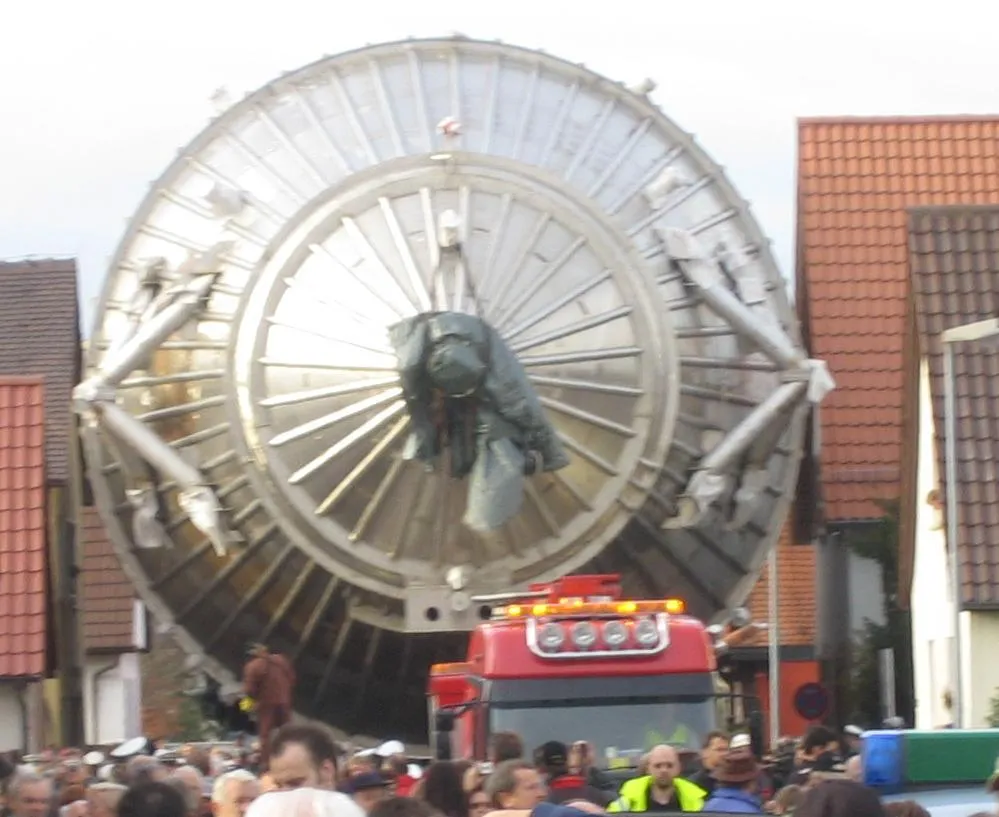
The main spectrometer became famous in 2006, when it was too large for German roads: it was shipped from the manufacturer in Deggendorf down the Danube, across the Black Sea and Mediterranean, around Europe and up the Rhine, a detour of more than 8,000 km, before travelling the last few kilometres through the village of Leopoldshafen.
Key results
- 2019: mβ < 1.1 eV (90% CL).
- 2022: mβ < 0.8 eV (90% CL), published in Nature Physics – the first direct measurement to reach the sub-eV range.
- 2025: mβ < 0.45 eV (90% CL) from 259 days of data and about 36 million electrons, published in Science.
- Searches for eV-scale sterile neutrinos that disfavour parts of the region suggested by the gallium and reactor anomalies.
Status today
KATRIN finished its neutrino-mass measurements in October 2025 after 1,000 days of data taking; the analysis of the full data set is under way. The original design goal was a sensitivity of 0.2 eV. From 2026 the beamline is being equipped with TRISTAN, a new detector to search for keV-scale sterile neutrinos across the entire tritium spectrum. The experiment grew out of the Mainz and Troitsk groups; Guido Drexlin and Christian Weinheimer were long-time co-spokespersons.
Frequently asked questions
What is KATRIN's current limit on the neutrino mass?
mβ < 0.45 eV at 90% confidence level, published in Science in 2025. A result from the full 1,000-day data set is expected.
Can KATRIN measure the mass if it is smaller than 0.2 eV?
No. Below its sensitivity it can only set an upper limit. Smaller masses require new techniques such as Project 8.
Original papers
- First resultM. Aker et al. (KATRIN Collaboration), Improved Upper Limit on the Neutrino Mass from a Direct Kinematic Method by KATRIN, Phys. Rev. Lett. 123, 221802 (2019)DOI 10.1103/PhysRevLett.123.221802arXiv:1909.06048
- MeasurementM. Aker et al. (KATRIN Collaboration), Direct neutrino-mass measurement with sub-electronvolt sensitivity, Nature Phys. 18, 160 (2022)DOI 10.1038/s41567-021-01463-1
- MeasurementM. Aker et al. (KATRIN Collaboration), Direct neutrino-mass measurement based on 259 days of KATRIN data, Science 388, 180 (2025)DOI 10.1126/science.adq9592
Related terms
People
- Christian Weinheimer
- Eligio Lisi
- Ernst-Wilhelm Otten
- Guido Drexlin
- R. G. Hamish Robertson
- Vladimir Mikhailovich Lobashev
- Yakov Borisovich Zeldovich
- Susanne Mertens
- Joseph A. Formaggio
- Thomas Schwetz
- Kathrin Valerius
Latest research on this topic
- The Effective Description of General Neutrino Interactions in Tritium β Decay and first Constraints based on the second KATRIN Science RunFengler, Caroline · 3 August 2026
- KATRIN Sensitivity to keV Sterile Neutrinos with the TRISTAN Detector UpgradeKATRIN Collaboration · 24 March 2026
- A precision 32 keV angular-selective photoelectron source for calibration measurements at the KATRIN experimentSchneidewind, Sonja, Sack, Rudolf, Block, Fabian et al. · 16 March 2026
- Direct neutrino mass measurement at the KATRIN experimentKATRIN Collaboration · 20 January 2026
- KATRIN experimentDrexlin, Guido, Weinheimer, Christian · 1 January 2026
- Determination of the Energy-dependent Energy-loss Function and Sensitivity Improvements for the KATRIN ExperimentSchneidewind, Sonja · 2026
On the timeline
- 2005Mainz sets a 2.3 eV neutrino-mass limit
- 2011Troitsk publishes a 2.05 eV mass limit
- 2018KATRIN is inaugurated in Karlsruhe
- 2019KATRIN's first limit: below 1.1 eV
- 2022KATRIN breaks the 1 eV barrier
- 2025KATRIN completes 1,000 days of mass measurements
- 2025KATRIN: neutrinos weigh less than 0.45 eV
- 2025KATRIN finds no sign of light sterile neutrinos
Mentioned in 96 pages
Lessons 10
FAQ 5
Comparisons 5
Milestones 12
- 1914 · Chadwick finds the beta spectrum is continuous
- 1966 · Cosmology bounds the neutrino mass
- 2005 · Mainz sets a 2.3 eV neutrino-mass limit
- 2011 · Troitsk publishes a 2.05 eV mass limit
- 2015 · Nobel Prize for neutrino oscillations
- 2015 · Project 8 detects single electrons by their radiation
- 2018 · KATRIN is inaugurated in Karlsruhe
- 2019 · KATRIN's first limit: below 1.1 eV
People 15
Terms 49
- Absolute neutrino mass scale
- Beta decay
- Beta spectrum endpoint
- Blind analysis
- Calibration
- Confidence level (CL)
- Cosmological neutrino mass bounds
- Cosmological neutrino-mass tension
41 more
- Cosmology and astrophysics
- Cyclotron radiation emission spectroscopy
- Detector technologies
- Direct Neutrino-mass experiments
- Effective Electron-neutrino mass
- Electron neutrino
- Electronvolt
- Energy resolution
- Energy-momentum relation
- eV and Sub-eV (mass scale)
- Experiments & detectors
- Fermi theory of beta decay
- Gravitational clustering of relic neutrinos
- Gravity
- Holmium-163 experiments (ECHo, HOLMES)
- Lightest neutrino mass
- MAC-E filter spectrometer
- Mainz Neutrino Mass Experiment
- Mass eigenstates
- Mass-squared differences
- Maximum-likelihood fit
- Neutrino energy density
- Neutrino kinetic energy
- Neutrino mass
- Neutrino mass in cosmology
- Neutrino speed and time of flight
- Neutrino-4
- Normal ordering
- Project 8
- PTOLEMY
- Quasi-degenerate neutrino masses
- Relic neutrino detection methods
- Relic neutrinos
- Sensitivity
- Sterile neutrino
- Sterile neutrino dark matter
- Sum of neutrino masses
- Systematic uncertainty
- Tritium beta endpoint method
- Troitsk nu-mass Experiment
- Upper limit / exclusion
Last updated: · Editorial standard
Cite this page
Text
Neutrino Atlas (2026). “KATRIN”. Retrieved 22 November 2026, from https://neutrino-atlas.com/terms/katrin/BibTeX
@misc{neutrinoatlas2026termskatrin,
  title        = {KATRIN},
  author       = {{Neutrino Atlas}},
  year         = {2026},
  url          = {https://neutrino-atlas.com/terms/katrin/},
  note         = {Accessed 2026-11-22},
  language     = {english}
}