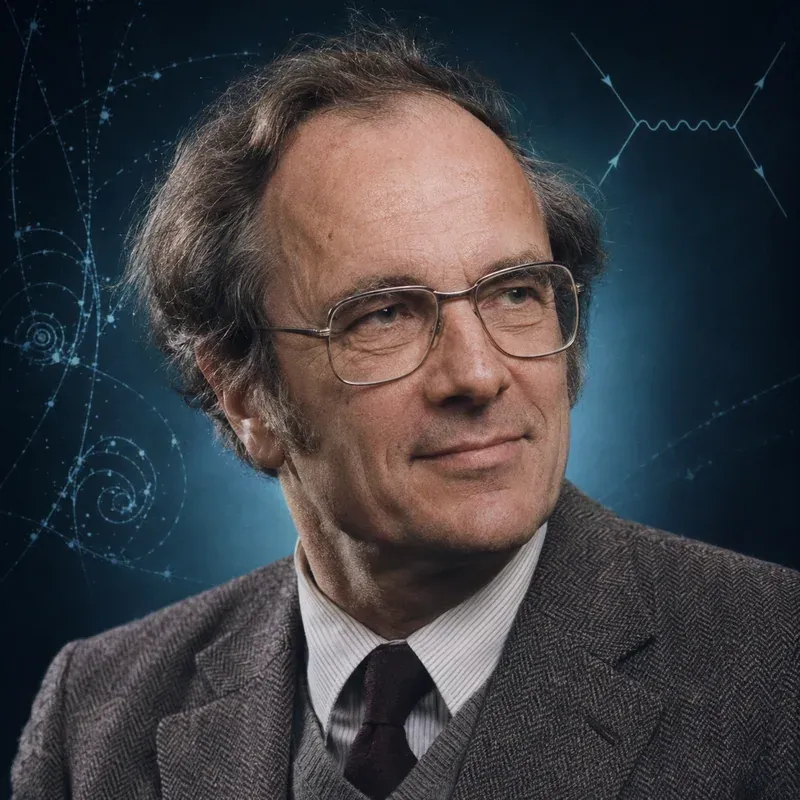
 Illustration
Ernst-Wilhelm Otten
Otten led the Mainz Neutrino Mass Experiment, which, together with the Troitsk experiment, used electrostatic (MAC-E-filter) spectrometers to measure the tritium beta spectrum near its endpoint and set the best upper limits on the electron-neutrino mass (about 2 eV) before KATRIN.
- Born
- 1934
- Died
- 8 July 2019
- Nationality
- German
- Field
- Experimental nuclear and atomic physics
- Institutions
- Johannes Gutenberg University Mainz, Heidelberg University, CERN, École Normale Supérieure, Paris
Education and early research
Ernst-Wilhelm Otten was born in 1934. He received his doctorate in 1962 at Heidelberg University under the atomic and nuclear physicist Hans Kopfermann. In Heidelberg he developed optical pumping to polarise the nuclear spins of radioactive isotopes and so measure their nuclear moments, an early example of the precision atomic methods that run through his whole career.
Otten recognised early the potential of ISOLDE, the on-line isotope separator at CERN that began operating in the late 1960s. From 1972 his group studied neutron-deficient mercury isotopes there and discovered dramatic changes in nuclear size and the coexistence of differently shaped nuclei. In the same year he became head of the department of experimental atomic and nuclear physics (EXAKT) at Johannes Gutenberg University Mainz, a position he held until his retirement in 2002. His group developed high-resolution collinear laser spectroscopy, now widely used at ISOLDE, and pioneered laser-based trace analysis of radionuclides in the environment. He also spent research periods at CERN and at the École Normale Supérieure in Paris.
Path to neutrino physics
In 1980 a group at ITEP in Moscow, including Valentin Lyubimov, reported evidence for a neutrino mass of around 30 eV from the tritium beta spectrum. Such a mass would have had major consequences for cosmology, since neutrinos of that mass could make up a large part of the dark matter as hot dark matter. The claim needed an independent test with a different spectrometer.
In the 1980s Otten built such an instrument at Mainz. The Mainz Neutrino Mass Experiment used a MAC-E filter, a type of spectrometer developed in parallel at Mainz and at Troitsk under Vladimir Lobashev. Electrons from a thin film of frozen tritium are guided by a strong magnetic field into a region where the field drops by orders of magnitude; their motion becomes almost parallel to the field lines, and an electrostatic barrier then lets through only electrons above a chosen energy. This combination gives a very high energy resolution together with a large acceptance.
Key contributions
Mainz and Troitsk ruled out the 30 eV claim and lowered the limit step by step. The final phase II results from Mainz, published in 2005 by Christine Kraus and colleagues, gave an upper limit of about 2 eV on the effective electron-neutrino mass. The Mainz work also identified and controlled subtle systematic effects, such as the roughening of the frozen tritium film over time, that proved essential for the next generation.
After Super-Kamiokande showed in 1998 that neutrinos oscillate and therefore have mass, Otten initiated the much larger KATRIN experiment at the Karlsruhe Institute of Technology, in which his former colleagues Christian Weinheimer and Guido Drexlin became co-spokespersons. Construction began in 2001. KATRIN scales the MAC-E principle up to a main spectrometer 10 metres in diameter and uses a gaseous tritium source. Otten remained actively involved after his retirement until his death on 8 July 2019, the year KATRIN published its first neutrino-mass limit of about 1 eV.
Other work
Otten's group at Mainz also tested parity violation in the scattering of polarised electrons on nucleons and measured the electric form factor of the neutron with polarised helium-3 targets. Together with the German Cancer Research Centre in Heidelberg and the Mainz university radiology department, he developed the use of hyperpolarised helium-3 gas for magnetic resonance imaging of the lungs.
Known for
- Tritium beta-decay endpoint measurements
- Precursor of KATRIN
- Mainz tritium neutrino-mass experiment
- Upper limit of ~2 eV on neutrino mass
- Initiator of KATRIN
Chronology
- 1962Doctorate at Heidelberg under Kopfermann
- 1972Professor at Mainz
- 2001KATRIN spectrometer construction begins
- 2005Final Mainz neutrino-mass result published (Eur. Phys. J. C)
- 2019Dies (8 July)
Original papers
- Ch. Kraus et al., Final results from phase II of the Mainz neutrino mass search in tritium beta decay, Eur. Phys. J. C 40, 447 (2005)
- C. Kraus et al., Final results from phase II of the Mainz neutrino mass search in tritium β decay, Eur. Phys. J. C 40, 447 (2005)DOI 10.1140/epjc/s2005-02139-7
Experiments
Connected people
Frequently asked questions
What did Ernst Otten contribute to neutrino physics?
He led the Mainz tritium experiment, which set an upper limit of about 2 eV on the neutrino mass, and he initiated its successor KATRIN.
What was the 30 eV neutrino-mass claim?
In 1980 an ITEP group reported a neutrino mass of around 30 eV from tritium decay. Mainz and Troitsk, using MAC-E filter spectrometers, later excluded it.
On the timeline
Mentioned in 10 pages
Lessons 1
Last updated: · Editorial standard
Cite this page
Text
Neutrino Atlas (2026). “Ernst-Wilhelm Otten”. Retrieved 22 November 2026, from https://neutrino-atlas.com/people/ernst-otten/BibTeX
@misc{neutrinoatlas2026peopleernstotten,
  title        = {Ernst-Wilhelm Otten},
  author       = {{Neutrino Atlas}},
  year         = {2026},
  url          = {https://neutrino-atlas.com/people/ernst-otten/},
  note         = {Accessed 2026-11-22},
  language     = {english}
}