2018Experiment
KATRIN is inaugurated in Karlsruhe
The Karlsruhe Tritium Neutrino experiment was inaugurated on 11 June 2018 with first tritium in its windowless gaseous source. Its 70 m beamline includes a 23 m long, 10 m wide main spectrometer that arrived at Karlsruhe in 2006 after a detour of nearly 9,000 km by sea and river. KATRIN was designed to measure the effective electron antineutrino mass with a sensitivity near 0.2 eV.
- Date
- 11 June 2018
- Kind of event
- Experiment
- People involved
- Guido Drexlin, Christian Weinheimer
- Experiments
- KATRIN
Background
Oscillation experiments show that neutrinos have mass but cannot tell how large it is. The most direct, model-independent approach is to measure the shape of the tritium beta spectrum close to its endpoint at 18.6 keV. The previous generation of such experiments, in Mainz around Ernst Otten and in Troitsk around Vladimir Lobashev, had reached upper limits of about 2 eV by the early 2000s using the MAC-E filter principle. A tenfold improvement required a much larger spectrometer and a much stronger tritium source. KATRIN was proposed in 2001 for this purpose and sited at the Karlsruhe Institute of Technology, whose Tritium Laboratory is one of very few facilities licensed to handle such quantities of tritium.
What happened
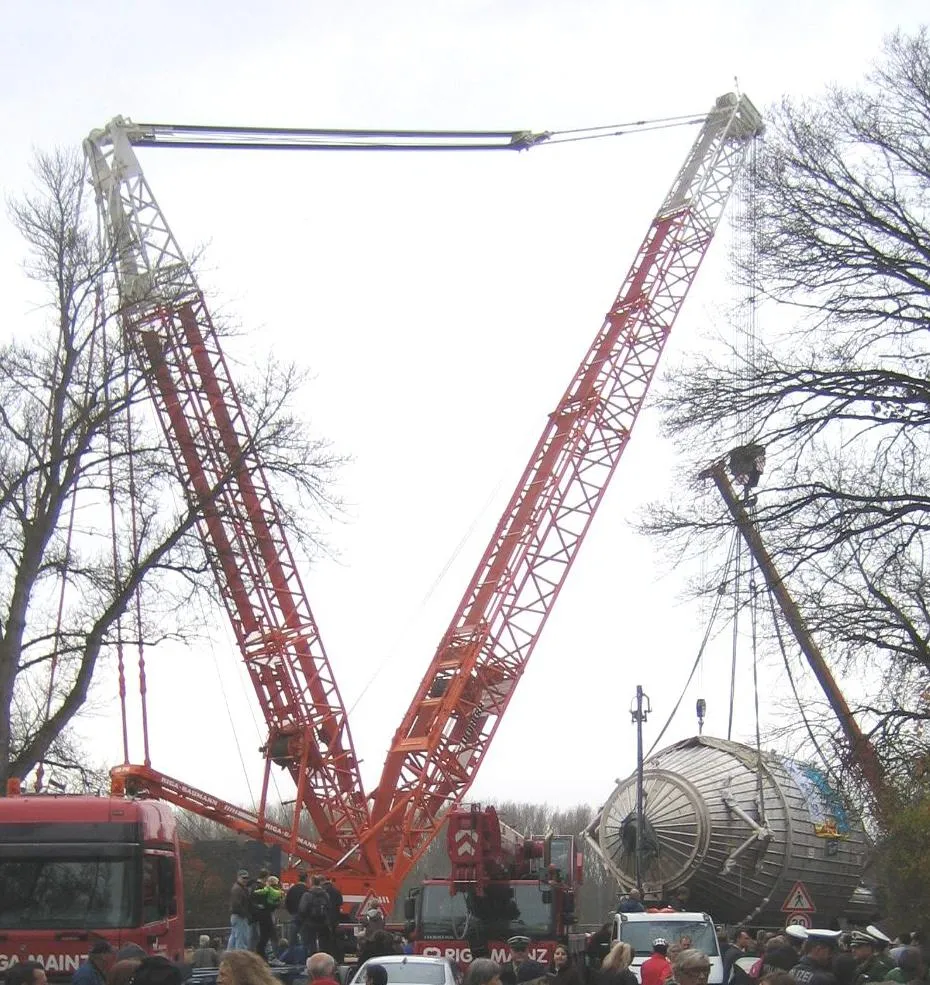
The centrepiece, the main spectrometer, is a steel vessel 23 m long and 10 m in diameter weighing about 200 tonnes. It was built by a manufacturer in Deggendorf in Bavaria and was far too large for the roads to Karlsruhe, which are only about 400 km away. In 2006 it was therefore shipped down the Danube to the Black Sea, through the Mediterranean, around the Iberian Peninsula and France to Rotterdam, and up the Rhine, a journey of nearly 9,000 km. On 25 November 2006 it covered the last few kilometres by road through the village of Eggenstein-Leopoldshafen, watched by thousands of people.
Building and commissioning the full 70 m beamline, from the windowless gaseous tritium source through the transport and pumping sections to the spectrometers and detector, took more than a decade. Tritium was first circulated in the source in May 2018 at a low concentration. On 11 June 2018 the experiment was officially inaugurated at KIT with guests from politics and science. At the time the collaboration comprised about 150 scientists from some 20 institutions in seven countries, with Guido Drexlin and Christian Weinheimer as co-spokespersons.
Reaction
The inauguration was reported widely in Germany as the start of the world's most precise scale for neutrinos, a common description that conveys the idea of weighing the lightest massive particles. For the collaboration it was mainly a technical milestone: the source, the cryogenic pumping that keeps tritium out of the spectrometers and the high-voltage system all worked together for the first time.
Consequences
Regular neutrino-mass campaigns began in spring 2019. The first four weeks of data already lowered the limit to 1.1 eV, and a second campaign brought it to 0.8 eV in 2022. With 259 days of data, KATRIN reported an upper limit of 0.45 eV in 2025. Neutrino-mass data taking was scheduled to end in 2025, after which the beamline is to be used to search for keV-scale sterile neutrinos.
Frequently asked questions
When was KATRIN inaugurated?
On 11 June 2018 at the Karlsruhe Institute of Technology, a few weeks after the first tritium was circulated in its source.
Why did the spectrometer travel 9,000 km?
At 23 m long and 10 m wide it could not be transported by road from Deggendorf to Karlsruhe, so it went by ship around Europe and up the Rhine.
What has KATRIN achieved since?
Its limit on the effective electron antineutrino mass fell from 1.1 eV in 2019 to 0.8 eV in 2022 and 0.45 eV in 2025.
Original papers
- ProposalM. Aker et al. (KATRIN Collaboration), The design, construction, and commissioning of the KATRIN experiment, JINST 16, T08015 (2021)DOI 10.1088/1748-0221/16/08/T08015arXiv:2103.04755
- First resultM. Aker et al. (KATRIN Collaboration), First operation of the KATRIN experiment with tritium, Eur. Phys. J. C 80, 264 (2020)DOI 10.1140/epjc/s10052-020-7718-zarXiv:1909.06069
Concepts
Mentioned in 1 page
Lessons 1
Last updated: · Editorial standard
Cite this page
Text
Neutrino Atlas (2026). “2018: KATRIN is inaugurated in Karlsruhe”. Retrieved 22 November 2026, from https://neutrino-atlas.com/timeline/2018-katrin-inauguration/BibTeX
@misc{neutrinoatlas2026ne2018katrininauguration,
  title        = {2018: KATRIN is inaugurated in Karlsruhe},
  author       = {{Neutrino Atlas}},
  year         = {2026},
  url          = {https://neutrino-atlas.com/timeline/2018-katrin-inauguration/},
  note         = {Accessed 2026-11-22},
  language     = {english}
}