 Illustration
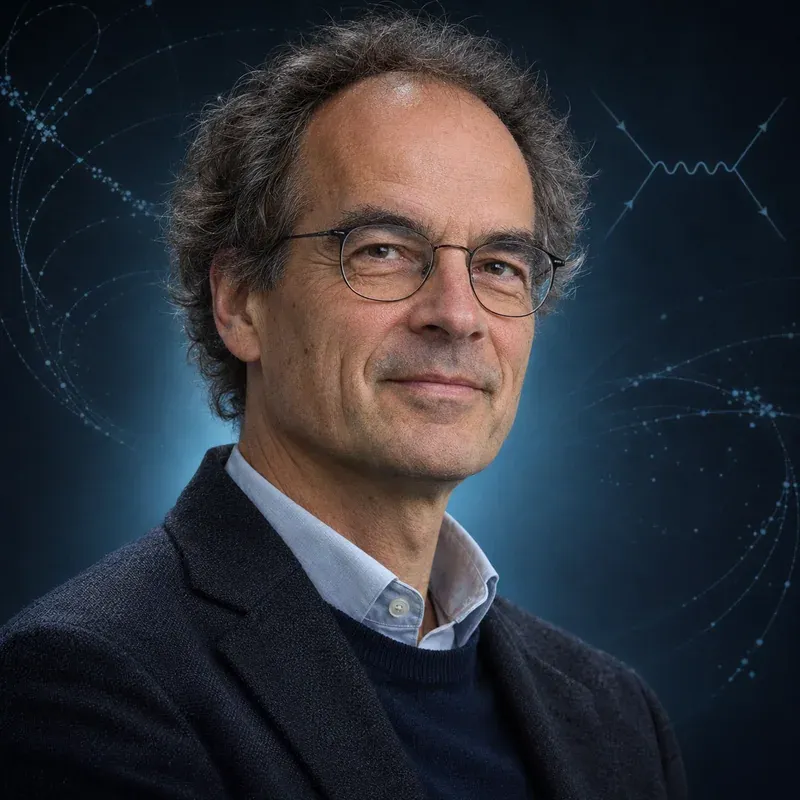
Guido Drexlin
Drexlin was KATRIN project leader and, with Christian Weinheimer, co-spokesperson of the KATRIN collaboration from its founding in 2001 until 2022. KATRIN measures the shape of the tritium beta spectrum near its endpoint with a 70-m-long MAC-E-filter beamline at KIT; it set the first sub-eV direct limit (<1.1 eV, 2019), then <0.8 eV (2022) and <0.45 eV (2025).
- Nationality
- German
- Field
- Experimental astroparticle physics
- Institutions
- Karlsruhe Institute of Technology (KIT)
Background
Guido Drexlin is a German experimental physicist and professor at the Karlsruhe Institute of Technology (KIT), where he teaches astroparticle physics. He was still a doctoral candidate in 1987, the year neutrinos from SN 1987A were detected, and earned his doctorate with distinction. Before KATRIN he worked in the Karlsruhe group of KARMEN, an experiment at the ISIS pulsed spallation source of the Rutherford Appleton Laboratory in England that studied neutrinos from pion and muon decays at rest and searched for the muon-to-electron antineutrino oscillations reported by LSND. KARMEN did not confirm the LSND signal.
The problem KATRIN addresses
Oscillation experiments show that neutrinos have mass but measure only differences between the squared masses. The absolute mass scale has to come from elsewhere. The most model-independent route is kinematic: in tritium beta decay the electron and the antineutrino share 18.6 keV of energy, and a non-zero neutrino mass removes a tiny slice of the electron spectrum right at its endpoint. The effect concerns only a fraction of about 10⁻¹³ of all decays, and the earlier experiments at Mainz and Troitsk had reached a limit of about 2 eV on the effective electron-neutrino mass.
Key contributions
From the founding of the collaboration in 2001 until 2022 Drexlin was KATRIN's project leader and, together with Christian Weinheimer of Münster, one of its two co-spokespersons. KATRIN scales up the MAC-E filter principle developed at Mainz and Troitsk by Ernst Otten, Weinheimer and Vladimir Lobashev: magnetic fields guide beta electrons from a windowless gaseous tritium source into a spectrometer where an electrostatic potential lets only the most energetic electrons pass. The resolution improves with the ratio of the magnetic field in the source to that in the analysing plane, which forces a very large vessel. KATRIN's main spectrometer is 10 metres in diameter and about 23 metres long and was transported to Karlsruhe in 2006 on a detour of some 9,000 km by river and sea because it was too large for German roads. The full beamline measures about 70 metres. The project was funded mainly by the Helmholtz Association, with the U.S. Department of Energy contributing chiefly the focal-plane detector.
Results
After first tritium operation in 2018, KATRIN reported in 2019 an upper limit of 1.1 eV (90 percent confidence level), the first direct limit below 1 eV. Further data lowered it to 0.8 eV in 2022. In 2025, under the new spokespersons Susanne Mertens and Kathrin Valerius, the collaboration published a limit of 0.45 eV in Science based on 259 days of data from 2019 to 2021, about a quarter of the planned total. Data-taking continued until the end of 2025; from 2026 the TRISTAN detector is to search for keV-scale sterile neutrinos in the same spectrum, and R&D towards a next-generation experiment has begun under the name KATRIN++.
In his own words
In a 2015 interview, asked about the challenges of the project, Drexlin quoted the motto of NASA's Apollo 13 mission control: ‘Failure is not an option’ (‘Scheitern ist keine Option’). Looking ahead he remarked that ‘the questions keep getting more fantastic’ (‘Die Fragen werden immer fantastischer’).
Known for
- KATRIN project leader
- KATRIN co-spokesperson (2001-2022)
- Direct neutrino-mass measurement via tritium beta decay
Chronology
- 2001KATRIN collaboration founded; co-spokesperson
- 2019KATRIN first result, m < 1.1 eV
- 2022Hands over spokesperson role (Mertens & Valerius)
- 2025KATRIN limit m < 0.45 eV (Science)
Original papers
- KATRIN Collaboration (M. Aker et al.), Improved upper limit on the neutrino mass from a direct kinematic method by KATRIN, Phys. Rev. Lett. 123, 221802 (2019)DOI 10.1103/PhysRevLett.123.221802
- KATRIN Collaboration, Direct neutrino-mass measurement based on 259 days of KATRIN data, Science 388, 180 (2025)DOI 10.1126/science.adq9592
Experiments
Connected people
- Christian Weinheimer
- Ernst-Wilhelm Otten
- R. G. Hamish Robertson
- Vladimir Mikhailovich Lobashev
- Kathrin Valerius
- Susanne Mertens
Frequently asked questions
What did KATRIN find about the neutrino mass?
It has not measured a non-zero mass but has set the most stringent direct upper limit, 0.45 eV at 90 percent confidence (2025). The result does not depend on cosmological models or on whether neutrinos are Majorana particles.
What was Guido Drexlin's role in KATRIN?
He was project leader and co-spokesperson from 2001 to 2022, steering the experiment from design and construction to its first sub-eV results.
How does KATRIN differ from cosmological mass bounds?
Cosmology constrains the sum of neutrino masses through its effect on structure formation and depends on a cosmological model; KATRIN measures the kinematics of single decays in the laboratory.
On the timeline
- 2018KATRIN is inaugurated in Karlsruhe
- 2019KATRIN's first limit: below 1.1 eV
- 2022KATRIN breaks the 1 eV barrier
- 2025KATRIN completes 1,000 days of mass measurements
- 2025KATRIN: neutrinos weigh less than 0.45 eV
Mentioned in 14 pages
Lessons 1
Milestones 5
People 5
Terms 1
Last updated: · Editorial standard
Cite this page
Text
Neutrino Atlas (2026). “Guido Drexlin”. Retrieved 22 November 2026, from https://neutrino-atlas.com/people/guido-drexlin/BibTeX
@misc{neutrinoatlas2026peopleguidodrexlin,
  title        = {Guido Drexlin},
  author       = {{Neutrino Atlas}},
  year         = {2026},
  url          = {https://neutrino-atlas.com/people/guido-drexlin/},
  note         = {Accessed 2026-11-22},
  language     = {english}
}