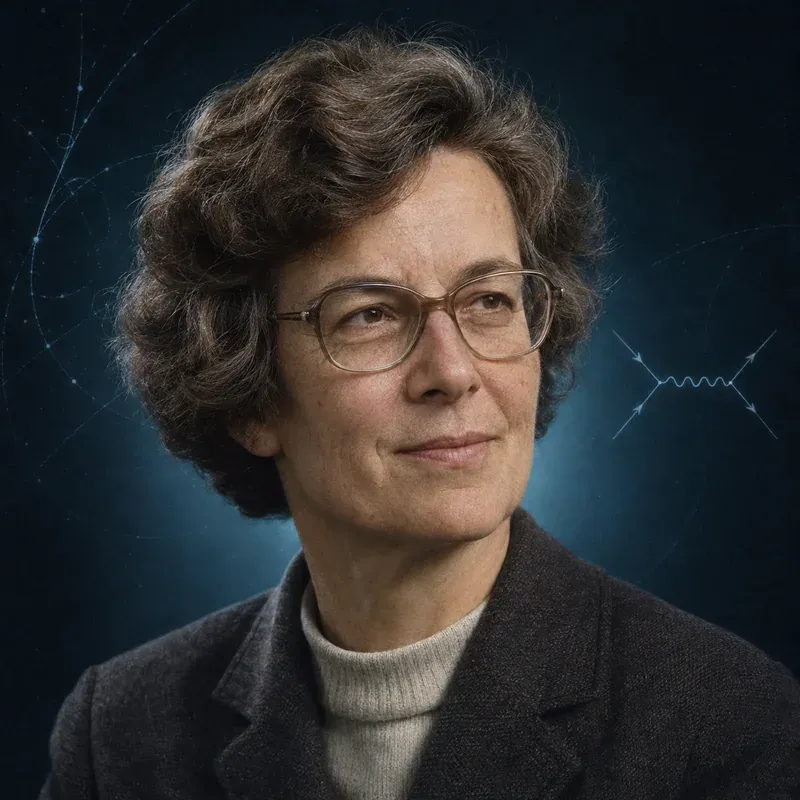
 Illustration
Susanne Mertens
Mertens wrote her doctoral thesis on background processes in the electrostatic spectrometers of KATRIN and has worked on the experiment ever since. Her groups at the Max Planck Institute for Physics and TU Munich coordinated the data analysis behind KATRIN's sub-electronvolt limits on the effective electron-neutrino mass, and in October 2022 she became co-spokesperson together with Kathrin Valerius. In 2012 she initiated TRISTAN, a silicon-drift-detector system meant to extend KATRIN to a search for sterile neutrinos with keV masses, a dark-matter candidate, supported by an ERC Starting Grant from 2019.
- Nationality
- German
- Field
- Experimental astroparticle physics
- Institutions
- Karlsruhe Institute of Technology (PhD 2012), Lawrence Berkeley National Laboratory, Max Planck Institute for Physics, Munich, Technical University of Munich
Education and early career
Susanne Mertens studied physics at the Karlsruhe Institute of Technology (KIT) from 2002 to 2008, with an Erasmus year at Trinity College Dublin, and wrote her master's thesis in theoretical particle physics. She then switched to experiment and completed her PhD at KIT in 2012 under Guido Drexlin, with a thesis on background processes in the electrostatic spectrometers of KATRIN; the work received the KIT doctoral prize and a Springer Thesis Award. From 2012 to 2016 she was a postdoctoral researcher at Lawrence Berkeley National Laboratory, supported by a Feodor Lynen fellowship, where she also took part in the MAJORANA Demonstrator search for neutrinoless double-beta decay.
Weighing the neutrino
KATRIN measures the shape of the electron spectrum from tritium beta decay just below its endpoint at 18.6 keV, where a non-zero neutrino mass removes a sliver of the spectrum. Electrons are analysed in a 23-metre MAC-E filter, and any electron created by radioactive decays or stored in the spectrometer's magnetic field adds background exactly where the signal is smallest. Mertens's doctoral work on these background mechanisms fed directly into the design and operation of the experiment.
Her groups at the Max Planck Institute for Physics and TU Munich coordinated the analysis of the data that gave KATRIN's first sub-electronvolt limit, published in 2022, and they were central to analysis and calibration for the 2025 result based on 259 measurement days, which lowered the upper bound on the effective electron-neutrino mass to 0.45 eV. In October 2022 she and Kathrin Valerius succeeded the founding co-spokespersons Guido Drexlin and Christian Weinheimer.
TRISTAN and keV sterile neutrinos
Mertens's own initiative, started in 2012, is TRISTAN. A sterile neutrino with a mass of a few keV that mixes slightly with the electron neutrino would leave a kink in the tritium spectrum far below the endpoint, and such particles are discussed as dark matter. Seeing the kink requires measuring the whole spectrum at very high count rates, which KATRIN's original detector cannot do. TRISTAN therefore develops a large array of silicon drift detectors with excellent energy resolution and high rate capability, to be installed after the neutrino-mass programme ends. An ERC Starting Grant awarded in 2019 supports the project.
Present roles
Mertens led a Max Planck Research Group in Munich from 2016, became W3 professor and chair for neutrinos and dark matter at TUM in 2022, and since 1 March 2025 has been a director at the Max Planck Institute for Nuclear Physics in Heidelberg, heading its astroparticle physics division. She is also principal investigator of ComPol, a small satellite mission to measure X-ray polarisation from the black-hole binary Cygnus X-1.
Known for
- KATRIN co-spokesperson (from 2022)
- Initiator and principal investigator of TRISTAN
- Search for keV-scale sterile neutrinos in tritium beta decay
- Coordination of KATRIN neutrino-mass analyses
- Director at MPI for Nuclear Physics (from 2025)
Chronology
- 2012PhD at KIT on KATRIN spectrometer backgrounds; TRISTAN idea initiated
- 2016Max Planck Research Group leader at MPP and tenure-track professor at TUM
- 2019ERC Starting Grant for a sterile-neutrino search with KATRIN
- 2022W3 professor at TUM; KATRIN co-spokesperson (October)
- 2025Director at the Max Planck Institute for Nuclear Physics (1 March)
Original papers
- S. Mertens et al., A novel detector system for KATRIN to search for keV-scale sterile neutrinos, J. Phys. G 46, 065203 (2019)arXiv:1810.06711
- KATRIN Collaboration (M. Aker et al.), Direct neutrino-mass measurement with sub-electronvolt sensitivity, Nature Phys. 18, 160 (2022)DOI 10.1038/s41567-021-01463-1
- KATRIN Collaboration (M. Aker et al.), Direct neutrino-mass measurement based on 259 days of KATRIN data, Science 388, 180 (2025)
Experiments
- KATRIN
- TRISTAN
- MAJORANA Demonstrator
Connected people
Frequently asked questions
What is TRISTAN?
A planned extension of KATRIN with a silicon-drift detector array that would search the full tritium spectrum for a kink caused by a keV-mass sterile neutrino.
What is her role in KATRIN?
She has been co-spokesperson since October 2022, together with Kathrin Valerius, and her groups have coordinated major neutrino-mass analyses.
On the timeline
Mentioned in 6 pages
Last updated: · Editorial standard
Cite this page
Text
Neutrino Atlas (2026). “Susanne Mertens”. Retrieved 22 November 2026, from https://neutrino-atlas.com/people/susanne-mertens/BibTeX
@misc{neutrinoatlas2026peoplesusannemertens,
  title        = {Susanne Mertens},
  author       = {{Neutrino Atlas}},
  year         = {2026},
  url          = {https://neutrino-atlas.com/people/susanne-mertens/},
  note         = {Accessed 2026-11-22},
  language     = {english}
}