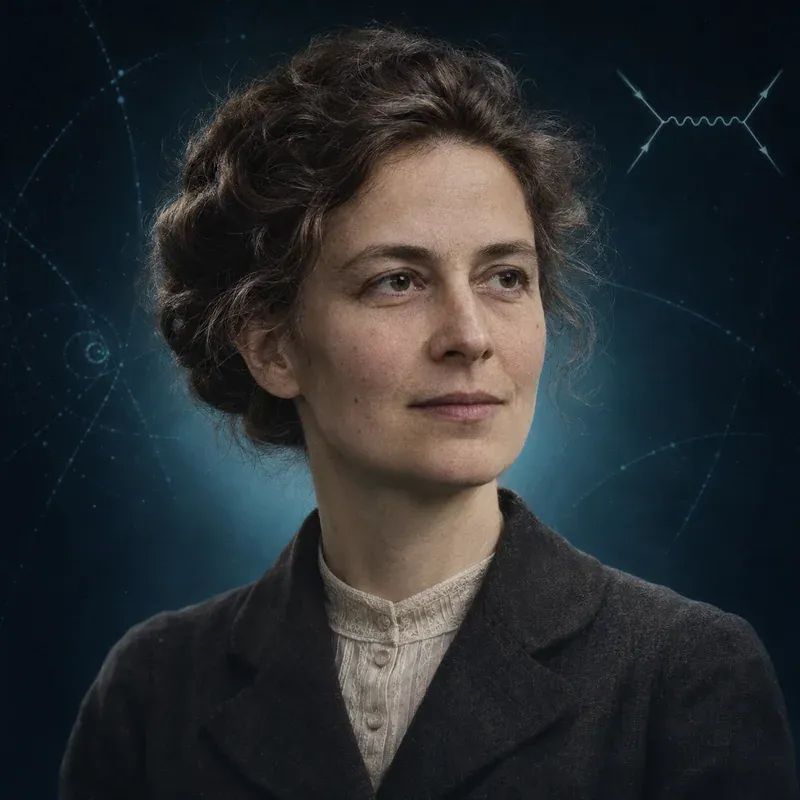
 Illustration
Kathrin Valerius
Valerius has worked on KATRIN since her doctorate at Münster, where she contributed to the design of the main spectrometer and to calibration sources. From 2014 she led a Helmholtz Young Investigator Group at KIT devoted to KATRIN data analysis, the period in which the experiment produced its first neutrino-mass results. Since October 2022 she has been co-spokesperson with Susanne Mertens, and in 2025 she presented the analysis of five measurement campaigns from 2019 to 2021 that set an upper limit of 0.45 eV on the effective electron-neutrino mass.
- Nationality
- German
- Field
- Experimental astroparticle physics
- Institutions
- University of Bonn, University of Münster (PhD 2009), Erlangen Centre for Astroparticle Physics, APC Paris
Education and early research
Kathrin Valerius studied physics at the University of Bonn and received her doctorate from the University of Münster in 2009. Münster, where Christian Weinheimer leads one of the founding KATRIN groups, was her base for thesis work on the design of the main spectrometer of KATRIN and on the development of calibration sources for it. She then spent postdoctoral years in gamma-ray astronomy, at the Erlangen Centre for Astroparticle Physics and at APC in Paris, studying Galactic sources with the H.E.S.S. telescopes in Namibia.
Analysing KATRIN data
In 2014 Valerius moved to the Karlsruhe Institute of Technology to lead a Helmholtz Young Investigator Group on KATRIN data analysis, and in 2020 she joined the KIT faculty; she is professor of experimental astroparticle physics. The analysis is demanding because the neutrino mass appears only as a tiny distortion of the tritium beta spectrum in the last few electronvolts below 18.6 keV. Every ingredient of the predicted spectrum, from the energy loss of electrons in the gaseous source to the transmission of the MAC-E filter, must be modelled and calibrated, and the analysis is carried out blind to avoid bias.
KATRIN published its first limit of 1.1 eV in 2019, reached the sub-electronvolt range in 2022 and, in 2025, reported an upper limit of 0.45 eV on the effective electron-neutrino mass from five campaigns with about 250 measurement days between 2019 and 2021, roughly a quarter of the planned data. Valerius and Susanne Mertens have been the collaboration's co-spokespersons since October 2022, succeeding Guido Drexlin and Christian Weinheimer.
Beyond neutrino mass
Since 2019 her group has also been part of the XENON collaboration, extending its work to the direct search for dark matter with xenon time-projection chambers. In 2019 the business magazine Capital included her in its list of 40 young leaders under 40 in the category science and society.
Known for
- KATRIN co-spokesperson (from 2022)
- Helmholtz Young Investigator Group on KATRIN data analysis
- Direct neutrino-mass limit of 0.45 eV (2025)
- Calibration sources for the KATRIN main spectrometer
- Dark-matter searches with XENON
Chronology
- 2009PhD at the University of Münster on KATRIN
- 2014Helmholtz Young Investigator Group leader at KIT
- 2019Joins the XENON dark-matter collaboration
- 2020Appointed to the KIT faculty
- 2022KATRIN co-spokesperson (October)
- 2025KATRIN publishes the 0.45 eV upper limit
Original papers
- KATRIN Collaboration (M. Aker et al.), Improved upper limit on the neutrino mass from a direct kinematic method by KATRIN, Phys. Rev. Lett. 123, 221802 (2019)DOI 10.1103/PhysRevLett.123.221802
- KATRIN Collaboration (M. Aker et al.), Direct neutrino-mass measurement based on 259 days of KATRIN data, Science 388, 180 (2025)
Experiments
- KATRIN
- XENON
- H.E.S.S.
Connected people
Frequently asked questions
What is Kathrin Valerius's role in KATRIN?
She is one of the experiment's two co-spokespersons, since October 2022, after leading a young investigator group on KATRIN data analysis at KIT from 2014.
What limit did KATRIN set in 2025?
An upper limit of 0.45 eV on the effective electron-neutrino mass, about half the 2022 bound.
On the timeline
Mentioned in 7 pages
Last updated: · Editorial standard
Cite this page
Text
Neutrino Atlas (2026). “Kathrin Valerius”. Retrieved 22 November 2026, from https://neutrino-atlas.com/people/kathrin-valerius/BibTeX
@misc{neutrinoatlas2026peoplekathrinvalerius,
  title        = {Kathrin Valerius},
  author       = {{Neutrino Atlas}},
  year         = {2026},
  url          = {https://neutrino-atlas.com/people/kathrin-valerius/},
  note         = {Accessed 2026-11-22},
  language     = {english}
}