2025Experiment
KATRIN finds no sign of light sterile neutrinos
In Nature in December 2025, KATRIN reported a search for light sterile neutrinos in the tritium beta spectrum, using 259 days of data and more than 36 million electrons. A sterile neutrino would add a small kink to the spectrum; none was found. The result excludes a large part of the parameter region suggested by the reactor and gallium anomalies and refutes the oscillation claim of the Neutrino-4 experiment. It is complementary to reactor searches such as STEREO.
- Date
- 4 December 2025
- Kind of event
- Experiment
- People involved
- Kathrin Valerius, Susanne Mertens
The situation before
Two families of anomalies had kept the idea of a light sterile neutrino alive. The reactor antineutrino anomaly was a deficit of a few percent in the measured flux compared with predictions. The gallium anomaly was a deficit in source calibrations of gallium detectors, confirmed in 2022 by BEST. In addition, the Neutrino-4 experiment at a Russian research reactor claimed to see oscillations pointing to a sterile neutrino with a mass splitting of several eV². Reactor experiments such as STEREO had tested part of this region, but they are most sensitive to splittings below a few eV².
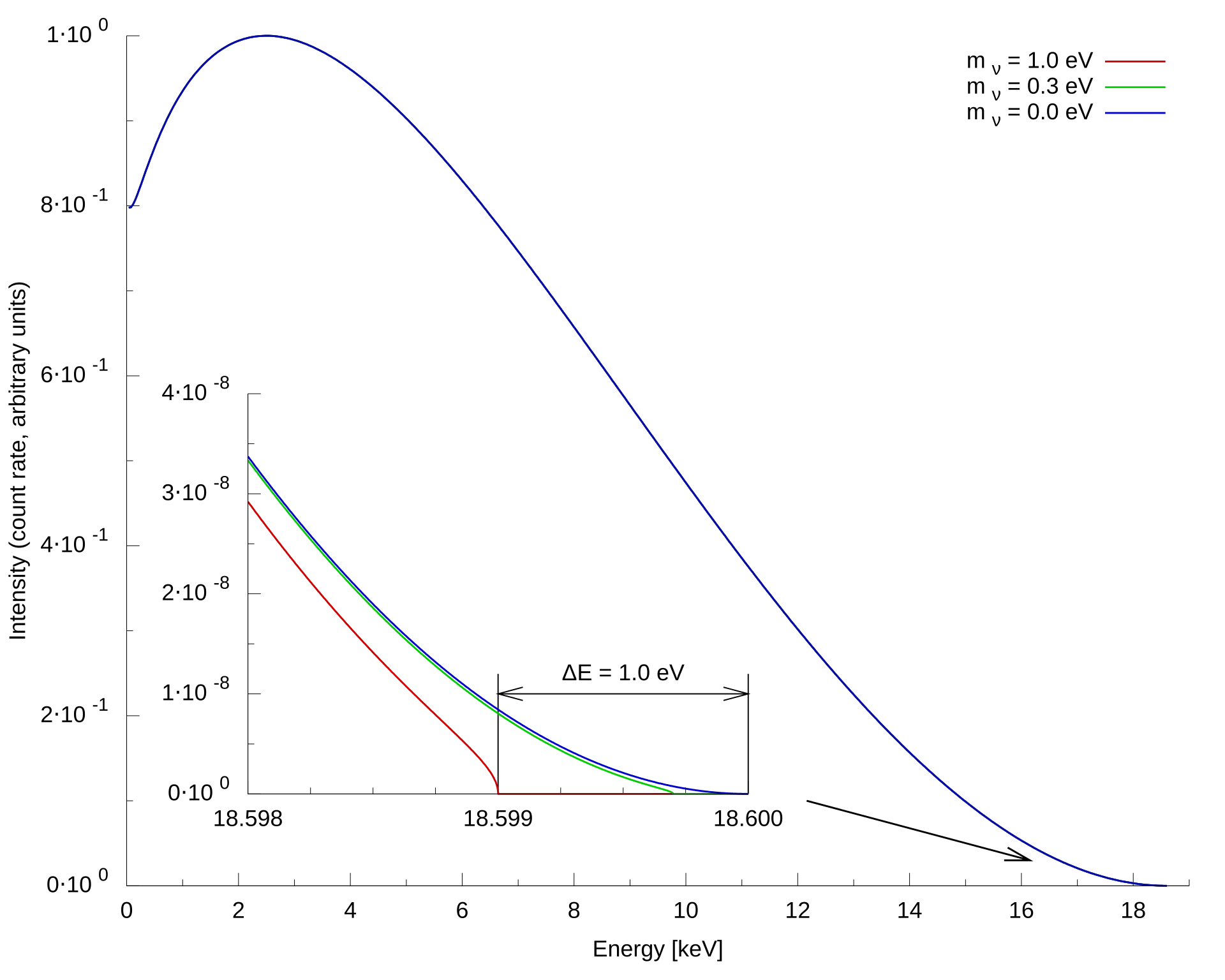
KATRIN was built to measure the absolute neutrino mass from the end of the tritium beta spectrum (see tritium endpoint). In April 2025 it had set an upper limit of 0.45 eV from 259 days of data. The same kind of measurement can also look for a heavier, sterile mass state.
What happened
If an electron neutrino has a small admixture of a fourth mass state m4, the beta spectrum becomes a superposition of two spectra, and a characteristic kink appears at an energy m4 below the endpoint. On 4 December 2025 the collaboration published in Nature its "Sterile-neutrino search based on 259 days of KATRIN data", an analysis led by Thierry Lasserre of the Max Planck Institute for Nuclear Physics in Heidelberg. It used more than 36 million electrons.
No kink appeared. The result excludes a large part of the parameter region suggested by the reactor and gallium anomalies and refutes the Neutrino-4 claim. KATRIN is sensitive to mass splittings from a few up to several hundred eV², so it covers the range above that of reactor experiments. Together, the two approaches rule out light sterile neutrinos that mix noticeably with the known neutrinos.
Reaction
Lasserre said: "Our new result is fully complementary to reactor experiments such as STEREO." Co-spokesperson Kathrin Valerius of KIT summarised: "We found no indication of sterile neutrinos", adding that "this allows us to exclude a large region of parameter space".
Consequences
Data taking for the neutrino mass continued to the end of 2025. "By then, we will have recorded over 220 million electrons in the region of interest", Valerius said, more than six times the statistics of this analysis. From 2026 KATRIN is being upgraded with the TRISTAN detector, which can record the entire spectrum and extends the search to keV masses, where sterile neutrinos could form part of the dark matter (see sterile neutrino dark matter). Co-spokesperson Susanne Mertens said: "This next-generation setup will open a new window into the keV-mass range." The gallium deficit itself remains to be explained, for example through cross-section uncertainties.
Frequently asked questions
What did KATRIN's sterile-neutrino search find?
No sign of a light sterile neutrino in 259 days of tritium data with more than 36 million electrons.
Which claims does the result contradict?
It excludes a large part of the region suggested by the reactor and gallium anomalies and refutes the Neutrino-4 oscillation claim.
What comes next for KATRIN?
From 2026 the TRISTAN detector upgrade extends the search to keV-scale sterile neutrinos, a dark-matter candidate.
Concepts
Last updated: · Editorial standard
Cite this page
Text
Neutrino Atlas (2026). “2025: KATRIN finds no sign of light sterile neutrinos”. Retrieved 22 November 2026, from https://neutrino-atlas.com/timeline/2025-katrin-sterile-search/BibTeX
@misc{neutrinoatlas2026e2025katrinsterilesearch,
  title        = {2025: KATRIN finds no sign of light sterile neutrinos},
  author       = {{Neutrino Atlas}},
  year         = {2026},
  url          = {https://neutrino-atlas.com/timeline/2025-katrin-sterile-search/},
  note         = {Accessed 2026-11-22},
  language     = {english}
}