2026Experiment
IceCube Upgrade strings deployed
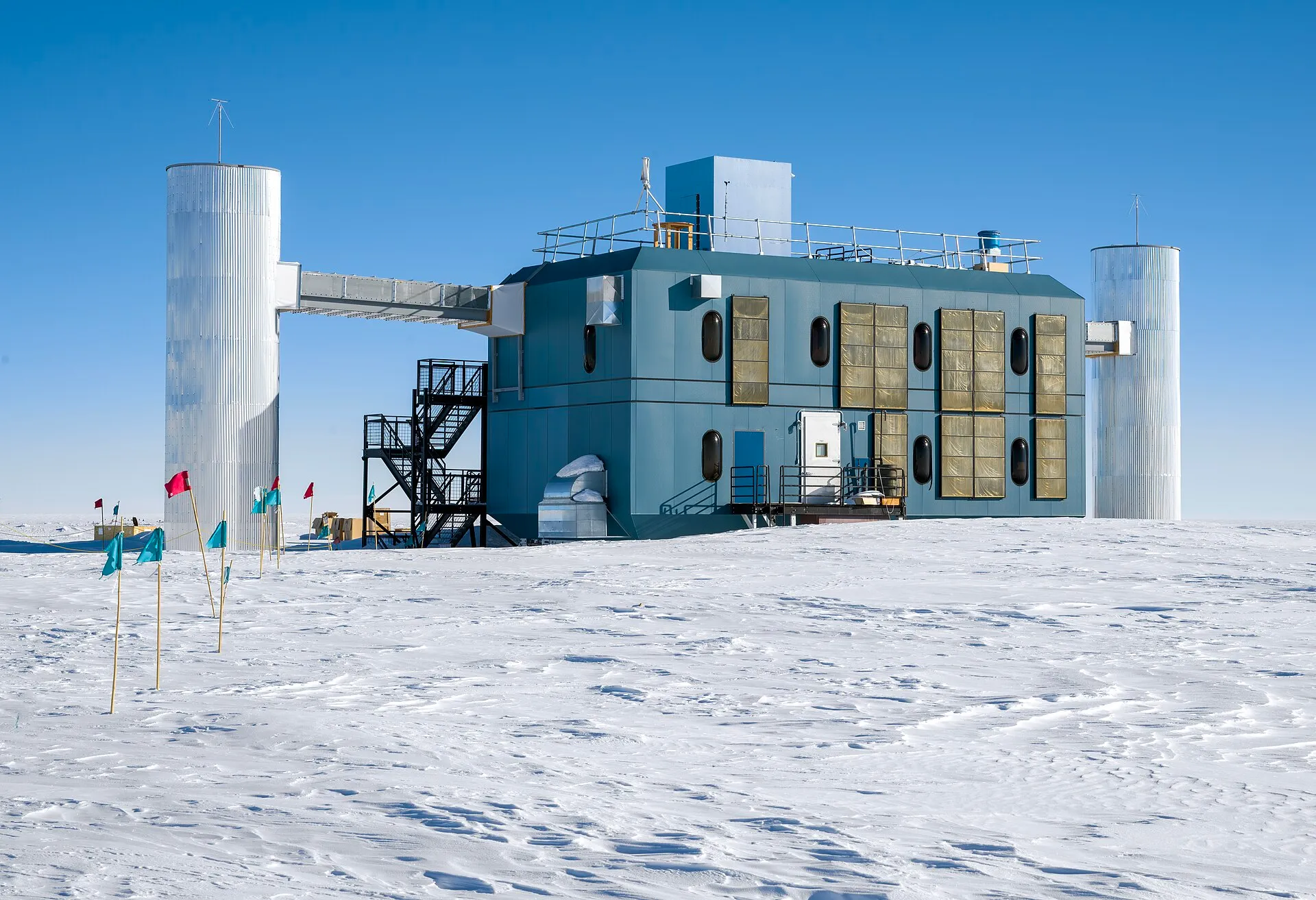
During the 2025/26 austral summer, the third and final field season of the project, five new, densely instrumented strings were installed in the centre of IceCube down to about 2,400 m, as announced in February 2026. Their multi-directional sensors improve sensitivity to lower-energy atmospheric neutrinos for oscillation and tau-neutrino studies and allow recalibration of the ice. The Upgrade also tests technology for the proposed IceCube-Gen2.
- Date
- 12 February 2026
- Kind of event
- Experiment
- People involved
- Francis Halzen
- Experiments
- IceCube Neutrino Observatory, IceCube-Gen2
The situation before
IceCube, completed in December 2010, instruments a cubic kilometre of Antarctic ice with 5,160 optical sensors on 86 strings. Its dense central region, DeepCore, lowered the energy threshold to about 10 GeV and made IceCube a competitive detector for atmospheric neutrino oscillations. Two limitations remained: the spacing of sensors restricted precision at the lowest energies, and uncertainties in the optical properties of the ice limited the reconstruction of all events.
In 2019 the US National Science Foundation, with institutional and international partners, approved the IceCube Upgrade: a set of new, densely instrumented strings in the centre of the array, built with new sensor designs.
What happened
The project needed three consecutive field seasons of about ten weeks each at the South Pole, from 2023 to 2026. The first two were used to refurbish, test and winterise the drilling equipment and set up the drill camp. In the third, the 2025/26 austral summer, a 5-megawatt hot-water drill melted five holes to about 2.4 km depth, each taking about three days. Into them the team lowered more than 600 new sensors and calibration devices.
- mDOM: a multi-PMT digital optical module with many small photomultipliers looking in all directions
- D-Egg: an elongated glass module with two large photomultipliers, developed as a prototype for IceCube-Gen2
- Calibration devices, including cameras and light sources, to map the ice
- Two seismometers installed with the US Geological Survey, described as the deepest in the world
The new modules have two to three times the sensitivity of the original sensors. Germany and Japan supplied the light sensors, Sweden the surface cables, and the United States the main cables, logistics, drilling and coordination. On 12 February 2026 the collaboration announced the completion of the installation, and commissioning became the top priority.
Reaction
Principal investigator Albrecht Karle said: "By placing new optical sensors into the clearest ice on Earth, we will measure neutrino properties" with new precision. Project director Vivian O'Dell thanked the partners, whose contributions "allowed us to complete the entire installation in one drilling season".
Why it matters
The Upgrade improves sensitivity to atmospheric neutrinos of a few GeV, sharpening measurements of oscillation parameters and of tau-neutrino appearance. The new calibration of the ice will allow a reanalysis of about fifteen years of archived data with better directions and energies, benefiting the astrophysical results as well. The sensors also serve as a field test for the proposed IceCube-Gen2, which would have about eight times the instrumented volume. The deployment came eight months before Francis Halzen received the 2026 Nobel Prize in Physics for IceCube.
Frequently asked questions
What is the IceCube Upgrade?
Five new strings with more than 600 sensors and calibration devices, installed in the centre of IceCube during the 2025/26 South Pole season.
What will the Upgrade improve?
Low-energy oscillation and tau-neutrino measurements, and the calibration of the ice, which improves the reconstruction of all IceCube events.
How is it related to IceCube-Gen2?
Its new sensor types, mDOM and D-Egg, are prototypes for the proposed much larger IceCube-Gen2 observatory.
Original papers
- ProposalA. Ishihara (IceCube Collaboration), The IceCube Upgrade – Design and Science Goals, PoS ICRC2019, 1031 (2019)arXiv:1908.09441
Concepts
Mentioned in 2 pages
Last updated: · Editorial standard
Cite this page
Text
Neutrino Atlas (2026). “2026: IceCube Upgrade strings deployed”. Retrieved 22 November 2026, from https://neutrino-atlas.com/timeline/2026-icecube-upgrade/BibTeX
@misc{neutrinoatlas2026meline2026icecubeupgrade,
  title        = {2026: IceCube Upgrade strings deployed},
  author       = {{Neutrino Atlas}},
  year         = {2026},
  url          = {https://neutrino-atlas.com/timeline/2026-icecube-upgrade/},
  note         = {Accessed 2026-11-22},
  language     = {english}
}