2025Discovery
CONUS+ observes CEvNS at a nuclear reactor
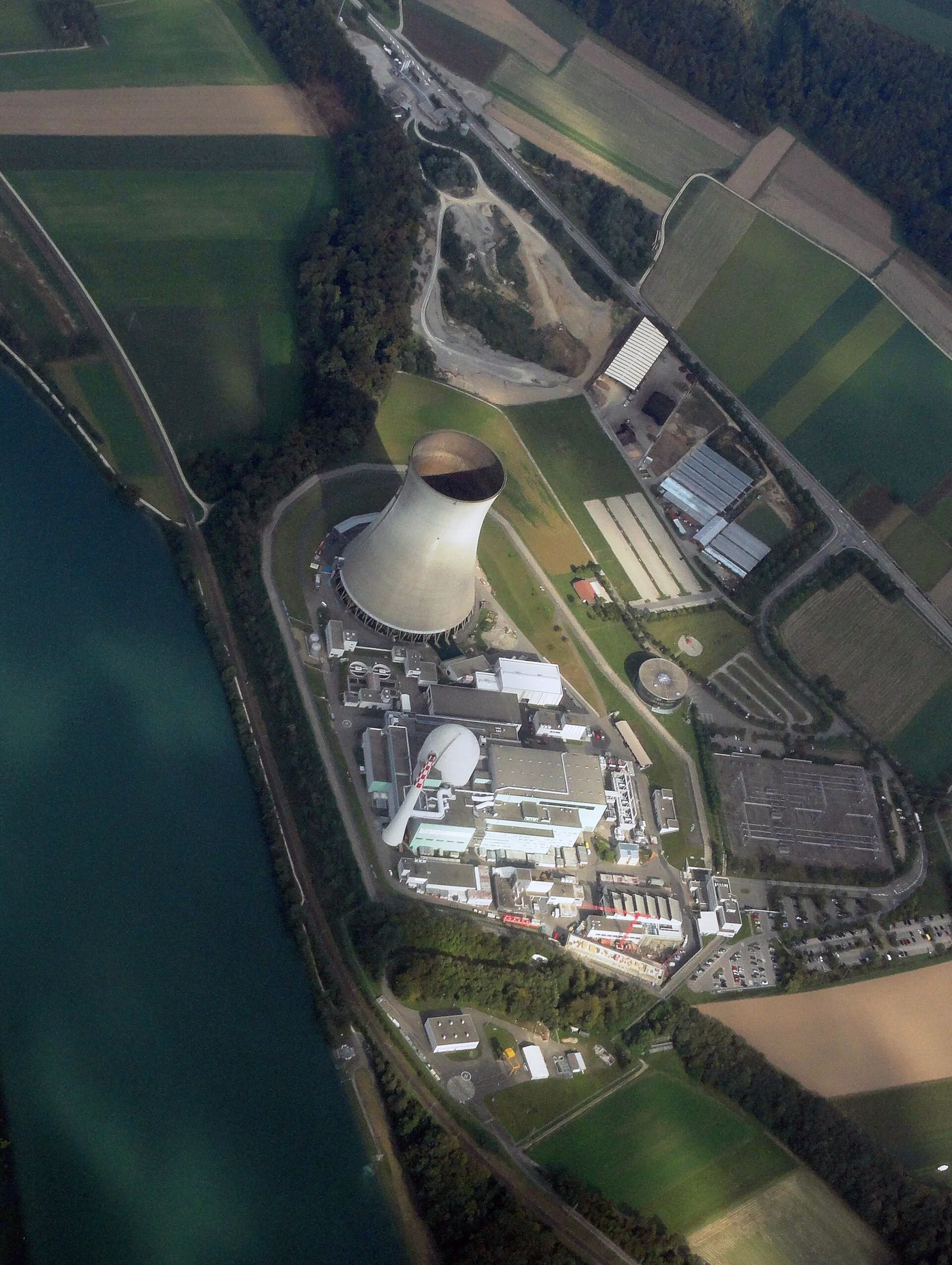
The CONUS+ experiment, with low-threshold germanium detectors 20.7 m from the core of the Leibstadt nuclear power plant in Switzerland, reported in Nature in July 2025 the first observation of coherent elastic scattering of reactor antineutrinos. Over 119 days of reactor operation it measured 395 ± 106 events, in agreement with the Standard Model prediction of 347 ± 59, at 3.7σ. It was the first CEvNS detection at reactor energies, where the recoils are especially tiny.
- Date
- 2025
- Kind of event
- Discovery
- Experiments
- CONUS / CONUS+
The situation before
Coherent elastic neutrino–nucleus scattering, predicted in 1974 by Daniel Freedman, was first observed in 2017 by COHERENT at Oak Ridge, using neutrinos of a few tens of MeV from stopped pions. Nuclear reactors are a far more intense source of antineutrinos, but their energies are only a few MeV. At those energies the scattering is fully coherent, yet the nuclear recoil in germanium amounts to well under a kiloelectronvolt, and only a fraction of that appears as a measurable ionisation signal.
Several groups had tried. In 2022 a germanium measurement at the Dresden-II reactor in Illinois, involving Juan Collar, reported suggestive evidence, but its interpretation depended on a disputed value of the quenching factor at low energies. The CONUS experiment of the Max Planck Institute for Nuclear Physics in Heidelberg had operated germanium detectors at the Brokdorf nuclear power plant in Germany from 2018 and set upper limits before the plant closed.
What happened
In summer 2023 the experiment moved to the Leibstadt nuclear power plant (KKL) in Switzerland as CONUS+. Three high-purity germanium detectors of about 1 kg each were placed 20.7 m from the reactor core, where the antineutrino flux exceeds 10¹³ per square centimetre per second. Electrical cryocoolers, ultra-low-noise electronics and a compact shield of lead, polyethylene and an active muon veto brought energy thresholds down to the order of 0.2 keV of ionisation energy.
Between autumn 2023 and summer 2024 the detectors collected data during about 119 days of reactor operation. After subtracting the measured backgrounds, an excess remained at the lowest energies, exactly where coherent scattering was expected.
The analysis was posted as a preprint in January 2025 and published in Nature on 30 July 2025 under the title "Direct observation of coherent elastic antineutrino–nucleus scattering".
Reaction
Co-author Christian Buck said the measurement had confirmed the sensitivity of CONUS+ and its ability to detect antineutrino scattering on atomic nuclei. Project initiator Manfred Lindner described the results as a possible starting point for a new field of neutrino research. Because 3.7σ is below the 5σ discovery standard, physicists welcomed the result as a first observation that still needs confirmation by more data and by other experiments.
Why it matters
CONUS+ showed that the process can be measured with a few kilograms of detector instead of the tonnes needed for inverse beta decay. That opens several directions. At reactor energies, coherent scattering tests the Standard Model where new forces or a sizeable neutrino magnetic moment would show up as extra events. It is also sensitive to the weak mixing angle at very low momentum transfer.
In the longer term, compact detectors could be used for reactor monitoring, since the count rate follows the reactor power. In autumn 2024 the collaboration installed improved, larger detectors to increase statistics. Other groups, including NUCLEUS, Ricochet and νGeN, are pursuing reactor CEvNS with different technologies. Together with the first solar CEvNS indications in xenon in 2024, the measurement completed the picture of coherent scattering across accelerator, solar and reactor neutrino sources.
Frequently asked questions
What did CONUS+ observe?
It observed coherent elastic scattering of reactor antineutrinos on germanium nuclei for the first time, with 395 ± 106 events at 3.7σ.
Where was the measurement made?
At the Leibstadt nuclear power plant in Switzerland, 20.7 m from the reactor core.
Why is reactor CEvNS hard to detect?
Reactor antineutrinos have only a few MeV, so the nuclear recoils are tiny and only a small part becomes a measurable signal; very low-threshold detectors are needed.
Original papers
- DiscoveryN. Ackermann et al. (CONUS+ Collaboration), Direct observation of coherent elastic antineutrino–nucleus scattering, Nature 643, 1229 (2025)DOI 10.1038/s41586-025-09322-2arXiv:2501.05206
Concepts
Mentioned in 2 pages
Last updated: · Editorial standard
Cite this page
Text
Neutrino Atlas (2026). “2025: CONUS+ observes CEvNS at a nuclear reactor”. Retrieved 22 November 2026, from https://neutrino-atlas.com/timeline/2025-conus-plus-reactor-cevns/BibTeX
@misc{neutrinoatlas2026025conusplusreactorcevns,
  title        = {2025: CONUS+ observes CEvNS at a nuclear reactor},
  author       = {{Neutrino Atlas}},
  year         = {2026},
  url          = {https://neutrino-atlas.com/timeline/2025-conus-plus-reactor-cevns/},
  note         = {Accessed 2026-11-22},
  language     = {english}
}