NUCLEUS
A CEvNS experiment using gram-scale cryogenic calorimeters with eV-scale thresholds, planned at the Chooz reactors in France.
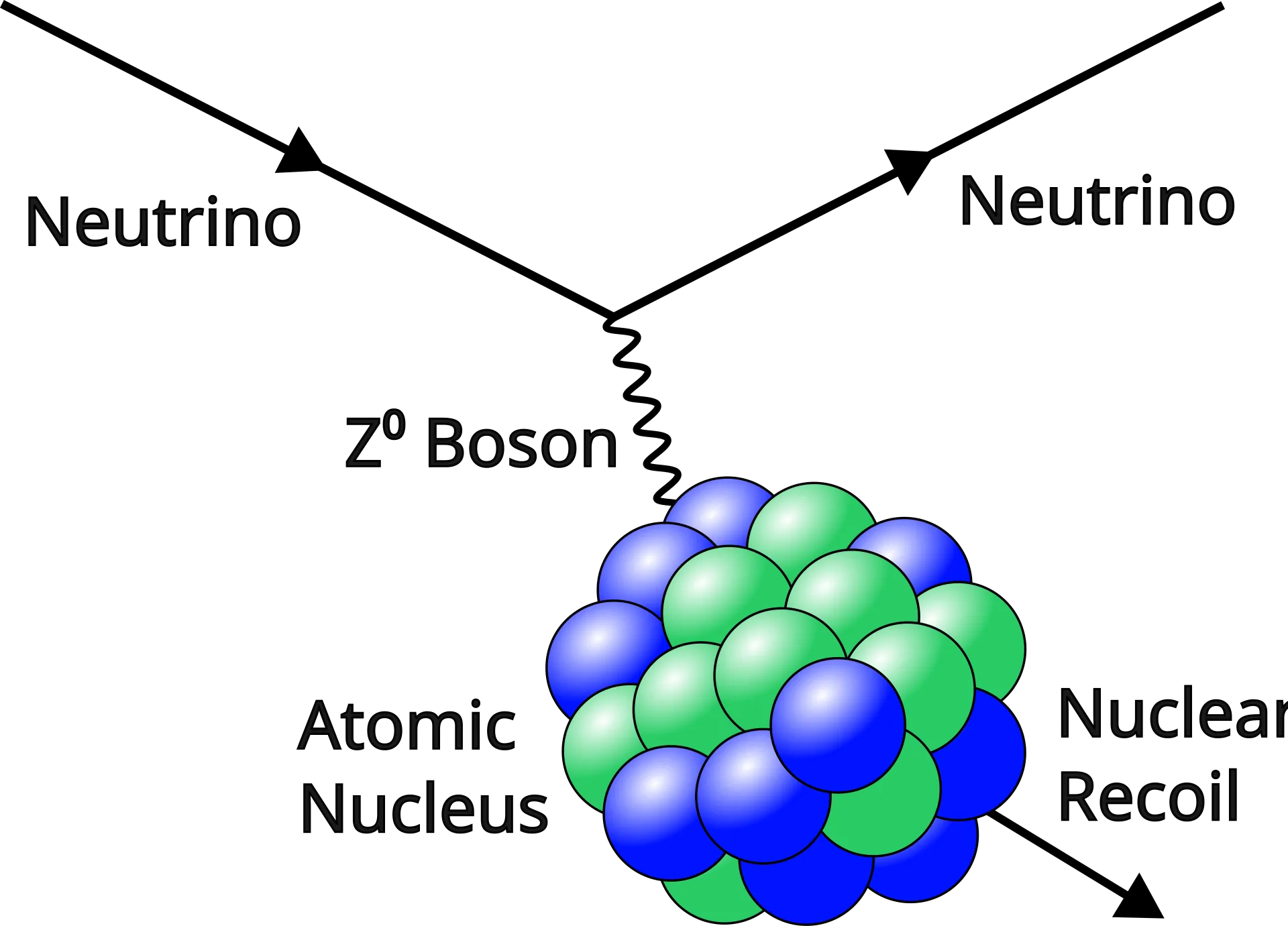
NUCLEUS uses cubes of CaWO₄ and Al₂O₃ of about 0.75 g each, read out by tungsten transition-edge sensors, inside cryogenic and muon vetoes. An eight-week commissioning run at the Technical University of Munich in 2024 reached thresholds of about 30 eV. The full setup of 18 crystals is to run at the Chooz Very Near Site, 72 m and 102 m from two 4.25 GW cores.
Compare all experiments → · World map →
In plain words
NUCLEUS takes the idea of a heat detector to an extreme. Instead of kilogram crystals it uses cubes about half a centimetre across, weighing less than a gram. Such a small crystal has a tiny heat capacity, so even a nuclear recoil of a few tens of electronvolts, the kind of kick a reactor antineutrino gives in coherent scattering, warms it measurably. The price is a small target mass, which the strong antineutrino flux near a power reactor is meant to compensate.
How the detector works
Each target crystal of calcium tungstate (CaWO₄) or sapphire (Al₂O₃) carries a tungsten transition-edge sensor, a superconducting film held at the edge of its transition so that a minute temperature change produces a large change in resistance. The approach grew out of the CRESST dark matter programme and was proposed for reactor neutrinos in 2017. The light oxygen and aluminium nuclei recoil more strongly, while tungsten offers a large coherent cross-section. Around the targets, an inner cryogenic veto made of kilogram germanium crystals rejects particles entering from outside, and an outer muon veto of 28 plastic scintillator panels tags cosmic muons.
Commissioning results
From 1 August to 27 September 2024 the collaboration ran the full apparatus with two target crystals in the shallow underground laboratory of the Technical University of Munich, under about 10 m water equivalent. The sensors reached baseline resolutions of about 6 eV, corresponding to thresholds of roughly 28–31 eV, and the muon veto had an efficiency of about 98.6%. The results were published in 2025.
Next steps
The final payload of nine CaWO₄ and nine Al₂O₃ cubes is to be installed at the Very Near Site of the Chooz nuclear plant in France, 72 m and 102 m from the two 4.25 GW reactors whose antineutrinos Double Chooz studied. The site has only about 3 m water equivalent of overburden, so background suppression is a central challenge. Like other cryogenic detectors, NUCLEUS must also understand the unexplained excess of events seen at the lowest energies in many such devices.
Frequently asked questions
Why are the NUCLEUS crystals so small?
A smaller crystal has a smaller heat capacity, so the same deposited energy causes a larger temperature rise. This allows thresholds of a few tens of electronvolts, far below what ionisation detectors reach.
How is NUCLEUS different from Ricochet?
Both are cryogenic CEvNS experiments. NUCLEUS uses gram-scale crystals with transition-edge sensors at a power plant, while Ricochet uses larger germanium and zinc detectors at a research reactor.
Original papers
- ProposalR. Strauss et al., The ν-cleus experiment: A gram-scale fiducial-volume cryogenic detector for the first detection of coherent neutrino-nucleus scattering, Eur. Phys. J. C 77, 506 (2017)DOI 10.1140/epjc/s10052-017-5068-2arXiv:1704.04320
Related terms
Latest research on this topic
- Probing the structure of the two proton Borromean nucleus 17Ne through inclusive breakup dataPinheiro, B., Rodríguez-Gallardo, M., Lubian, J. · 19 November 2026
- EP241206a: A Sub-kilosecond X-Ray Flare Possibly from an Active Galactic Nucleus with a Flux Increase over 3 Orders of MagnitudeWang, Chen-Yu, Wang, Tinggui, Feng, Hua et al. · 16 November 2026
- LHC Based Antimuon-Nucleus Collider LHμC: Nucleus OptionsCanbay, Ali Can, Dagli, Burak, Goroglu, Arda et al. · 13 November 2026
- Tau polarization, new physics and CP violation in ντ-nucleus hyperon productionHernández, E., Nieves, J., Sobczyk, J.E. · 11 November 2026
- Probing gluon saturation with forward heavy-flavor correlations in proton-nucleus collisionsSalazar, Farid, Schenke, Björn, Zhao, Wenbin · 11 November 2026
- NuSTEC Review: Current Experimental and Theoretical Challenges of Neutrino-Nucleus ScatteringFurmanski, A.P., Morfín, J.G., Alvarez-Ruso, L. et al. · 7 November 2026
Mentioned in 3 pages
Terms 2
Last updated: · Editorial standard
Cite this page
Text
Neutrino Atlas (2026). “NUCLEUS”. Retrieved 22 November 2026, from https://neutrino-atlas.com/terms/nucleus/BibTeX
@misc{neutrinoatlas2026termsnucleus,
  title        = {NUCLEUS},
  author       = {{Neutrino Atlas}},
  year         = {2026},
  url          = {https://neutrino-atlas.com/terms/nucleus/},
  note         = {Accessed 2026-11-22},
  language     = {english}
}