Ricochet
A cryogenic CEvNS experiment 8.8 m from the ILL research reactor in Grenoble, aiming at sub-100 eV recoil thresholds.
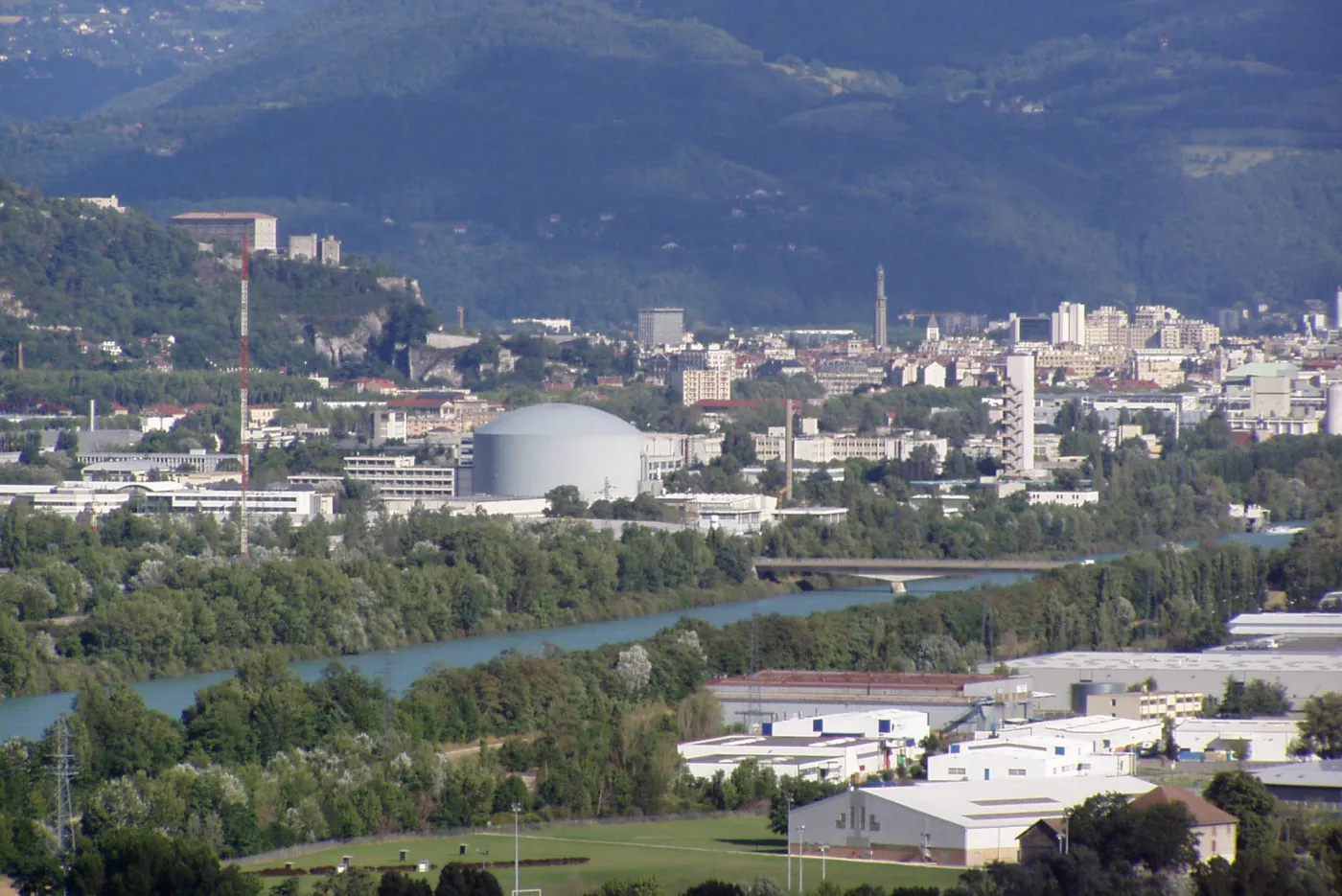
Ricochet operates germanium bolometers (CryoCube, eighteen 42 g crystals) and superconducting zinc detectors (Q-Array) in a dilution cryostat 8.8 m from the 58 MW ILL reactor core. The cryostat was installed in December 2023; 2024 commissioning runs with a three-crystal mini-CryoCube characterised backgrounds without yet claiming a CEvNS signal.
Compare all experiments → · World map →
In plain words
Most detectors measure the electric charge that a particle frees in matter. Ricochet instead measures heat: a neutrino that bumps into a germanium or zinc nucleus warms a crystal cooled to a few hundredths of a degree above absolute zero by a tiny but measurable amount. Because heat does not suffer from the quenching that reduces ionisation signals, this approach can reach the very low recoil energies produced by reactor antineutrinos in coherent scattering.
How the detector works
The experiment sits in the H7 site of the Institut Laue-Langevin, 8.8 m from the core of a research reactor with a thermal power of about 58 MW, inside about 20 tonnes of shielding and a muon veto. Two detector arrays share a dilution cryostat. The CryoCube will hold eighteen 42 g germanium bolometers that record both the heat signal and the ionisation. Comparing the two separates nuclear recoils, which produce little charge, from electron recoils caused by gamma rays. The Q-Array is a set of superconducting zinc crystals designed to distinguish event types in a different way. The goal is a recoil threshold below 100 eV.
Key results so far
- In a 2023 test, prototype germanium detectors reached a baseline ionisation resolution of about 30 eVee, roughly ten times better than earlier cryogenic dark matter detectors (Eur. Phys. J. C, 2024).
- The Ricochet cryostat was installed at ILL in December 2023, and first heat and ionisation signals at the reactor were recorded about two months later.
- Commissioning runs in 2024 with a mini-CryoCube of three crystals measured a reactor-off nuclear-recoil background of about 15 events per kg, day and keV between 2 and 7 keV, consistent with simulations of cosmic-ray-induced neutrons. Surface events were identified as the main limitation.
Why it matters
A precise CEvNS spectrum at low recoil energies is sensitive to a neutrino magnetic moment, non-standard interactions and light new mediators. Ricochet and NUCLEUS represent the cryogenic route to these measurements, complementary to germanium ionisation detectors such as CONUS.
Frequently asked questions
Why measure heat instead of charge?
For a nuclear recoil only a fraction of the energy becomes ionisation, and that fraction is poorly known at low energies. The heat signal captures nearly all of the deposited energy, so thresholds can be lower and the energy scale is less dependent on quenching models.
Has Ricochet detected CEvNS?
Not yet. The 2024 runs were commissioning runs that tested shielding, vetoes and particle identification.
Original papers
- ProposalJ. Billard et al., Coherent Neutrino Scattering with Low Temperature Bolometers at Chooz Reactor Complex, J. Phys. G 44, 105101 (2017)arXiv:1612.09035
Related terms
- Coherent elastic Neutrino-nucleus scattering
- Cryogenic bolometers
- Phonon / heat signal
- NUCLEUS
- CONUS / CONUS+
Latest research on this topic
- Status of the RICOCHET experiment at the ILLRICOCHET Collaboration · 13 January 2026
- Gamma background characterization and modeling for the RICOCHET experiment at the Institut Laue-LangevinRICOCHET Collaboration · 11 January 2026
Last updated: · Editorial standard
Cite this page
Text
Neutrino Atlas (2026). “Ricochet”. Retrieved 22 November 2026, from https://neutrino-atlas.com/terms/ricochet/BibTeX
@misc{neutrinoatlas2026termsricochet,
  title        = {Ricochet},
  author       = {{Neutrino Atlas}},
  year         = {2026},
  url          = {https://neutrino-atlas.com/terms/ricochet/},
  note         = {Accessed 2026-11-22},
  language     = {english}
}