CONUS / CONUS+
A Heidelberg-led germanium experiment that observed CEvNS from reactor antineutrinos for the first time.
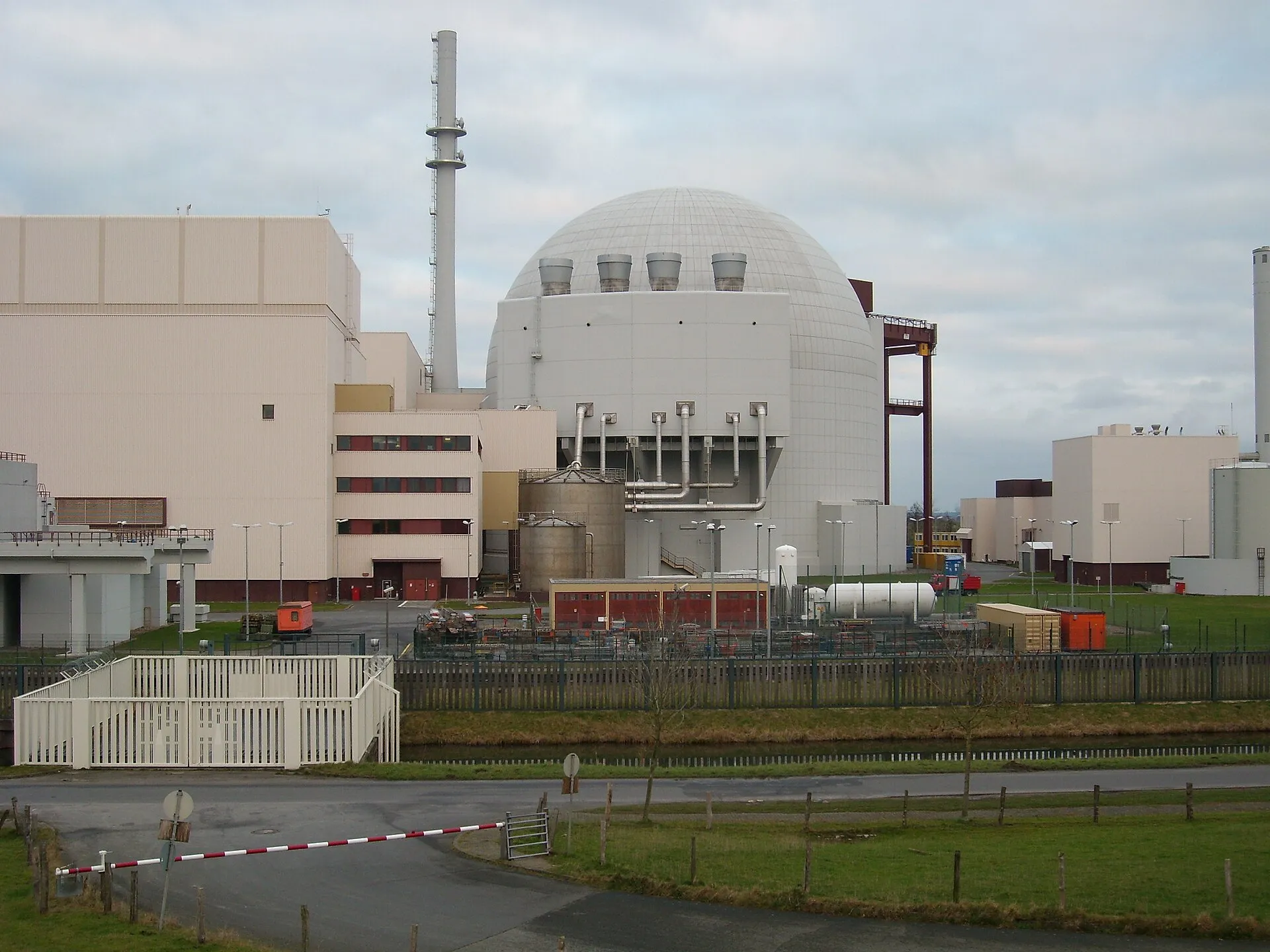
CONUS used four 1 kg point-contact HPGe detectors at the Brokdorf nuclear plant (Germany), setting limits. Its successor CONUS+, moved to the Leibstadt plant in Switzerland, reported 395 ± 106 CEvNS events in 119 days, a 3.7σ observation consistent with the Standard Model (Nature, 2025).
Compare all experiments → · World map →
In plain words
A nuclear power reactor is the most intense neutrino source on Earth, emitting roughly 10²⁰ antineutrinos per second per gigawatt of thermal power. Its antineutrinos are so low in energy, however, that the nuclei they push in a CEvNS event recoil with only a few hundred electronvolts. CONUS, led by the Max Planck Institute for Nuclear Physics in Heidelberg, set out to see those whispers with a few kilograms of germanium placed a short distance from a reactor core.
How the detector works
The experiment uses point-contact high-purity germanium detectors, each about 1 kg, developed for extremely low electronic noise. Their small readout contact gives very low capacitance, which pushes the energy threshold for ionisation down to about 160–180 eV. A compact shield of lead, borated polyethylene and an active muon veto suppresses background at a site with little rock overburden. Two effects make the analysis demanding: the detected ionisation is only a fraction of the recoil energy, set by germanium's quenching factor, and the expected signal sits just above the noise edge.
From CONUS to CONUS+
- CONUS ran at the Brokdorf nuclear plant in northern Germany, about 17 m from the 3.9 GW core, from 2018 to 2022; the reactor was shut down permanently at the end of 2021. It set upper limits on CEvNS and constrained non-standard interactions and the neutrino magnetic moment.
- CONUS+ moved upgraded detectors to the Leibstadt plant in Switzerland, about 20.7 m from a 3.6 GW boiling-water reactor with an antineutrino flux of about 1.5 × 10¹³ cm⁻²s⁻¹. Using three detectors with a combined active mass of 2.83 kg over 119 days of reactor operation, it measured 395 ± 106 events against a Standard Model prediction of 347 ± 59, a 3.7σ observation (Nature, 2025).
Why it matters for neutrino physics
Reactor CEvNS probes the process at much lower momentum transfer than COHERENT, where the coherence is essentially complete and nuclear form-factor uncertainties are negligible. This makes it a clean testing ground for new physics. It also points to compact reactor monitoring detectors that need neither large volumes nor the inverse-beta-decay threshold of 1.8 MeV. An earlier claim of reactor CEvNS from the Dresden-II plant (2022) remained disputed; CONUS+ provides the first observation accepted with sufficient significance.
Frequently asked questions
Why is reactor CEvNS harder to see than at a spallation source?
Reactor antineutrinos have energies of only a few MeV, so the nuclear recoils are about a hundred times smaller than at a stopped-pion source and lie near the detector noise.
Is the CONUS+ result consistent with the Standard Model?
Yes. The measured 395 ± 106 events agree with the predicted 347 ± 59 within uncertainties.
Original papers
- Final resultH. Bonet et al. (CONUS Collaboration), Final CONUS results on coherent elastic neutrino-nucleus scattering at the Brokdorf reactor, Phys. Rev. Lett. 133, 251801 (2024)arXiv:2401.07684
- DiscoveryN. Ackermann et al. (CONUS+ Collaboration), Direct observation of coherent elastic antineutrino–nucleus scattering, Nature (2025)DOI 10.1038/s41586-025-09322-2arXiv:2501.05206
Related terms
People
Latest research on this topic
- High significance measurement of reactor coherent elastic neutrino-nucleus scattering on germanium by CONUS+Ackermann, N., Bonet, H., Buck, C. et al. · 27 October 2026
- Analysis of CONUS+ run 2: Detector performance, background model and CEνNS measurementAckermann, N., Bonet, H., Buck, C. et al. · 27 October 2026
- Background decomposition of the CONUS+ run 1 dataAckermann, N., Bonet, H., Buck, C. et al. · 12 August 2026
- Non-Standard Interactions and Light Z' Bosons from CEvNS Data at CONUS+Benavides, Ch.M., Muñoz, C.S., Canas, B.C. et al. · 22 June 2026
- New constraints on physics within and beyond the standard model from the latest CONUS datasetsCONUS Collaboration · 21 May 2026
- Sub-keV energy calibration of CONUS+ via 71Ge M-shell neutron activationSánchez García, E., Shi, Y., Ackermann, N. et al. · 28 April 2026
On the timeline
Mentioned in 21 pages
Milestones 4
People 2
Last updated: · Editorial standard
Cite this page
Text
Neutrino Atlas (2026). “CONUS / CONUS+”. Retrieved 22 November 2026, from https://neutrino-atlas.com/terms/conus/BibTeX
@misc{neutrinoatlas2026termsconus,
  title        = {CONUS / CONUS+},
  author       = {{Neutrino Atlas}},
  year         = {2026},
  url          = {https://neutrino-atlas.com/terms/conus/},
  note         = {Accessed 2026-11-22},
  language     = {english}
}