CONNIE
Reactor experiment in Brazil that uses silicon CCDs, later Skipper-CCDs, to search for coherent elastic neutrino–nucleus scattering at very low thresholds.
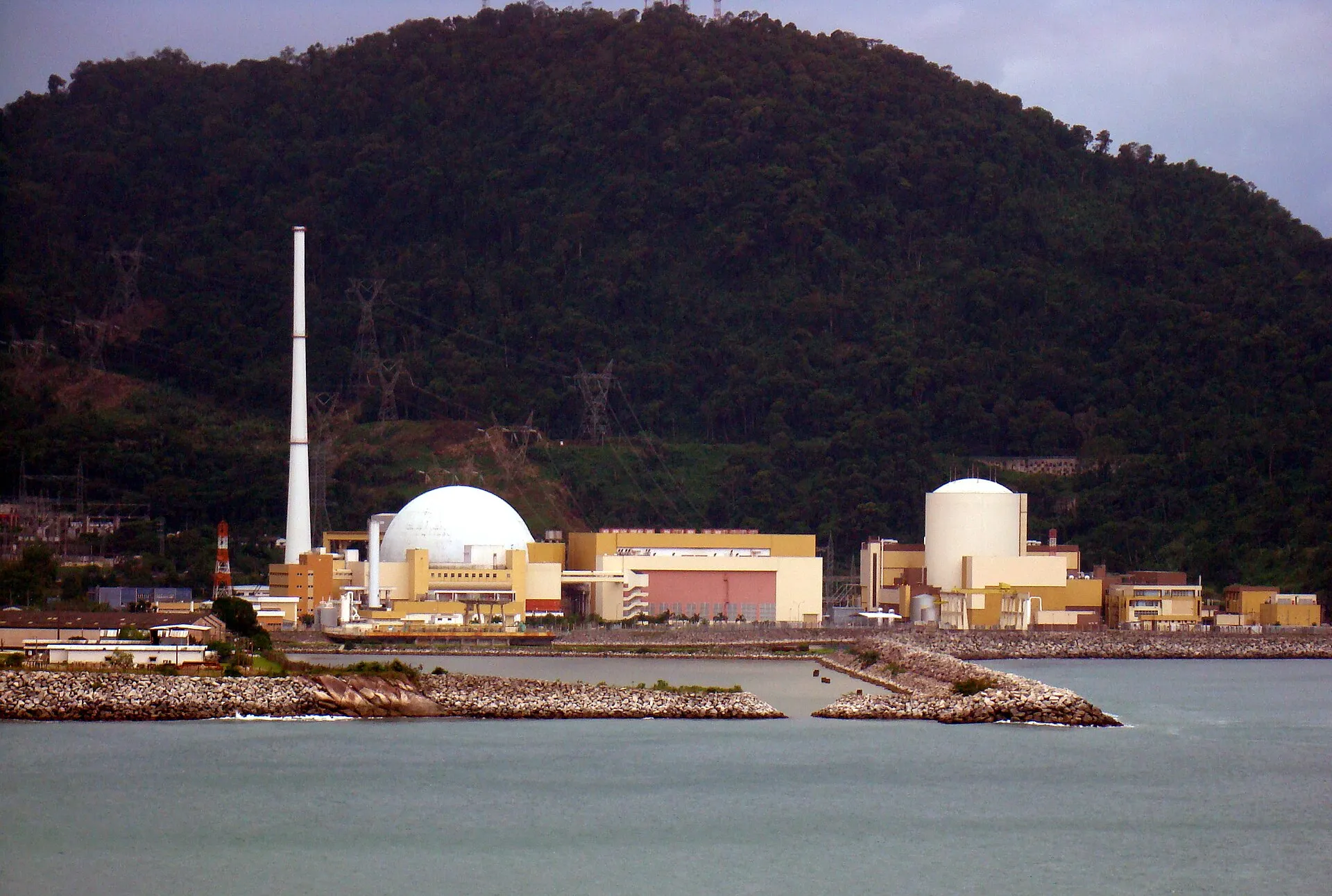
CONNIE operates silicon charge-coupled devices 30 m from the 3.8 GW(th) Angra 2 reactor in the state of Rio de Janeiro. Its 2019 data, 2.2 kg·day with a 50 eV threshold, set a CEvNS rate limit of 66 times the Standard Model expectation. Skipper-CCDs installed in 2021 reached a 15 eVee threshold and gave world-leading limits on millicharged particles below 1 MeV.
Compare all experiments → · World map →
In plain words
In coherent elastic neutrino–nucleus scattering a neutrino nudges a whole nucleus, which recoils with an energy of only a few hundred electronvolts or less when the neutrino comes from a reactor. Seeing such a tiny kick requires a detector with an extremely low noise level. CONNIE uses the same kind of silicon image sensors as astronomical cameras, cooled and shielded next to a nuclear reactor in Brazil, to look for these recoils.
How the detector works
A charge-coupled device (CCD) is a thin silicon sensor divided into millions of pixels. A nuclear recoil frees a small number of electrons in the silicon, which are collected in the pixels and read out. Fully depleted CCDs several hundred micrometres thick give a useful target mass. The more recent Skipper-CCDs measure the charge in each pixel many times without destroying it, reducing the readout noise to a fraction of an electron and allowing individual electrons to be counted. The detector stands 30 m from the core of the Angra 2 reactor, inside lead and polyethylene shielding, and compares reactor-on with reactor-off data.
Key results
- 2016 data: an array of 8 CCDs with 47.6 g active mass set limits at recoil energies near 1 keV, then the lowest reached in a reactor CEvNS search.
- 2019 data: with 2.2 kg·day and a 50 eV threshold achieved by hardware binning, the 95% CL limit on the CEvNS rate was 66 times the Standard Model expectation in the 50–180 eV range.
- Skipper-CCDs (2021–2023): a threshold of 15 eVee and only 18.4 g·day gave a limit of 76 times the expected rate, similar to the standard-CCD result with far less exposure. The same data set world-leading limits on millicharged particles below 1 MeV and constrained light vector mediators and MeV-scale dark matter.
Status today
A 16-sensor Skipper-CCD module was installed in May 2024 and is being commissioned. The collaboration, with groups from Brazil, Argentina, Mexico, Paraguay, Switzerland and the United States, plans a kilogram-scale Skipper-CCD detector and is negotiating a position closer to the core. It complements germanium experiments such as CONUS by using a light target with a lower recoil threshold.
Frequently asked questions
Why silicon?
Silicon is a light nucleus, so it recoils with more energy than germanium for the same neutrino, and CCDs offer extremely low noise.
Has CONNIE observed CEvNS?
Not yet. Its limits lie well above the Standard Model rate, which future larger Skipper-CCD arrays aim to reach.
Original papers
- First resultA. Aguilar-Arevalo et al. (CONNIE Collaboration), Exploring low-energy neutrino physics with the Coherent Neutrino Nucleus Interaction Experiment, Phys. Rev. D 100, 092005 (2019)DOI 10.1103/PhysRevD.100.092005arXiv:1906.02200
- MeasurementA. Aguilar-Arevalo et al. (CONNIE Collaboration), Search for coherent elastic neutrino-nucleus scattering at a nuclear reactor with CONNIE 2019 data, JHEP 05, 017 (2022)DOI 10.1007/JHEP05(2022)017arXiv:2110.13033
- MeasurementA. Aguilar-Arevalo et al. (CONNIE Collaboration), Searches for CEνNS and Physics beyond the Standard Model using Skipper-CCDs at CONNIE (2024)arXiv:2403.15976
Related terms
- Coherent elastic Neutrino-nucleus scattering
- CEvNS experiments
- CONUS / CONUS+
- Nuclear recoil in CEvNS
- Neutrino millicharge
Mentioned in 1 page
Terms 1
Last updated: · Editorial standard
Cite this page
Text
Neutrino Atlas (2026). “CONNIE”. Retrieved 22 November 2026, from https://neutrino-atlas.com/terms/connie/BibTeX
@misc{neutrinoatlas2026termsconnie,
  title        = {CONNIE},
  author       = {{Neutrino Atlas}},
  year         = {2026},
  url          = {https://neutrino-atlas.com/terms/connie/},
  note         = {Accessed 2026-11-22},
  language     = {english}
}