COHERENT
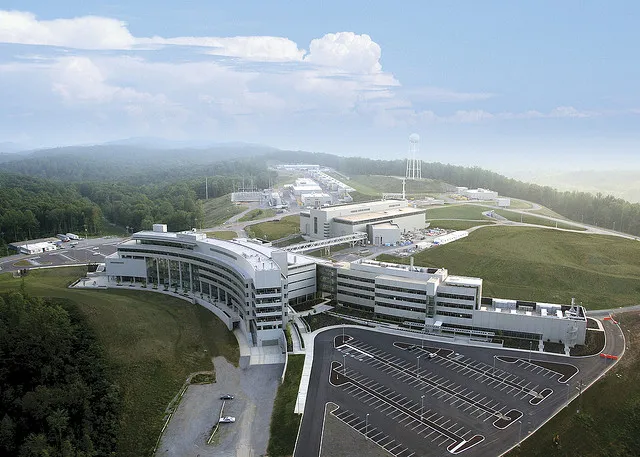
The collaboration at Oak Ridge's SNS that made the first observation of CEvNS in 2017.
A 14.6 kg CsI[Na] scintillator crystal in 'Neutrino Alley' observed CEvNS at 6.7σ (Science, 2017). Later detectors measured CEvNS on argon (2020) and germanium, and further targets (NaI) are being deployed, testing the N² scaling.
Compare all experiments → · World map →
In plain words
COHERENT placed small detectors in a basement corridor next to the most powerful pulsed neutron source in the United States. Each proton pulse also produces a short flash of neutrinos. By comparing what the detectors record just after each pulse with what they record between pulses, the team could pick out a few hundred nuclear recoils from neutrinos and so made the first observation of CEvNS.
The neutrino source
The Spallation Neutron Source at Oak Ridge National Laboratory fires 1 GeV protons at a liquid-mercury target 60 times a second, in pulses less than a microsecond long. Pions produced in the target stop and decay at rest, a classic stopped-pion source:
- π⁺ → μ⁺ + νμ gives a prompt, monoenergetic νμ of 29.8 MeV, arriving within the beam pulse.
- μ⁺ → e⁺ + νe + ν̄μ follows with the muon lifetime of 2.2 μs, giving delayed νe and ν̄μ with energies up to 52.8 MeV.
Because the beam is on for only a tiny fraction of the time, steady backgrounds can be measured directly between pulses and subtracted. The detectors sit in 'Neutrino Alley', about 20 m from the target behind thick layers of steel, concrete and gravel that stop beam neutrons.
Key results
- 2017, caesium iodide: a 14.6 kg CsI[Na] crystal, a technology proposed by Juan Collar, observed 134 ± 22 CEvNS events, consistent with the Standard Model, at 6.7σ (Science, 2017). The full CsI data set later raised the significance to 11.6σ.
- 2020, argon: the 24 kg CENNS-10 liquid-argon detector observed CEvNS on a much lighter nucleus at about 3.5σ.
- 2024, germanium: a 10.7 kg array of point-contact germanium detectors found evidence at 3.9σ.
- Sodium iodide detectors are being deployed, with a tonne-scale NaI array planned.
Why it matters for neutrino physics
Measuring the same process on caesium and iodine, argon and germanium, with neutron numbers from 22 to about 78, tests the predicted growth of the cross section with roughly N². The results constrain the neutron distribution in nuclei, non-standard interactions, the weak mixing angle and light dark-sector particles. The collaboration has been co-led by Kate Scholberg.
Frequently asked questions
Why was a spallation source used instead of a reactor?
Stopped-pion neutrinos have energies of tens of MeV, giving larger and easier-to-detect nuclear recoils, and the pulsed beam allows strong background rejection by timing.
What is Neutrino Alley?
A basement service corridor at the SNS, about 20 m from the mercury target, which is well shielded against neutrons and where COHERENT's detectors are installed.
Original papers
- DiscoveryD. Akimov et al. (COHERENT Collaboration), Observation of coherent elastic neutrino-nucleus scattering, Science 357, 1123 (2017)DOI 10.1126/science.aao0990
- MeasurementD. Akimov et al. (COHERENT Collaboration), First Measurement of Coherent Elastic Neutrino-Nucleus Scattering on Argon, Phys. Rev. Lett. 126, 012002 (2021)DOI 10.1103/PhysRevLett.126.012002arXiv:2003.10630
Related terms
People
- Daniel Z. Freedman
- Juan I. Collar
- Kate Scholberg
- M. Concepción (Concha) González-García
- Holger Thorsten Schubart
Latest research on this topic
- Generation of coherent-state Schrödinger cat states in a two-photon Jaynes-Cummings model implemented with Josephson junctionsAzuma, Hiroo, Munro, William J., Nemoto, Kae · 19 November 2026
- A receiver-side approach to confirm phase randomization in BB84 time-bin QKD with weak coherent pulsesHalcı, Bedir, Kaltenbaek, Rainer · 19 November 2026
- High-Power Short-Wavelength Frequency Comb from Coherent Radiation of Uncompressed Electron BeamsXu, Chenzhi, Yan, Bingyang, Yang, Hanxiang et al. · 19 November 2026
- Modeling the gravitational wave spectrum from slowly-evolving sources in the early Universe: constant-in-time and coherent-decay modelsMidiri, Antonino S., Roper Pol, Alberto, Salomé, Madeline et al. · 19 November 2026
- Accelerating Quantum Error Correction Simulations under Coherent Noise with Compiled Clifford-Augmented Matrix Product StatesHuang, Jiale, Chen, Yaojian, Liu, Ke et al. · 18 November 2026
- Coherent-Response and Thermal-Fluctuation Information in Cavity-Magnon MagnetometryZhao, G., Qian, X.-F. · 18 November 2026
On the timeline
Mentioned in 30 pages
Milestones 4
Terms 18
Last updated: · Editorial standard
Cite this page
Text
Neutrino Atlas (2026). “COHERENT”. Retrieved 22 November 2026, from https://neutrino-atlas.com/terms/coherent/BibTeX
@misc{neutrinoatlas2026termscoherent,
  title        = {COHERENT},
  author       = {{Neutrino Atlas}},
  year         = {2026},
  url          = {https://neutrino-atlas.com/terms/coherent/},
  note         = {Accessed 2026-11-22},
  language     = {english}
}