Dresden-II CEvNS search
A 3 kg germanium detector near a boiling-water reactor in Illinois that reported the first suggestive evidence for reactor CEvNS.
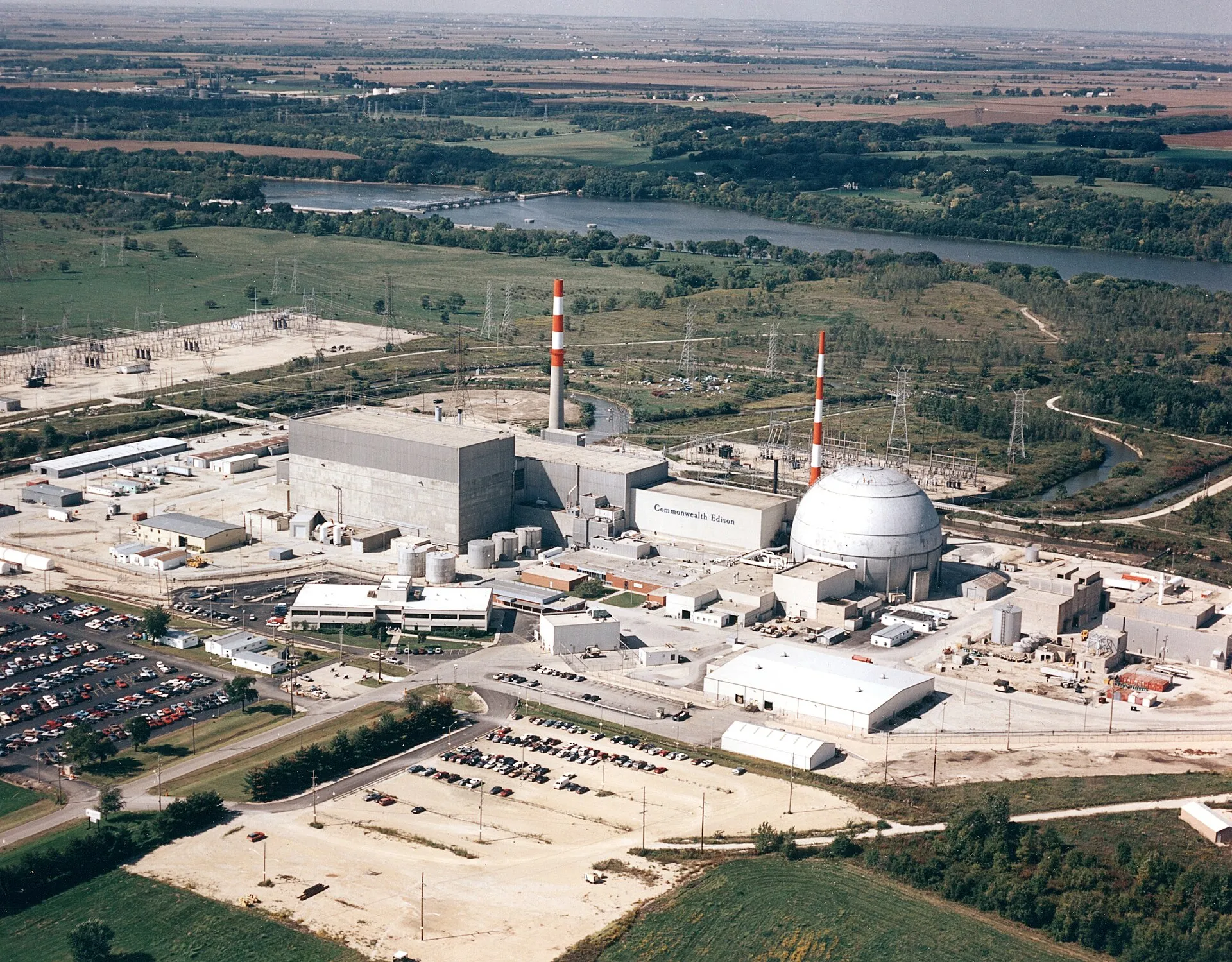
A team around Juan Collar placed an ultra-low-noise p-type point-contact germanium detector about 10 m from the 2.96 GW Dresden-II boiling-water reactor. From 96.4 days of reactor-on data it reported a preference for a CEvNS component (p < 1.2 × 10⁻³) in 2022. The interpretation depends on an enhanced quenching factor and is disputed by CONUS and νGeN.
Compare all experiments → · World map →
In plain words
After COHERENT observed coherent neutrino–nucleus scattering at an accelerator in 2017, the next goal was to see it with reactor antineutrinos, whose lower energies produce even smaller nuclear recoils. The Dresden-II search was the first to report a positive hint of such a signal, using a germanium crystal placed in a reactor building in Illinois.
How the detector works
The experiment was led by Juan Collar of the University of Chicago. Its p-type point-contact germanium detector of about 3 kg was built for extremely low electronic noise and reached a threshold of about 0.2 keVee. It sat inside compact shielding about 10 m from the core of the 2.96 GW thermal Dresden-II boiling-water reactor near Morris, Illinois, where the antineutrino flux is of order 10¹³ per square centimetre per second. A first set of results appeared in 2021.
The 2022 result
Using 96.4 days of reactor-on data and 25 days with the reactor off, the team reported in Physical Review Letters (2022) that the data preferred a CEvNS component over a background-only description with p < 1.2 × 10⁻³. No comparable excess appeared in the reactor-off period. Within the analysis, deviations of order 60% from the Standard Model prediction could be excluded.
Why it is contested
The expected signal in germanium at these energies depends on the quenching factor, the fraction of recoil energy that appears as ionisation. The Dresden-II analysis used quenching measurements by members of the same group that indicate considerably more ionisation below about 1 keV of nuclear recoil energy than the standard Lindhard model. With Lindhard quenching the predicted signal would be much smaller. Later reactor germanium experiments, CONUS in Germany and Switzerland and νGeN in Russia, did not see an excess of the size implied by the enhanced model. CONUS+ reported an observation of reactor CEvNS at 3.7σ in 2025 that is consistent with the Standard Model and conventional quenching.
Legacy
Whatever its final interpretation, the Dresden-II search pushed germanium thresholds lower and made the quenching factor of sub-keV nuclear recoils a central measurement problem for the field.
Frequently asked questions
Did Dresden-II discover reactor CEvNS?
It reported suggestive evidence, not a discovery. The significance of the signal depends on the quenching model, and other experiments have not confirmed it at the claimed level.
What is the quenching factor?
It is the ratio between the ionisation produced by a nuclear recoil and that produced by an electron of the same energy. In germanium at sub-keV energies it is difficult to measure, and different measurements disagree.
Original papers
- First resultJ. Colaresi et al., Suggestive evidence for Coherent Elastic Neutrino-Nucleus Scattering from reactor antineutrinos, Phys. Rev. D 104, 072003 (2021)DOI 10.1103/PhysRevD.104.072003arXiv:2108.02880
- MeasurementJ. Colaresi et al., Measurement of Coherent Elastic Neutrino-Nucleus Scattering from Reactor Antineutrinos, Phys. Rev. Lett. 129, 211802 (2022)DOI 10.1103/PhysRevLett.129.211802arXiv:2202.09672
Related terms
- Coherent elastic Neutrino-nucleus scattering
- High-purity germanium detectors
- Light quenching (Birks' law)
- νGeN
- CONUS / CONUS+
Mentioned in 5 pages
People 1
Terms 2
Last updated: · Editorial standard
Cite this page
Text
Neutrino Atlas (2026). “Dresden-II CEvNS search”. Retrieved 22 November 2026, from https://neutrino-atlas.com/terms/dresden-ii/BibTeX
@misc{neutrinoatlas2026termsdresdenii,
  title        = {Dresden-II CEvNS search},
  author       = {{Neutrino Atlas}},
  year         = {2026},
  url          = {https://neutrino-atlas.com/terms/dresden-ii/},
  note         = {Accessed 2026-11-22},
  language     = {english}
}