νGeN
A germanium CEvNS experiment about 11 m from a 3.1 GW reactor at the Kalinin nuclear power plant in Russia.
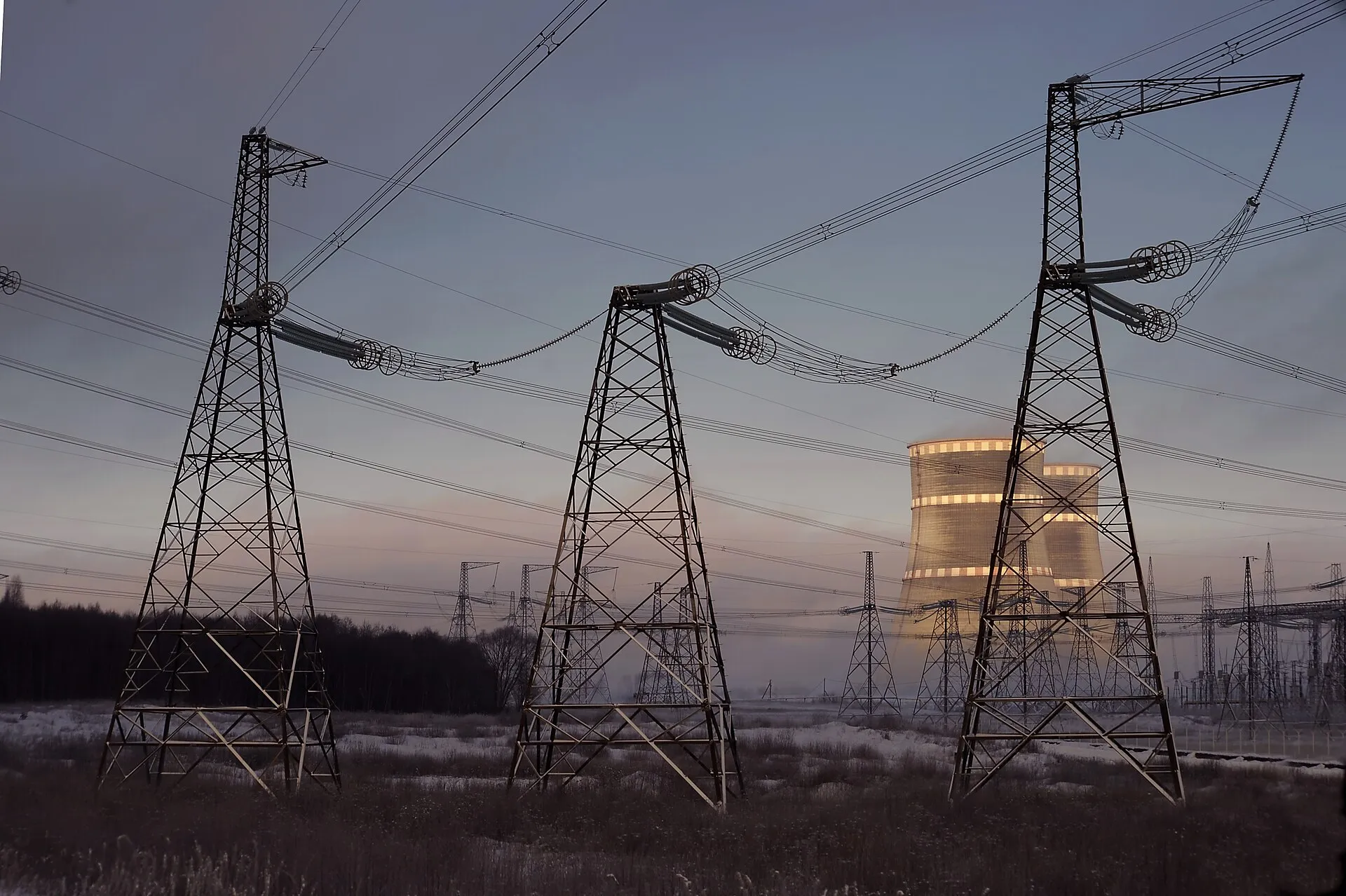
νGeN, led by groups at JINR Dubna, operates a 1.41 kg high-purity germanium point-contact detector on a movable platform beneath a WWER-1000 reactor at Kalinin. With a threshold of 0.29 keVee and about 195 kg·d of reactor-on exposure it found no reactor-correlated excess, and its 2025 limits disfavour strongly enhanced low-energy quenching models.
Compare all experiments → · World map →
In plain words
A power reactor emits an enormous number of antineutrinos, but almost all of them pass through matter untouched. Very rarely one bounces off a whole atomic nucleus and gives it a tiny kick, a process called coherent elastic neutrino–nucleus scattering. νGeN tries to catch these kicks in a germanium crystal parked directly under a reactor, comparing what it records when the reactor is running with what it records when the reactor is off.
How the detector works
The experiment uses a 1.41 kg p-type point-contact germanium detector, a design whose very small electrode keeps electronic noise low enough to register ionisation signals of a few hundred electronvolts. The detector, its passive shielding and an active muon veto sit on a lifting platform below unit 3 of the Kalinin plant, a 3.1 GW thermal WWER-1000 reactor. The reactor building above provides a modest overburden against cosmic muons. At the closest allowed position the detector is 11.1 m from the core, where the antineutrino flux is among the highest available at any reactor experiment. Moving the platform changes the flux and gives an additional handle on backgrounds.
Key results
In a 2025 analysis νGeN used an energy threshold of 0.29 keVee, with about 194.5 kg·d of data with the reactor on and 54.6 kg·d with it off. The count rates in the 0.29–0.40 keVee region showed no statistically significant difference. Because a nuclear recoil produces less ionisation than an electron of the same energy, the expected signal depends strongly on the assumed quenching factor. The collaboration therefore quoted limits for several models: 4.3, 3.1 and 0.7 times the Standard Model rate. For the most optimistic model the data would exclude even the Standard Model signal, which disfavours that model.
Why it matters
Reactor CEvNS in germanium probes the fully coherent regime at recoil energies far below those of the COHERENT measurements at a spallation source. νGeN's results, together with those of CONUS, bear directly on the earlier Dresden-II claim, which relied on an enhanced low-energy quenching factor.
Status today
The collaboration continues data taking at Kalinin and is working to lower its threshold and background further.
Frequently asked questions
Why does νGeN not simply see the signal?
The expected CEvNS signal in germanium lies right at the noise threshold, and its size depends on the poorly known quenching factor below about 1 keV of nuclear recoil energy. With realistic quenching the rate predicted above 0.29 keVee is small compared with the remaining background.
What is the advantage of a movable platform?
Raising or lowering the detector changes its distance to the core and hence the neutrino flux, while most backgrounds stay the same. This helps to separate reactor-correlated signals from detector effects.
Original papers
- First resultI. Alekseev et al. (νGeN Collaboration), First results of the νGeN experiment on coherent elastic neutrino-nucleus scattering, Phys. Rev. D 106, L051101 (2022)DOI 10.1103/PhysRevD.106.L051101arXiv:2205.04305
- MeasurementI. Alekseev et al. (νGeN Collaboration), New constraints on coherent elastic neutrino–nucleus scattering by the νGeN experiment, Chin. Phys. C (2025)DOI 10.1088/1674-1137/adb9c8arXiv:2502.18502
Related terms
- CONUS / CONUS+
- Coherent elastic Neutrino-nucleus scattering
- High-purity germanium detectors
- Light quenching (Birks' law)
- Dresden-II CEvNS search
Mentioned in 4 pages
Last updated: · Editorial standard
Cite this page
Text
Neutrino Atlas (2026). “νGeN”. Retrieved 22 November 2026, from https://neutrino-atlas.com/terms/nugen/BibTeX
@misc{neutrinoatlas2026termsnugen,
  title        = {νGeN},
  author       = {{Neutrino Atlas}},
  year         = {2026},
  url          = {https://neutrino-atlas.com/terms/nugen/},
  note         = {Accessed 2026-11-22},
  language     = {english}
}