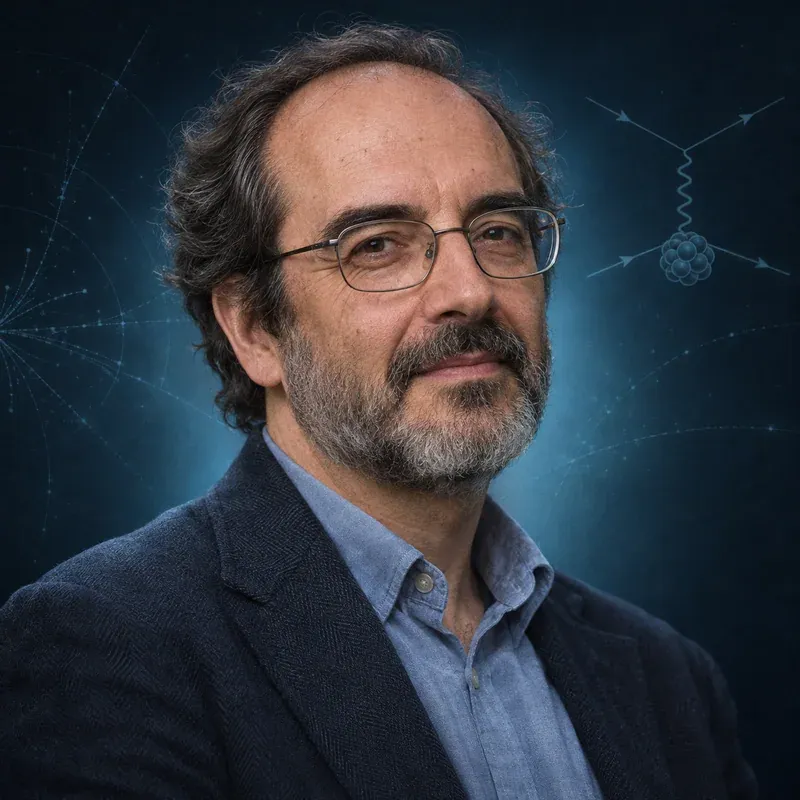
 Illustration
Juan I. Collar
Collar's University of Chicago group developed the 14.6 kg cesium-iodide detector – billed as the world's smallest neutrino detector – with which the COHERENT collaboration at Oak Ridge's Spallation Neutron Source made the first observation of coherent elastic neutrino-nucleus scattering in 2017, a process predicted by Freedman in 1974. He has since pursued low-threshold germanium detectors for CEvNS at reactors.
- Field
- Experimental astroparticle physics
- Institutions
- University of South Carolina (PhD 1992), University of Paris VI-VII, CERN, University of Chicago (Enrico Fermi Institute, KICP)
Background
Juan I. Collar is an experimental astroparticle physicist and professor of physics at the Enrico Fermi Institute and the College of the University of Chicago, where he has been on the faculty since 2001. He received his PhD from the University of South Carolina in 1992 and worked in Paris and at CERN before moving to Chicago. His research has centred on a single technical theme: building detectors that can see extremely small energy depositions – a few keV or less – with very low background. That skill is shared by two fields that rarely overlapped before: the search for dark matter and the detection of low-energy neutrinos.
Dark matter and axion searches
For much of his career Collar worked on direct searches for WIMPs, hypothetical heavy particles that could make up dark matter. His group developed COUPP, a bubble chamber filled with a superheated fluid that boils only where a nuclear recoil deposits enough energy, and which is almost blind to the electron recoils produced by gamma rays. COUPP later merged into PICO at SNOLAB, which Collar co-led. He also worked on the CoGeNT experiment with low-threshold germanium detectors and on the CERN Axion Solar Telescope (CAST), which looked for axions produced in the Sun.
Observing coherent neutrino scattering
In 1974 Daniel Freedman pointed out that a low-energy neutrino can scatter off an entire nucleus at once. In this process, coherent elastic neutrino–nucleus scattering or CEvNS, the contributions of all neutrons add up, so the cross section grows roughly with the square of the neutron number and is much larger than for other neutrino reactions. The catch is that the only observable is a nuclear recoil of a few keV. In Collar's analogy, it is like ping-pong balls striking a bowling ball. For more than four decades no detector was both sensitive and quiet enough.
Collar's group, as part of the COHERENT collaboration led by Kate Scholberg, chose a sodium-doped cesium iodide crystal. Cesium and iodine are heavy nuclei with many neutrons, CsI[Na] produces enough scintillation light for low thresholds, and the material is cheap. The detector, with 14.6 kg of crystal and about the size of a toaster, was placed in a basement corridor called ‘neutrino alley’ about 20 metres from the target of the Spallation Neutron Source at Oak Ridge. The SNS delivers short proton pulses, so the neutrinos from pion decay at rest arrive in a narrow time window while cosmic-ray background is spread evenly, and shielding of iron and concrete removes the neutrons. As Collar put it, ‘It was the marriage of ideal source and ideal detector that made the experiment work.’
The result, published in Science in August 2017, reported 134 ± 22 CEvNS events, a 6.7σ observation, in agreement with the Standard Model prediction. It turned CEvNS from a textbook process into a measurement tool: for non-standard interactions, for the neutron distribution in nuclei, and for understanding the neutrino fog that will limit future dark-matter searches.
Later work
Collar has since concentrated on neutrino detection with low-threshold detectors, in particular germanium detectors near nuclear reactors, where CEvNS could eventually allow compact reactor monitoring. In 2022 his group reported evidence suggestive of reactor CEvNS at the Dresden-II power plant in Illinois; other reactor experiments such as CONUS have studied the same process with different results, and the comparison is an active topic.
Known for
- Compact CsI[Na] detector with which COHERENT first observed CEvNS (2017)
- CoGeNT and COUPP/PICO dark-matter experiments
- CERN Axion Solar Telescope (CAST)
- Low-threshold detectors for reactor CEvNS
Chronology
- 1992PhD, University of South Carolina
- 2001Joins University of Chicago faculty
- 2017COHERENT first observation of CEvNS
Original papers
- COHERENT Collaboration (D. Akimov et al.), Observation of coherent elastic neutrino-nucleus scattering, Science 357, 1123 (2017)DOI 10.1126/science.aao0990
Experiments
- COHERENT
- CoGeNT
- COUPP
- PICO
- CAST
Connected people
Frequently asked questions
What did Juan Collar's detector observe?
Coherent elastic neutrino–nucleus scattering, seen for the first time in 2017 by COHERENT with his 14.6 kg cesium-iodide detector at Oak Ridge, 43 years after the process was predicted.
Why can a CEvNS detector be so small?
Because the coherent cross section is far larger than that of other neutrino interactions, a few kilograms of heavy-nucleus target suffice – provided the detector can record recoils of a few keV against a very low background.
On the timeline
Mentioned in 8 pages
Milestones 2
People 1
Last updated: · Editorial standard
Cite this page
Text
Neutrino Atlas (2026). “Juan I. Collar”. Retrieved 22 November 2026, from https://neutrino-atlas.com/people/juan-collar/BibTeX
@misc{neutrinoatlas2026peoplejuancollar,
  title        = {Juan I. Collar},
  author       = {{Neutrino Atlas}},
  year         = {2026},
  url          = {https://neutrino-atlas.com/people/juan-collar/},
  note         = {Accessed 2026-11-22},
  language     = {english}
}