 Illustration
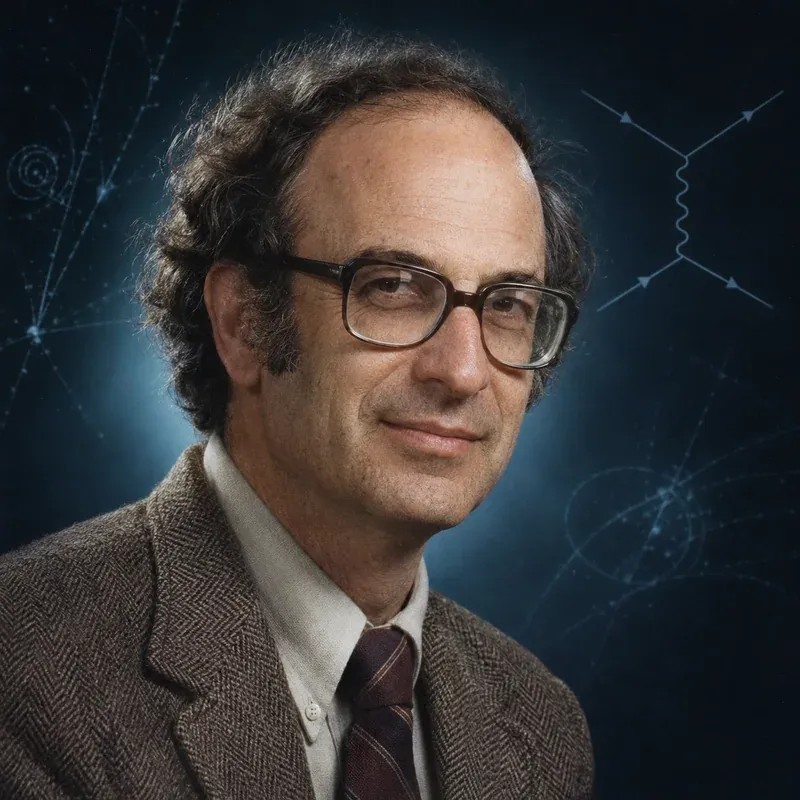
Daniel Z. Freedman
In 1974, shortly after the discovery of weak neutral currents, Freedman pointed out that low-energy neutrinos scatter coherently off whole nuclei via Z exchange, with a cross section growing roughly as the square of the neutron number. He noted that detecting the tiny nuclear recoils would be very hard; coherent elastic neutrino-nucleus scattering (CEvNS) was first observed by COHERENT in 2017. Kopeliovich and Frankfurt discussed the same process independently in 1974.
- Born
- 1939
Hartford, Connecticut, USA - Nationality
- American
- Field
- Theoretical physics; supergravity
- Institutions
- University of Wisconsin–Madison (PhD 1964), Stony Brook University, MIT, Stanford University
Education and career
Daniel Z. Freedman was born in Hartford, Connecticut, in 1939. He studied at Wesleyan University and received his PhD from the University of Wisconsin–Madison in 1964. After a period as a member of the Institute for Advanced Study in Princeton, he became a professor at Stony Brook University, and in 1980 he moved to MIT as professor of applied mathematics, later also of physics. He is now professor emeritus at MIT and a visiting professor at Stanford. Most of his career has been devoted to quantum field theory, gravity and supersymmetry, but one short paper made him a key figure in neutrino physics.
Key contribution: coherent neutrino–nucleus scattering
In 1973 the Gargamelle experiment at CERN discovered weak neutral currents, interactions in which a neutrino exchanges a Z boson and keeps its identity. In ‘Coherent effects of a weak neutral current’, published in Physical Review D in 1974, Freedman pointed out a striking consequence. When the momentum transferred to a nucleus is small, so that the neutrino’s wavelength is larger than the nucleus, the neutrino cannot resolve the individual nucleons. It then scatters off the nucleus as a whole, and the contributions of all nucleons add up in amplitude rather than in probability. Because the Z couples to protons only weakly, the cross section grows roughly with the square of the number of neutrons. This is coherent elastic neutrino–nucleus scattering, CEvNS. Vadim Kopeliovich and Leonid Frankfurt discussed the same process independently in the same year.
For heavy nuclei this makes CEvNS the largest of all neutrino cross sections at energies of a few tens of MeV. The catch is that the only signal is a tiny nuclear recoil of a few keV. Freedman was aware of this and wrote that the proposal ‘may be an act of hubris, because the inevitable constraints of interaction rate, resolution, and background pose grave experimental difficulties’. In 1977, with David Schramm and David Tubbs, he showed that coherent scattering on heavy nuclei traps neutrinos in collapsing stars, which became an important ingredient of the supernova mechanism.
It took 43 years for detector technology to catch up. In 2017 the COHERENT collaboration observed CEvNS with a 14.6 kg caesium iodide crystal at the Spallation Neutron Source at Oak Ridge, using neutrinos from pion decay at rest. Measurements with argon, germanium and, at reactors, by experiments such as CONUS followed (see CEvNS experiments). CEvNS now tests the weak mixing angle and non-standard interactions, measures neutron distributions in nuclei, and sets the neutrino fog that limits dark-matter searches.
Supergravity and recognition
In 1976, with Sergio Ferrara and Peter van Nieuwenhuizen, Freedman constructed supergravity, the extension of general relativity in which supersymmetry is a local symmetry and the graviton has a spin-3/2 partner, the gravitino. He later co-wrote the textbook ‘Supergravity’ (2012) with Antoine Van Proeyen. The three discoverers shared the 1993 Dirac Medal of the ICTP, the 2006 Dannie Heineman Prize for Mathematical Physics and the 2019 Breakthrough Prize in Fundamental Physics. Freedman is a member of the US National Academy of Sciences.
Known for
- Prediction of coherent elastic neutrino-nucleus scattering (1974)
- Co-discovery of supergravity (1976)
- Breakthrough Prize 2019
Chronology
- 1974'Coherent effects of a weak neutral current'
- 1976Supergravity with Ferrara and van Nieuwenhuizen
- 2017CEvNS observed by COHERENT
- 2019Breakthrough Prize in Fundamental Physics
Original papers
- D. Z. Freedman, Coherent effects of a weak neutral current, Phys. Rev. D 9, 1389 (1974)DOI 10.1103/PhysRevD.9.1389
Experiments
Connected people
Frequently asked questions
What did Daniel Freedman predict about neutrinos?
In 1974 he predicted coherent elastic neutrino–nucleus scattering, in which a low-energy neutrino scatters off a whole nucleus with a cross section roughly proportional to the square of the neutron number.
When was coherent neutrino scattering first observed?
In 2017, by the COHERENT experiment at the Spallation Neutron Source in Oak Ridge, 43 years after Freedman’s prediction.
On the timeline
- 1974Freedman predicts coherent neutrino-nucleus scattering
- 2017COHERENT observes coherent neutrino-nucleus scattering
Mentioned in 13 pages
Lessons 3
Milestones 5
People 2
Last updated: · Editorial standard
Cite this page
Text
Neutrino Atlas (2026). “Daniel Z. Freedman”. Retrieved 22 November 2026, from https://neutrino-atlas.com/people/daniel-freedman/BibTeX
@misc{neutrinoatlas2026peopledanielfreedman,
  title        = {Daniel Z. Freedman},
  author       = {{Neutrino Atlas}},
  year         = {2026},
  url          = {https://neutrino-atlas.com/people/daniel-freedman/},
  note         = {Accessed 2026-11-22},
  language     = {english}
}