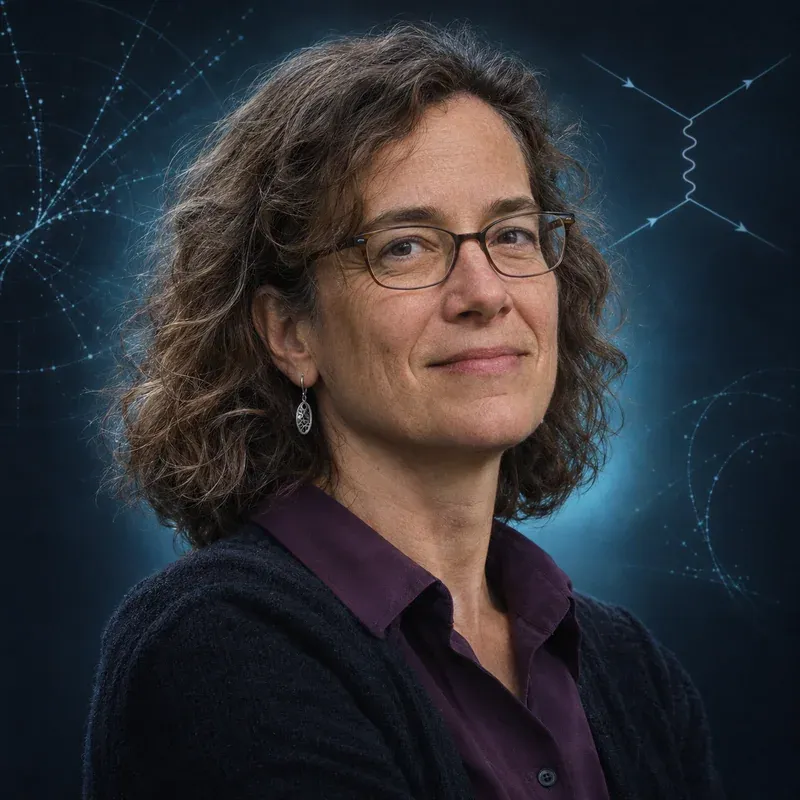
 Illustration
Kate Scholberg
Scholberg is spokesperson of the COHERENT collaboration, which made the first measurement of coherent elastic neutrino-nucleus scattering in 2017 using neutrinos from the Spallation Neutron Source at Oak Ridge. She co-founded and coordinates SNEWS, the inter-experiment network designed to give astronomers prompt alerts of a Galactic core-collapse supernova, and works on supernova-burst sensitivity in Super-Kamiokande and DUNE.
- Nationality
- Canadian and American
- Field
- Experimental neutrino physics
- Institutions
- McGill University (BSc 1989), California Institute of Technology (PhD 1996), Boston University, MIT
Education
Kate Scholberg studied physics at McGill University in Montreal (BSc 1989) and went on to the California Institute of Technology, where she received her PhD in 1996 under the joint supervision of Charles Peck and Barry Barish. Her thesis, ‘A search for neutrinos from gravitational collapse with the MACRO experiment’, used the MACRO detector at the Gran Sasso laboratory to look for the burst of neutrinos a collapsing star in our Galaxy would produce. That question – how to catch the next Galactic supernova in neutrinos – has run through her career ever since.
Career
After postdoctoral work at Boston University and a junior faculty position at the Massachusetts Institute of Technology, Scholberg joined Duke University in 2004, where she is Arts & Sciences Distinguished Professor of Physics. She has worked on Super-Kamiokande and on the long-baseline experiment T2K, and she is a member of DUNE, where she has helped develop the physics case for detecting supernova neutrinos in liquid argon. Argon is mainly sensitive to electron neutrinos through charged-current capture, whereas water and scintillator detectors see mainly electron antineutrinos, so DUNE would add a complementary view of the neutronization burst and the early phase of the collapse.
SNEWS
A core-collapse supernova in the Milky Way is expected only a few times per century. Its neutrinos escape the star hours before the shock wave breaks through the surface and the star brightens in visible light. Scholberg helped develop, and has long coordinated, the SuperNova Early Warning System, a network that links the online supernova triggers of detectors such as Super-Kamiokande, IceCube, KamLAND and others. To avoid false alarms, an alert is sent to astronomers only when several independent detectors report a burst within a short time window. A newer version, SNEWS 2.0, aims to add rough pointing to the supernova from the arrival-time differences between detectors and to issue alerts on pre-supernova neutrinos (see supernova early warning).
COHERENT
Scholberg is spokesperson of the COHERENT collaboration at Oak Ridge National Laboratory. The Spallation Neutron Source produces, besides neutrons, an intense pulsed flux of neutrinos from pion and muon decays at rest, with energies of a few tens of MeV – similar to supernova neutrinos and ideal for coherent elastic neutrino–nucleus scattering. In 2017 COHERENT reported the first observation of this process with a cesium-iodide detector developed by Juan Collar's group, confirming the prediction made by Daniel Freedman in 1974. The collaboration then observed CEvNS on argon (2020) and has continued with further targets, including germanium and sodium, to test how the cross section scales with neutron number (see CEvNS experiments). The connection to her supernova work is direct: CEvNS is the same process that occurs in collapsing stars, and large dark-matter detectors may one day record supernova neutrinos through it.
Honours
Scholberg became a Fellow of the American Physical Society in 2013, was elected to the U.S. National Academy of Sciences in 2022, and became a Fellow of the American Association for the Advancement of Science in 2023.
Known for
- Spokesperson of COHERENT
- Co-founder and coordinator of the Supernova Early Warning System (SNEWS)
- Supernova neutrino detection in Super-Kamiokande and DUNE
- T2K
Chronology
- 1989BSc, McGill University
- 1996PhD, Caltech (MACRO supernova neutrino search; advisers C. Peck, B. Barish)
- 2004Joins Duke University
- 2013Fellow of the American Physical Society
- 2017COHERENT first observation of CEvNS
- 2022Elected to the U.S. National Academy of Sciences
- 2023AAAS Fellow
Original papers
- COHERENT Collaboration (D. Akimov et al.), Observation of coherent elastic neutrino-nucleus scattering, Science 357, 1123 (2017)DOI 10.1126/science.aao0990
Experiments
Connected people
Frequently asked questions
What is SNEWS, which Kate Scholberg coordinates?
The SuperNova Early Warning System, a network of neutrino detectors that sends an automatic alert to astronomers when several of them see a burst of neutrinos at the same time, giving advance notice before the supernova becomes visible.
What did COHERENT discover?
In 2017, under Scholberg as spokesperson, COHERENT made the first observation of coherent elastic neutrino–nucleus scattering, using neutrinos from the Spallation Neutron Source at Oak Ridge.
Why are supernova neutrinos important?
They carry about 99 percent of the energy released in a core collapse and come from the heart of the explosion, so they test the supernova mechanism and neutrino properties in conditions no laboratory can produce.
On the timeline
Mentioned in 9 pages
People 1
Last updated: · Editorial standard
Cite this page
Text
Neutrino Atlas (2026). “Kate Scholberg”. Retrieved 22 November 2026, from https://neutrino-atlas.com/people/kate-scholberg/BibTeX
@misc{neutrinoatlas2026peoplekatescholberg,
  title        = {Kate Scholberg},
  author       = {{Neutrino Atlas}},
  year         = {2026},
  url          = {https://neutrino-atlas.com/people/kate-scholberg/},
  note         = {Accessed 2026-11-22},
  language     = {english}
}