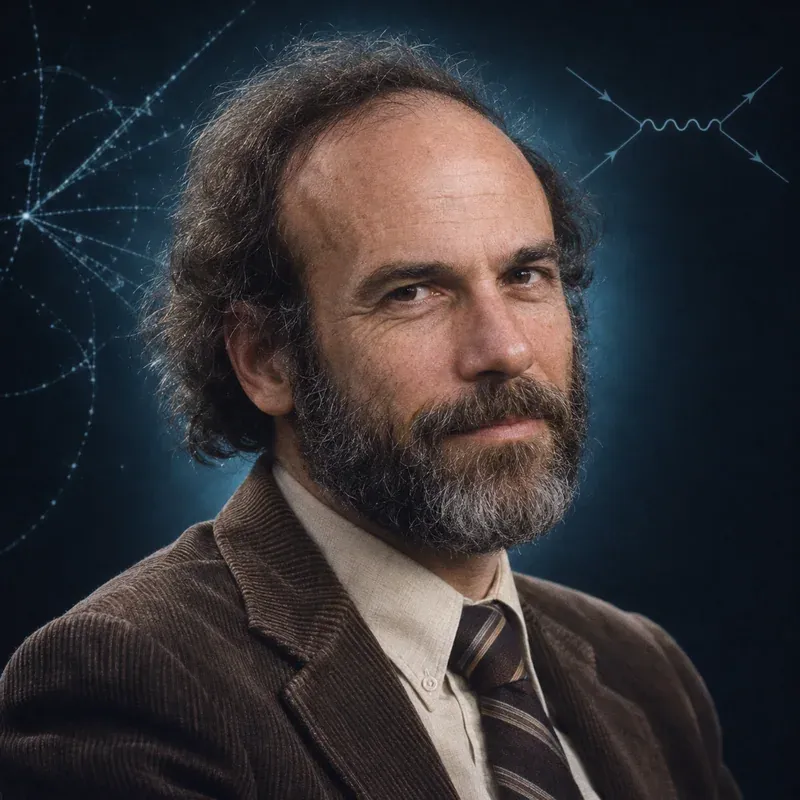
 Illustration
Barry C. Barish
Barish's Fermilab neutrino experiments used high-energy neutrino collisions to probe the quark substructure of the nucleon and were among the first to observe weak neutral currents. He then led MACRO at Gran Sasso, whose atmospheric neutrino measurements supported neutrino oscillation and mass.
- Born
- 27 January 1936
Omaha, Nebraska, USA - Nationality
- American
- Field
- Experimental particle physics, gravitational waves
- Nobel Prize
- Physics 2017 – for decisive contributions to the LIGO detector and the observation of gravitational waves (shared with Weiss and Thorne; not for neutrino work)
- Institutions
- California Institute of Technology, Fermilab, LIGO
Early life and education
Barry Clark Barish was born in Omaha, Nebraska, on 27 January 1936; after the Second World War his family moved to Los Angeles. He studied at the University of California, Berkeley, earning a BA in physics in 1957 and a PhD in experimental high-energy physics in 1962. In 1963 he joined Caltech as a research fellow, where he spent most of his career and led the high-energy physics group from 1984 to 1996.
Neutrino experiments at Fermilab
In the early 1970s Barish and Frank Sciulli led the Caltech–Fermilab neutrino experiment, which fired high-energy neutrinos from the new Fermilab accelerator into a massive iron-and-scintillator target. Neutrinos are ideal probes of the nucleon's interior because they interact only weakly and see the quarks directly; through deep inelastic scattering the experiment studied the quark structure of protons and neutrons. It was also among the first to observe neutral-current interactions, in which the neutrino leaves the collision without turning into a charged lepton, confirming a key prediction of electroweak theory.
MACRO
In the 1980s Barish led MACRO, a large detector in the Gran Sasso underground laboratory built to search for magnetic monopoles and study cosmic rays. MACRO also recorded upward-going muons produced by atmospheric neutrinos that had crossed the Earth. It found fewer of them than expected, with an angular pattern consistent with muon-neutrino oscillation, independent support for the Super-Kamiokande discovery of 1998.
Later work and Nobel Prize
In the early 1990s Barish was spokesperson of the GEM experiment for the Superconducting Super Collider, which was cancelled in 1993. He then became principal investigator of LIGO in 1994 and its director in 1997, overseeing construction of the two interferometers and founding the LIGO Scientific Collaboration. LIGO detected gravitational waves from merging black holes on 14 September 2015. From 2005 to 2013 he directed the Global Design Effort for the proposed International Linear Collider. In 2017 he shared the Nobel Prize in Physics with Rainer Weiss and Kip Thorne for LIGO; neutrino physics was the earlier half of his research life.
Known for
- Fermilab neutrino scattering experiments
- Leader of MACRO at Gran Sasso
- LIGO
Chronology
- 1974Fermilab neutral-current observations
- 1989MACRO begins operation at Gran Sasso
- 2017Nobel Prize in Physics (LIGO)
Experiments
- Caltech–Fermilab neutrino experiment
- MACRO
Connected people
Frequently asked questions
Did Barry Barish win the Nobel Prize for neutrino research?
No. His 2017 Nobel Prize in Physics was for decisive contributions to LIGO and the observation of gravitational waves. His neutrino work at Fermilab and with MACRO came earlier.
What did MACRO contribute to neutrino physics?
It measured a deficit and angular distortion of upward-going muons from atmospheric neutrinos, consistent with muon-neutrino oscillation.
Mentioned in 3 pages
People 2
Terms 1
Last updated: · Editorial standard
Cite this page
Text
Neutrino Atlas (2026). “Barry C. Barish”. Retrieved 22 November 2026, from https://neutrino-atlas.com/people/barry-barish/BibTeX
@misc{neutrinoatlas2026peoplebarrybarish,
  title        = {Barry C. Barish},
  author       = {{Neutrino Atlas}},
  year         = {2026},
  url          = {https://neutrino-atlas.com/people/barry-barish/},
  note         = {Accessed 2026-11-22},
  language     = {english}
}